Updated: August 26, 2026
Quick Answer: Apple debuted its first 2-nanometer chip, the M6, in the Mac mini because the base M6 is the practical first step for a new manufacturing process: it is a smaller, less complex chip than a Max or Ultra-class design, and Mac mini provides a stable desktop platform for the initial rollout. Apple has not publicly stated this reasoning, so it should be understood as an engineering and product-roadmap inference.
The new Mac Studio does not use M6. It launches with M5 Max and M5 Ultra. Current reporting says Apple may skip M6 Pro, M6 Max and M6 Ultra entirely as it accelerates high-end M7 chips. That makes an M6 Mac Studio unlikely; the next major Mac Studio generation may instead move to M7 Max and M7 Ultra, with no official release date announced.
For buyers today, Mac mini with M6 starts at $899, Mac mini with M5 Pro at $1,699, Mac Studio with M5 Max at $2,499, and Mac Studio with M5 Ultra at $5,499. All four starting configurations have U.S. education pricing.
What Apple has confirmed
M6 is Apple’s first 2 nm chip and debuts in Mac mini. The 2026 Mac Studio uses M5 Max and M5 Ultra. Preorders opened August 25, with general availability beginning September 22.
What remains a roadmap report
Apple may skip the high-end M6 family and move directly to M7 Pro, M7 Max and M7 Ultra. Apple has not announced the next Mac Studio or its release date.
Why Did Apple Put the 2nm M6 in Mac mini First?
The most important distinction is that “first” does not mean “most powerful.” The M6 is Apple’s newest process-generation chip, while M5 Pro, M5 Max and M5 Ultra remain much larger chips built for higher sustained performance, more GPU cores and far more memory.
Apple’s M6 announcement confirms that the chip uses a 2 nm process and has a 12-core CPU, 12-core GPU, Dual 16-core Neural Engine and up to 170GB/s of unified memory bandwidth. Apple does not say why Mac mini received it before another Mac.
There are four likely reasons.
1. A base chip is the safest way to begin a new process node
A smaller base chip generally produces more usable dies per wafer than a much larger Max or Ultra-class design. Early in a new manufacturing process, that can make volume, yield and cost easier to manage.
This does not prove Apple’s internal decision, but it fits the launch lineup: Apple can introduce 2 nm technology with the compact M6 while continuing to use the mature M5 architecture for chips that require far more CPU, GPU and memory resources.
2. Mac mini is an efficient desktop launch platform
Mac mini does not have to balance battery capacity, display power, keyboard thermals and ultra-thin notebook dimensions. Its desktop power supply and active cooling make it a controlled platform for introducing a new chip while Apple scales 2 nm production.
The same chip can later appear in other systems, but Mac mini lets Apple establish performance, reliability and manufacturing volume without waiting for an entire notebook redesign.
3. Mac Studio needed high-end silicon, not the base M6
A standard M6 cannot replace M5 Max or M5 Ultra in Mac Studio. The performance tiers are fundamentally different.
M6 supports up to 32GB of unified memory and 170GB/s of memory bandwidth. M5 Ultra scales to 512GB and 1.2TB/s. Even though M6 uses the newer 2 nm process, it does not have the core count, memory capacity or bandwidth expected from Apple’s highest-end desktop.
4. Apple is separating efficiency leadership from absolute performance
The M6 gives Apple a new everyday chip with higher performance per watt and faster on-device AI. M5 Ultra gives Mac Studio the maximum number of CPU and GPU cores, massive unified memory and a new quad-die architecture.
Launching both together allows Apple to claim two different advances: a new process node for mainstream computing and a much larger professional chip for extreme workloads.
Will There Be an M6 Mac Studio?
There is no M6 Mac Studio in Apple’s current lineup. The Mac Studio announced on August 25, 2026 uses M5 Max and M5 Ultra.
It is also unlikely that Apple would put the standard M6 in Mac Studio. Since the first Mac Studio launched, the product has been built around Max and Ultra-class chips. A future “M6 Mac Studio” would therefore require an M6 Max, M6 Ultra or both.
That is where the roadmap becomes important. Reporting summarized by 9to5Mac says Apple plans to skip M6 Pro, M6 Max and M6 Ultra as it accelerates development of high-end M7 chips. If that report is accurate, Mac Studio will not simply “go directly to M6 Max and M6 Ultra.” Those chips may never ship.
| Question | Best current answer | Status |
|---|---|---|
| Is there a Mac Studio with base M6? | No. The current Mac Studio uses M5 Max or M5 Ultra. | Official |
| Will Mac Studio get M6 Max? | Unlikely under the currently reported roadmap. | Reported, not confirmed |
| Will Mac Studio get M6 Ultra? | Current reporting says Apple may skip it. | Reported, not confirmed |
| What could replace it? | A later Mac Studio based on M7 Max and/or M7 Ultra. | Expected from reporting |
| When? | No official date. High-end M7 chips have been reported for late 2027 through 2028. | Reported timeframe |
When Could the Next Mac Studio Arrive?
Apple has not announced another Mac Studio after the new M5 Max and M5 Ultra models. Because this generation has only just opened for preorder, buyers should not treat an M6 replacement as imminent.
The reported roadmap points to M7 Pro and M7 Max beginning later in 2027 and M7 Ultra following in 2028. That makes 2028 the more plausible window for a complete next-generation Mac Studio lineup, especially if Apple wants Max and Ultra configurations to launch together.
There are still several possible outcomes:
- Apple could leave Mac Studio unchanged until an M7-based refresh.
- An M7 Max model could arrive before an M7 Ultra model.
- Apple could alter the roadmap again as 2 nm yields, AI priorities and product schedules change.
The practical buying conclusion is simple: do not delay a necessary professional purchase solely for an M6 Mac Studio. No such product has been announced, and the most credible current report says the high-end M6 chips may be skipped.
Mac mini and Mac Studio Pricing, Preorders and Education Savings
Apple opened preorders for the new Mac mini and Mac Studio on August 25, 2026. Customer deliveries, Apple Store availability and authorized-reseller sales begin September 22. The Mac Studio configuration with 512GB of unified memory is scheduled for late October.
| New desktop | Standard U.S. price | U.S. education price | Education saving | Starting memory / storage |
|---|---|---|---|---|
| Mac mini M6 | $899 | $799 | $100 | 16GB / 256GB |
| Mac mini M5 Pro | $1,699 | $1,599 | $100 | 24GB / 512GB |
| Mac Studio M5 Max | $2,499 | $2,299 | $200 | 36GB / 512GB |
| Mac Studio M5 Ultra | $5,499 | $5,099 | $400 | 96GB / 1TB |
In the United States, education pricing is available through the Apple Education Store to eligible college students, newly accepted college students, parents buying for eligible students, faculty, staff and qualifying educators. Verification may be required, and eligibility rules vary by country.
Buyers can preorder the new Mac mini from Apple or configure the new Mac Studio. Custom memory, storage and networking selections may show later delivery estimates than the general September 22 release date.

ZEERA DESK SETUP
Turn the New Mac mini Into a Mini Mac Pro
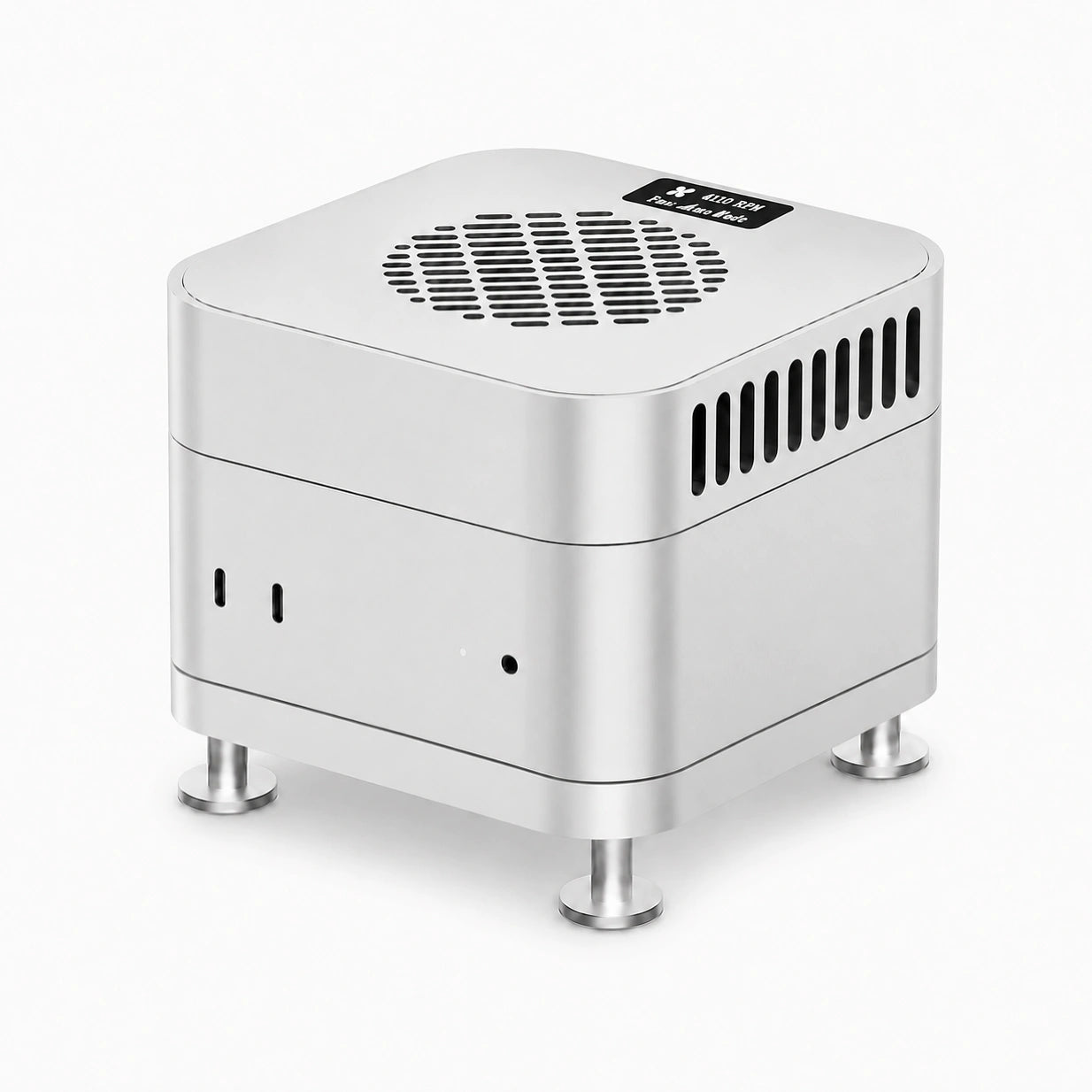
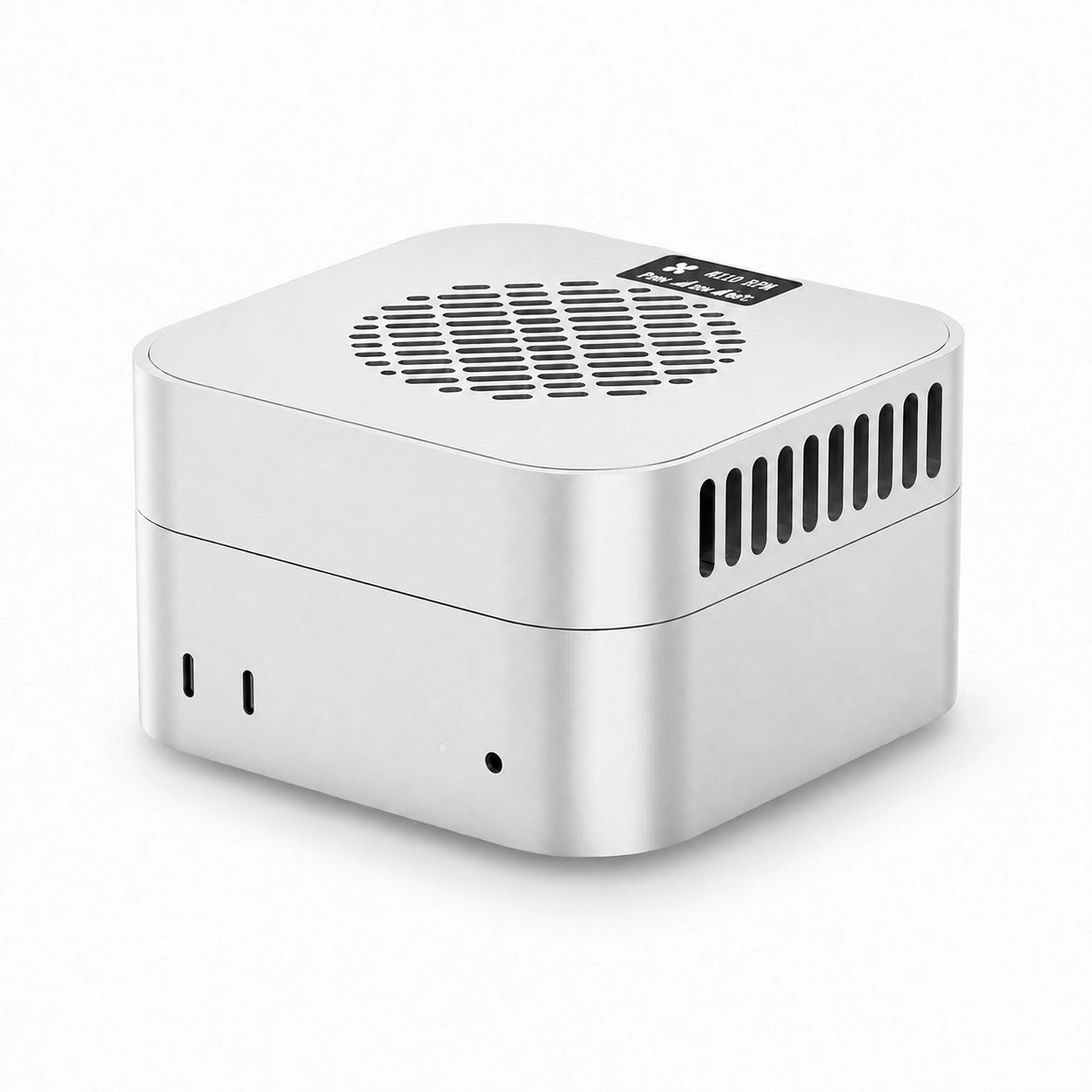
The ZEERA MacForge Gen3 aluminum case is confirmed to fit the Mac mini M6 and M5 Pro. Its CNC-machined aluminum body, Mac Pro-inspired grille, redesigned airflow path and top-access connections create a more substantial and organized desktop workstation.
The current design also provides a dedicated space for a compatible external SSD enclosure up to approximately 120 × 60 × 19 mm. The SSD, drive enclosure and data connection are not included; your external enclosure still connects to the Mac mini with its own cable.
Explore MacForge Gen3M6 vs M5 Pro vs RTX PRO 6000: What Is the Real Performance Difference?
This comparison needs one major qualification: M6 and M5 Pro are complete system-on-a-chip designs with CPU, GPU, media engines and unified memory controllers. The RTX PRO 6000 Blackwell Workstation Edition is a discrete professional GPU. It requires a separate workstation with a CPU, system memory, motherboard, storage, power supply and operating system.
There is no honest single percentage that describes the performance gap across every workload. Apple and NVIDIA use different architectures, precision formats, APIs and test methods. GPU-core counts and AI TOPS should not be compared one-for-one.
| Specification | Apple M6 in Mac mini | Apple M5 Pro in Mac mini | NVIDIA RTX PRO 6000 Blackwell |
|---|---|---|---|
| Product type | Complete SoC inside a computer | Complete pro SoC inside a computer | Discrete workstation GPU only |
| Process / architecture | 2 nm Apple silicon | Apple M5 Pro architecture | NVIDIA Blackwell |
| CPU | 12 cores | Up to 18 cores | None; separate CPU required |
| GPU | 12 Apple GPU cores | Up to 20 Apple GPU cores | Blackwell CUDA GPU with 5th-gen Tensor and 4th-gen RT cores |
| Maximum attached memory | 32GB unified memory | 64GB unified memory | 96GB GDDR7 ECC VRAM |
| Memory bandwidth | Up to 170GB/s | Up to 307GB/s | 1,792GB/s |
| Published AI peak | No directly comparable TOPS figure published | No directly comparable TOPS figure published | 4,000 AI TOPS, theoretical FP4 with sparsity |
| Published FP32 peak | Not published in a directly comparable format | Not published in a directly comparable format | 125 TFLOPS |
| Maximum GPU power | Part of the complete Mac mini system | Part of the complete Mac mini system | 600W for the GPU alone |
| Main software ecosystem | macOS, Metal, Core ML, Apple media engines | macOS, Metal, Core ML, Apple media engines | CUDA, OptiX, RTX, NVIDIA AI and professional Windows/Linux stacks |
| Starting hardware price | $899 complete Mac mini | $1,699 complete Mac mini | $16,000 GPU card from NVIDIA Marketplace |
How much larger are the M5 Pro specifications than M6?
Using the maximum published Mac mini configurations, M5 Pro provides up to 50% more CPU cores, about 67% more GPU cores, twice the maximum unified memory and about 81% more memory bandwidth than M6.
Those numbers explain why a newer 2 nm M6 does not automatically beat M5 Pro in sustained multithreaded, graphics or memory-heavy professional work. M6 is likely to lead in efficiency and may be exceptionally strong in single-threaded tasks, but M5 Pro has substantially more parallel hardware.
How much larger are the RTX PRO 6000 memory specifications?
The RTX PRO 6000 has 96GB of dedicated GDDR7 ECC memory. That is three times the maximum memory capacity of M6 and 1.5 times the maximum of M5 Pro. Its 1,792GB/s bandwidth is about 10.5 times M6’s 170GB/s and about 5.8 times M5 Pro’s 307GB/s.
These are specification ratios, not guaranteed application-speed ratios. A program must support NVIDIA’s GPU stack and keep the GPU fed efficiently to turn that bandwidth and compute capacity into real performance.
Which is faster for CPU work?
The RTX PRO 6000 has no general-purpose desktop CPU, so CPU performance depends on the workstation it is installed in. For code compilation, office work, application responsiveness and macOS development, the meaningful comparison is M6 versus M5 Pro.
M6 has Apple’s newest CPU architecture and Apple claims the world’s fastest single-threaded performance. M5 Pro adds up to six more CPU cores and is the better choice for workloads that can use sustained multithreading, including large builds, simulation and heavy production tasks.
Which is faster for 3D rendering and CUDA workloads?
For CUDA-native rendering, AI training, scientific computing and professional applications built specifically for NVIDIA hardware, RTX PRO 6000 is in another performance class. It is designed for workstations that need 96GB of ECC VRAM, 125 FP32 TFLOPS, 4,000 theoretical FP4 AI TOPS and a 600W GPU power envelope.
M5 Pro is the stronger of the two Mac mini options for Metal-accelerated 3D and GPU work. M6 is suitable for lighter creative work, everyday development, photography and moderate video editing, but it is not positioned as a substitute for a $16,000 professional GPU.
Which is better for local AI?
For smaller models and private on-device inference, M6 offers an efficient, compact entry point. Apple says the M6 Mac mini can process LLM prompts in LM Studio up to 4.8 times faster than M4 in its selected test.
M5 Pro supports up to 64GB of unified memory and 307GB/s bandwidth, allowing larger models and more demanding AI workflows. It is the better Mac mini choice when model size or memory pressure exceeds the M6 ceiling.
RTX PRO 6000 is the better fit when the workload is designed for CUDA, requires professional training or fine-tuning, benefits from FP4 Tensor Core acceleration, or must fit inside 96GB of dedicated ECC VRAM. Mac Studio with M5 Ultra offers a different advantage: up to 512GB of unified memory, enabling some exceptionally large models that cannot fit within 96GB of VRAM, even if an NVIDIA GPU may be much faster in a compatible smaller model.
Should You Buy Mac mini M6, M5 Pro, Mac Studio or an RTX Workstation?
Buy Mac mini M6
Best for students, office work, coding, photography, music, everyday creative apps, smaller local AI models and buyers who want the newest 2 nm Apple chip at the lowest system price.
Buy Mac mini M5 Pro
Best for developers, editors and creators who need up to 64GB of memory, Thunderbolt 5, more CPU/GPU cores, larger local models or sustained professional performance in a compact Mac.
Buy Mac Studio M5 Max or M5 Ultra
Best when Mac mini limits are measurable: more than 64GB of memory, more GPU cores, additional displays, heavier media engines, larger projects or extreme local AI and VFX workloads.
Build an RTX PRO 6000 workstation
Best for CUDA-dependent AI, high-end rendering, simulation, professional visualization and organizations that can justify a 600W, $16,000 GPU plus the cost of the rest of the workstation.
Is the 2nm M6 Automatically Better Than M5 Pro?
No. A smaller process node can improve transistor density, performance and efficiency, but it does not erase product tiers.
M6 is newer and may be faster in some single-threaded, AI-assisted and everyday workloads. M5 Pro has more CPU and GPU cores, double the maximum memory, higher bandwidth and Thunderbolt 5. The best chip depends on the software and the size of the workload.
Buy M6 because it meets your needs efficiently—not because “2 nm” guarantees that it beats every older Pro, Max or Ultra chip.
Sources and Methodology
Frequently Asked Questions
Why is the M6 chip in Mac mini first?
Apple has not stated the reason. The most likely explanation is that the smaller base M6 is easier to introduce on a new 2 nm process than a much larger Max or Ultra design, while Mac mini provides a controlled desktop platform for the first rollout.
Is there a Mac Studio M6?
No. The 2026 Mac Studio uses M5 Max and M5 Ultra. Apple has not announced a Mac Studio with M6.
Will Mac Studio go directly to M6 Max and M6 Ultra?
That now appears unlikely. Current reporting says Apple may skip M6 Pro, M6 Max and M6 Ultra and move its high-end Mac chips to the M7 generation instead.
When will the next Mac Studio be released?
There is no official date. Reported timing for high-end M7 chips stretches from late 2027 into 2028, with M7 Ultra associated with 2028. Apple could change that schedule.
When does Mac Studio preorder begin?
Preorders for Mac Studio with M5 Max and M5 Ultra opened August 25, 2026. General availability begins September 22, while the 512GB unified-memory configuration is scheduled for late October.
Does Apple offer education pricing on the new desktops?
Yes in the United States. Education prices start at $799 for Mac mini M6, $1,599 for Mac mini M5 Pro, $2,299 for Mac Studio M5 Max and $5,099 for Mac Studio M5 Ultra. Eligibility and verification rules vary by market.
Is M6 faster than M5 Pro?
M6 can be faster in some single-threaded and efficiency-sensitive tasks, but M5 Pro has up to 50% more CPU cores, about 67% more GPU cores, twice the maximum unified memory and about 81% more memory bandwidth. M5 Pro remains the stronger choice for many sustained professional workloads.
How much faster is RTX PRO 6000 than M6?
No universal multiplier exists because the products use different architectures and the RTX PRO 6000 is a discrete GPU, not a complete computer. Its memory bandwidth is about 10.5 times higher than M6 and it has three times the maximum attached memory capacity, but real performance depends on software, precision, model size and API support.
Is RTX PRO 6000 a full computer?
No. It is a professional graphics card. A complete RTX PRO 6000 workstation also needs a CPU, system memory, motherboard, storage, cooling, power supply and operating system.