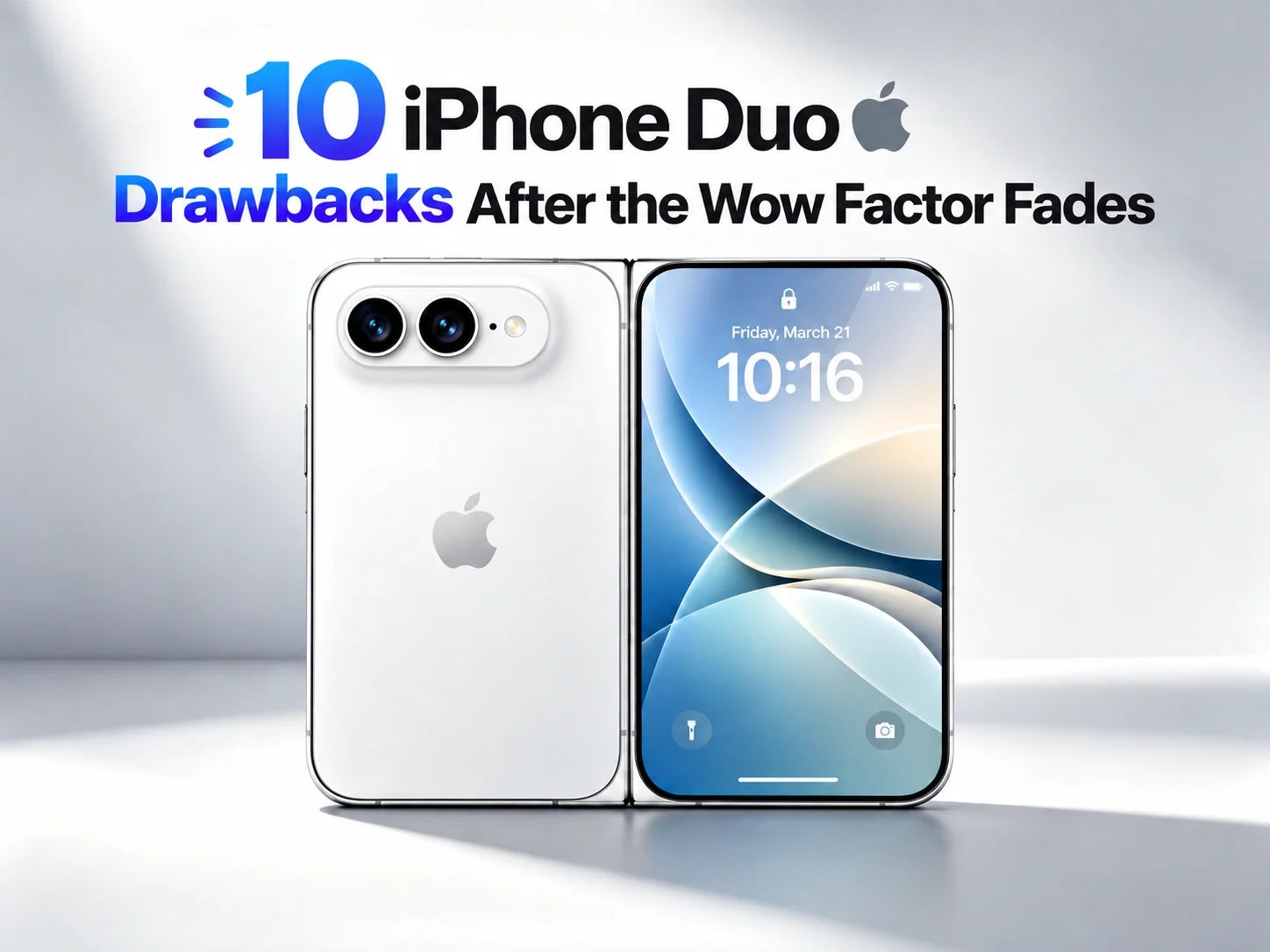
Foldable iPhone, iPhone Duo, iPhone Ultra and iPhone Fold currently refer to the same expected product category in rumor coverage. Apple has not confirmed the final retail name or complete specifications at the time of writing. This article will be updated after Apple publishes official details.
The biggest first-generation foldable iPhone problems are unlikely to be learning iOS or understanding a tablet-sized interface. iPhone and iPad users already know both.
The real novelty is the fold itself—and that initial excitement may fade faster than the compromises surrounding it.
Potential iPhone Duo or iPhone Ultra drawbacks include a softer inner screen, a visible crease, hinge and sealing concerns, camera trade-offs, extra thickness, more heat, inconsistent app layouts, cold-weather limits and expensive repairs.
Apple may reduce many of these issues, but buyers should not assume a first-generation Apple foldable will eliminate problems that remain fundamental to foldable-phone design.
A foldable iPhone may feel instantly familiar and completely new at the same time.
Closed, it should behave like an iPhone. Open, it may feel like a compact iPad. Most Apple users will not need to relearn messaging, browsing, photos, video, multitasking or the App Store.
The moment that creates the strongest first impression is simpler: you open the phone and one screen becomes two—or one phone becomes a small tablet.
That is powerful in a demo. The harder question is whether it still feels valuable after six months, when folding becomes routine and the owner is left managing the physical compromises.
Those compromises are not proof that the first foldable iPhone will fail. They are the ten practical issues anyone asking “Should I buy the iPhone Duo?” or “Is the iPhone Ultra worth it?” should consider before paying a first-generation premium.
Why the Fold May Feel Less Revolutionary Over Time
The foldable iPhone’s largest inner screen could be genuinely useful for reading, maps, spreadsheets, video, photo review and side-by-side apps.
But the software idea is not completely unfamiliar. Apple users already move between iPhone and iPad, and Apple already has years of tablet interface design.
The new experience is therefore concentrated in one mechanical action: opening a phone into a larger display.
Once that action becomes normal, the product must justify itself through daily utility. If most tasks still happen on the outer screen, users may carry the weight, thickness and repair risk of a foldable while rarely using its defining feature.
This is the central first-generation question: will you open the foldable iPhone because the larger screen improves your task, or mainly because opening it feels impressive?
| What feels new | What may remain familiar | What you manage every day |
|---|---|---|
| Opening one device into a tablet-sized screen | iOS, apps, gestures, Apple services and iPad-like layouts | Two displays, a hinge, added thickness and more vulnerable inner layers |
| Using split views without carrying an iPad | Multitasking concepts already used on iPad | Battery use, heat, app scaling and changing aspect ratios |
| Folding and unfolding as part of the interface | Normal iPhone tasks on the cover display | Screen care, hinge protection and potentially higher repair costs |
10 Potential Foldable iPhone Problems and Drawbacks
1. The Inner Display Will Require More Care Than a Normal iPhone Screen
A folding display cannot behave exactly like the rigid cover glass on a conventional iPhone.
Modern foldables often use several flexible layers, with ultra-thin glass beneath a softer polymer surface and a factory-applied protective layer. The part touched by a finger can therefore be easier to dent or mark than normal smartphone cover glass.
Fingernails, grit, keys and a hard point pressed between the two halves may matter more than they do on an iPhone 18 Pro Max.
Current foldable manufacturers explicitly warn owners to keep crumbs, sand and sharp objects away from the inner screen. Google states that flexible screens are softer than traditional phone screens and cautions against closing a foldable with particles inside.
Apple may use better materials or a different display stack. It cannot, however, make a screen fold repeatedly without accepting engineering limits that do not apply to a rigid slab phone.
2. The Factory Inner-Screen Protector May Not Be User-Replaceable
On a regular iPhone, a tempered-glass protector is an optional accessory. On many foldables, the pre-installed inner film is part of the intended display system.
That changes how owners respond to bubbles, lifting edges or scratches. Peeling off the layer and installing a random third-party film may damage the screen or affect warranty coverage.
Samsung says users should not remove a foldable phone’s main-screen protector themselves and recommends authorized service for replacement. Google similarly warns users not to remove the pre-installed protector or apply a third-party protector.
Until Apple publishes official guidance, the safest assumption is simple: protect the outer display as normal, but do not modify the folding inner display without device-specific instructions.
Read our detailed guide: Does iPhone Ultra Need a Screen Protector?
3. “Nearly Crease-Free” Will Not Necessarily Mean Crease-Free
The crease may be subtle when viewed straight on and more obvious under a lamp, sunlight or an angled reflection.
It may also be felt while swiping across the center even when it is difficult to see. These are two different measurements: visual depth and tactile unevenness.
A shallow crease would be a real improvement. It would not make the flexible panel physically identical to a flat iPhone display.
Buyers should also separate a normal fold line from a defect. A light crease can be inherent to the design; a growing black line, dead touch zone, flicker or cracking sound is not something to dismiss as normal.
For a closer explanation, see what “nearly crease-free” could really mean for iPhone Ultra.
4. The Hinge Creates a New Path for Dust, Wear and Impact
A conventional iPhone has no large mechanical joint moving every time the display is used.
A foldable hinge must stay smooth, keep both halves aligned and manage particles over thousands of opening cycles. Sand or fine debris is especially concerning because it can enter moving areas or become trapped between the screens.
The hinge is also exposed during a corner drop. Even if the displays survive, a damaged or misaligned hinge can affect whether the phone opens flat and closes correctly.
This is why an iPhone Duo case is more complicated than a normal iPhone case. It must protect two moving halves without blocking the hinge or making the phone excessively bulky.
5. Water Resistance May Improve Faster Than Dust Resistance
Water resistance on foldable phones has improved, but a moving hinge and multiple body sections make sealing more difficult.
Dust protection is a separate question. An IP rating uses one digit for solid-particle protection and another for water. A phone can therefore resist freshwater immersion without being dust-tight.
Samsung’s 2026 Galaxy Z Fold8 Ultra, for example, carries an IP48 rating. That is useful progress, but IP4X is not the same as the IP6X dust-tight protection buyers may associate with conventional flagship phones.
Apple’s final foldable iPhone IP rating must be judged from Apple’s official specification—not from leaks or a competitor’s rating.
Until that rating is known, beaches, fine sand, dusty bags and wet environments deserve more caution than they would with a familiar slab iPhone.
6. The Camera System May Trail the iPhone 18 Pro Max
A foldable body must allocate internal space to a hinge, two display sections and a more complex frame.
That can leave less depth for large sensors, advanced stabilization and a long telephoto assembly. Thinness targets make the trade-off harder.
This does not confirm that the iPhone Duo camera will be weak. Apple could still deliver excellent image quality through sensor design, processing and its A-series chip.
The more useful comparison is not “Will it take good photos?” It almost certainly should. The question is “Will a more expensive foldable match the best camera hardware in the iPhone 18 Pro Max?”
Buyers who prioritize optical zoom, low-light photography or long-form video should wait for final camera specifications and direct retail-device tests.
7. A Thin Unfolded Body Can Still Be Thick and Heavy in Your Pocket
Foldable marketing often highlights how thin each half is when open.
Your pocket experiences the phone when it is closed. At that point, the two thin halves, hinge and any protective case are stacked together.
That can make one-handed typing, long calls, car-mount stability and pocket comfort more difficult. A hinge-cover case adds another layer around the thickest part of the device.
The outer display may also be narrower than a Pro Max screen. Some users will appreciate easier reach; others may find the keyboard compressed and unfold the device for tasks that used to need only one hand.
Before buying, compare the folded thickness and total weight—not only the dramatic unfolded measurement.
8. The Larger Screen Can Increase Battery Use, Heat and Charging Complexity
The inner display does not consume maximum power simply because it is large. Brightness, refresh rate, video, gaming, navigation and multitasking all affect the result.
Still, an unfolded screen gives users more reasons to run two apps, stream longer and perform tablet-like work. That can increase sustained power use and heat.
The mechanical layout can also divide the battery across both halves. Heat-producing parts, charging coils and cameras must fit around the hinge rather than inside one uninterrupted body.
Wireless charging adds another unknown: the final magnetic position and whether the phone is intended to charge folded, unfolded or in both states. Some stands or car mounts may hold the phone securely only in one orientation.
Do not assume every existing MagSafe stand will be ideal just because the phone supports magnetic charging. Weight balance, camera clearance and unfolded stability matter too.
For car use, navigation, wireless CarPlay, direct sunlight and wireless charging can stack several heat sources together. See the iPhone Ultra car mount and MagSafe charger guide before choosing a mount for the heavier foldable form.
9. Apps May Not Always Use the Inner Screen Well
Apple can optimize iOS, but it cannot instantly redesign every third-party app.
Some apps may simply stretch. Others may show unused space, move controls awkwardly or restart when the phone switches between outer and inner displays.
Video is another example. A larger diagonal number does not guarantee a proportionally larger picture when the display and video use different aspect ratios. Black bars can reduce the practical gain.
Good continuity matters as much as screen size. A message draft, video position, map route or game should remain in the same state as the device opens and closes.
Apple’s advantage is its control of hardware and software. The first retail reviews still need to show how consistently that advantage extends to popular third-party apps.
10. Cold Weather, Repairs and Accessories Raise the Cost of Ownership
Fold-cycle claims are normally based on controlled test conditions. Real life includes winter commutes, hot cars, dust, drops and pressure inside bags.
Temperature matters because flexible materials and adhesives change behavior in extreme conditions. Google warns owners of its foldables not to open or close the device at -20°C (-4°F) or below. That limit does not predict Apple’s specification, but it shows why a headline fold count cannot describe every environment.
If the inner display, hinge or multiple connected layers fail, repair is also more complex than replacing a conventional front panel.
Buyers should wait for Apple’s official out-of-warranty prices and AppleCare terms. The purchase decision should include possible service fees, not only the launch price.
Accessories add another cost. A foldable may need a two-piece case, hinge protection, an outer-screen protector and a stand strong enough for its changing center of gravity. Existing wallets, chargers and car mounts may attach but still feel poorly balanced.
In other words, the iPhone Ultra price may be only the start of the first-year ownership cost.
Which Foldable iPhone Drawbacks Matter Most?
Not every drawback carries equal weight for every buyer.
| If you care most about... | Watch this issue | What to verify after launch |
|---|---|---|
| Durability | Inner screen, hinge and dust exposure | Care instructions, IP rating and drop tests |
| Photography | Camera space trade-offs | Sensor sizes, telephoto hardware and Pro Max comparisons |
| All-day use | Inner-screen drain and sustained heat | Mixed-use battery tests, charging speed and thermal behavior |
| Comfort | Folded thickness, weight and narrow keyboard | In-hand testing with a real protective case |
| Long-term value | Repair and protection costs | AppleCare fees, inner-screen repair price and parts availability |
Should You Buy the First Foldable iPhone?
Buy the iPhone Duo or iPhone Ultra if: you regularly need a larger screen away from home, will use two apps together, read or review documents on your phone, and accept first-generation cost and care requirements.
Choose the iPhone 18 Pro Max instead if: you prioritize camera hardware, predictable durability, easier one-handed use, mature accessories and lower repair complexity.
Wait for the second generation if: the folding action itself is the main attraction but you cannot yet name a weekly task that the inner display would improve.
The first foldable iPhone does not need to be perfect to be exciting.
But excitement is not the same as durable value. After the folding motion stops feeling new, the large screen must earn its place every day.
For some users, it will replace the need to carry an iPad mini. For others, it may become a thicker, more expensive iPhone that stays closed most of the time.
The best buying decision will come from matching the foldable screen to a real workflow—not from assuming Apple’s logo removes every limitation of foldable hardware.
How to Reduce First-Generation Foldable iPhone Risks
- Wait for Apple’s official name, dimensions, IP rating and care instructions.
- Do not remove or cover the inner display film unless Apple explicitly permits it.
- Keep sand, crumbs and hard objects away from the folding screen and hinge.
- Compare the camera with the iPhone 18 Pro Max using retail-device tests.
- Check folded weight and thickness with the case you plan to use.
- Verify MagSafe alignment and stand stability before reusing older chargers or mounts.
- Read AppleCare and out-of-warranty repair prices before preorder day.
- Avoid folding the device in extreme temperatures until Apple publishes its operating limits.
Foldable iPhone FAQ
What are the biggest foldable iPhone problems?
The biggest potential problems are inner-screen scratches, protector damage, a visible or tactile crease, hinge wear, incomplete dust protection, heat, app scaling and high repair costs. Apple’s final retail device may reduce some of these concerns, but official testing is still required.
Are iPhone Duo and iPhone Ultra the same foldable iPhone?
In current rumor coverage, yes. iPhone Duo, iPhone Ultra and iPhone Fold are names being used for Apple’s expected first book-style foldable iPhone. Apple must confirm the final retail name.
Will the iPhone Ultra have a screen crease?
A reduced crease is possible, but “nearly crease-free” is not a guarantee of a perfectly flat inner display. Visibility can change with viewing angle and reflected light.
Can I remove the iPhone Duo inner-screen protector?
Do not remove or replace it until Apple publishes device-specific instructions. On existing foldables, the factory layer is often part of the intended display system rather than a normal optional protector.
Will Apple’s foldable iPhone be waterproof and dustproof?
Wait for Apple’s official IP rating. Water resistance and dust resistance are measured separately, and a foldable can offer useful water protection without being dust-tight.
Will the iPhone Duo camera be as good as the iPhone 18 Pro Max?
That is not confirmed. The foldable should take high-quality photos, but buyers should compare sensor, stabilization and telephoto specifications instead of assuming the more expensive iPhone has the better camera system.
Does a foldable iPhone need a special case?
Yes. A foldable case must fit two moving sections and may also protect the hinge. It should not obstruct opening, closing, cameras, buttons or magnetic charging alignment.
Is the first foldable iPhone worth buying?
It may be worth buying if the inner display improves tasks you perform every week. If the folding action is the main attraction, waiting for long-term durability tests or a second generation is the lower-risk choice.
Related Reading
- iPhone Duo: Is This Apple’s First Foldable iPhone?
- iPhone Ultra: 10 Things to Know Before Buying Apple’s First Foldable iPhone
- Does iPhone Ultra Need a Screen Protector?
- iPhone Ultra Crease: What “Nearly Crease-Free” Really Means
- Does iPhone Ultra Need Hinge Protection?
- iPhone Ultra Battery Life: Inner vs Outer Screen Compared
- iPhone Fold vs iPhone 18 Pro Max: Which Should You Buy?
- Best iPhone Ultra Car Mount and MagSafe Charger Guide
Sources and Context
This article separates confirmed foldable-industry limitations from unconfirmed Apple product details. Current naming coverage: The Verge on the reported iPhone Duo name. Foldable display care: Samsung foldable care guidance and Google Pixel Fold safety guidance. Current foldable protection example: Samsung’s Galaxy Z Fold8 series specifications.