Quick Answer
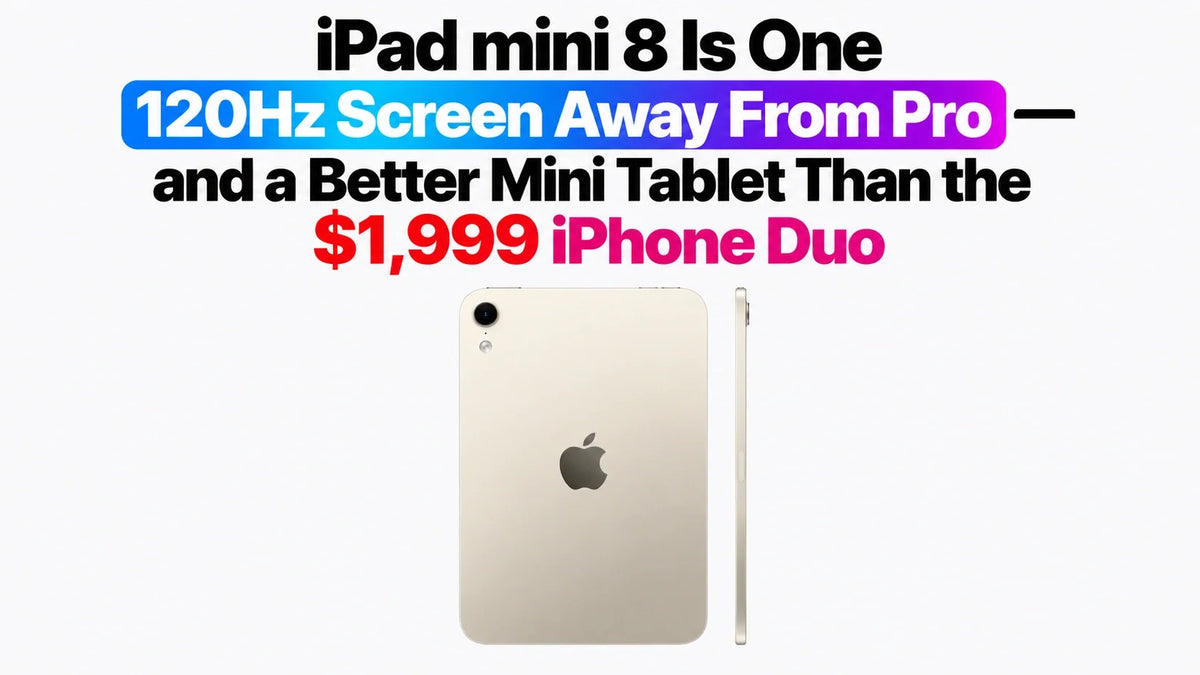
ZEERA’s view: iPad mini 8 feels one 120Hz display away from the compact Pro tablet many people want. OLED, A20 Pro and optional nano-texture glass have changed its appeal, even though iPad Pro still offers more capable hardware for demanding work.
For someone seeking a small tablet, the mini also makes a stronger case than spending $1,999 on an iPhone Duo: a larger workspace, Pencil Pro support and a much lower entry price. The Duo’s folding convenience and smoother screen remain compelling. Our argument is about the tablet experience and value, rather than a claim that mini wins every specification.
iPad mini 8: the hardware in small cards
Before the debate about what is missing, here is what Apple has actually put into its smallest iPad.
8.5-inch OLED · 60Hz
2316 × 1512, 326 ppi. No ProMotion. 600-nit full-screen brightness; 1,200-nit HDR peak.
A20 Pro · two configurations
128/256GB: 5-core CPU, 7-core GPU, 16-core Neural Engine.
512GB: 6-core CPU, 7-core GPU, dual 16-core Neural Engine.
255g · 5.4mm
Wi-Fi model; Cellular weighs 263g. Midnight or Starlight. IP67 water and dust resistance.
Pencil Pro + nano-texture
Pencil Pro and USB-C Pencil support. Nano-texture glass is optional on 256GB/512GB.
USB-C · modern connections
USB 3 up to 10Gb/s; 4K/60Hz external output. Wi-Fi 7, Bluetooth 6, landscape 12MP Center Stage camera and Acoustic Display stereo audio.
$699 · up to 10 hours
US Wi-Fi starting price, 128GB. Up to 10 hours of Wi-Fi browsing/video; about 50% charge in 30 minutes with a compatible 35W+ adapter.
Specifications: Apple technical specifications and launch announcement; 60Hz display also described in The Verge’s hands-on. Prices are US Apple list prices checked October 30, 2026, before tax.
iPad mini 8 vs iPad Pro: how close is it?
The resemblance is strongest in the features people associate with a premium screen and a serious digital notebook. The separation becomes clearer when the tablet is expected to run a demanding workstation-style workflow.
| Feature | iPad mini 8 | iPad Pro |
|---|---|---|
| Screen | 8.5-inch OLED, 60Hz | 11/13-inch tandem OLED, 10–120Hz ProMotion |
| Brightness | 600 nits full screen; 1,200 HDR peak | 1,000 nits full screen; 1,600 HDR peak |
| Processor | A20 Pro; 5/6-core CPU, 7-core GPU | M5; 9/10-core CPU, 10-core GPU; 12/16GB memory |
| Nano-texture | Optional: 256GB/512GB | Optional: 1TB/2TB |
| Pen | Pencil Pro, USB-C Pencil, hover | Pencil Pro, USB-C Pencil, hover |
| Port | USB 3, up to 10Gb/s | Thunderbolt/USB 4, up to 40Gb/s |
| Unlock | Touch ID | Face ID |
| Wi-Fi weight | 255g | 444g / 579g |
Hardware comparison: mini specifications and Pro specifications.
A20 Pro makes the mini attractive for portable creative work. It does not turn it into an M5 iPad Pro. The Pro’s media engine, faster peripheral connection, larger canvas and dedicated Magic Keyboard support matter for video projects, external storage and extended desk sessions. A 120Hz mini would still leave those differences intact.
“Only missing ProMotion” describes how close the mini feels to a premium handheld iPad—not the complete hardware gap.
Why 120Hz has become the test of “Pro”
The question that interests us after the mini’s announcement is why refresh rate has become such a powerful measure of its identity. Asking for 120Hz suggests that people increasingly want a premium small iPad, rather than simply Apple’s cheapest tablet in a smaller body.
For years, ProMotion was a visible dividing line in Apple’s range. Then the standard iPhone 17 gained ProMotion in 2025. Once that smoothness reaches an ordinary iPhone, a more expensive tablet staying at 60Hz becomes harder to accept.
The criticism is reasonable
Scrolling, moving windows and tracking a pen stroke all make motion visible. A faster chip cannot make a 60Hz panel display 120 different frames each second. Switching from a high-refresh phone can make the difference especially obvious.
It is still only part of screen quality
OLED contrast, glare control and motion smoothness solve different problems. Someone reading a mostly static page may value the first two more; someone scrolling constantly or playing fast games may place 120Hz first.
Apple’s own range offers another useful reminder: the current iPad Air has an M4 chip without ProMotion. Display refresh rate and processing capability are separate choices. That does not excuse the mini’s omission; it explains why the omission does not erase the rest of the upgrade.
A better small tablet than a $1,999 iPhone Duo?
For the jobs we buy a mini tablet to do, our answer is yes. If the goal is reading, handwritten notes, PDF annotation and carrying an extra screen in a small bag, the mini is the more convincing purchase.
More room for tablet tasks
The mini’s 8.5-inch screen gives documents and app controls more physical room than the Duo’s 7.6-inch inner display. It is ready to use without unfolding. That is a practical advantage when the task begins with a notebook, book or PDF.
A more capable pen setup
Mini supports Pencil Pro, including squeeze and barrel roll. Duo’s current specifications list USB-C Pencil support. Both can serve pen users, but the mini offers the more advanced Pencil option.
Far less money for the second-screen role
$699 for the entry mini versus $1,999 for the entry Duo leaves a $1,300 gap. Storage differs: 128GB versus 256GB. At matching 256GB, the standard-glass Wi-Fi mini is $799, still $1,200 less.
Duo keeps the folding advantage
Duo combines a phone with an expanding screen and offers ProMotion up to 120Hz. It folds into something far easier to pocket than an iPad. For someone who refuses to carry a second device, that can be worth the premium.
Comparison references: Duo specifications, Duo pricing and mini configurations.
There is also no reason to assume the mini is dramatically faster. Duo uses A20 Pro too, with a six-core CPU. The entry mini actually has fewer CPU cores. Our preference comes from the workspace, Pencil experience and cost, rather than an invented benchmark victory.
The most useful purchase question is whether you need your tablet to fold into your phone. If you already like your current phone and only want more room for reading and notes, an iPad mini avoids paying for that integration.
The price suggests a more premium mini
The previous mini launched in the US at $499 with 128GB. This generation starts at $699 with the same storage capacity: a $200 increase. Its quieter Midnight and Starlight finishes also look more restrained than the previous range’s Blue and Purple.
Colors alone say little about product strategy. Taken alongside OLED, the nano-texture option and the higher starting price, however, they support our interpretation that Apple is making mini feel more premium. This is ZEERA’s reading of the product, rather than an announced change in Apple’s positioning.
The configuration changes the value
The 256GB Wi-Fi mini is $799; nano-texture brings it to $899. The 512GB model is $999, or $1,099 with nano-texture. At the upper end, compare the total with the current iPad Pro, listed from $1,199 in Apple’s US store.
Premium does not require a larger screen
Mini can sit between Air and Pro in perceived display quality and portability without sitting between them in every performance metric. For a reader or sketchbook user, being small can itself be the feature worth paying for.
Current configuration prices: mini and Pro. Nano-texture is an optional finish, not a refresh-rate upgrade.
We would choose nano-texture around a real glare problem, rather than as a badge of having the best version. Our nano-texture versus standard glass guide covers that decision. The 512GB versus 256GB comparison explains the separate chip upgrade.
ZEERA’s view: let mini become premium on its own terms
We would welcome 120Hz. It is the missing feature most likely to make this mini feel complete for people already surrounded by high-refresh screens.
But the more interesting direction is a small iPad that earns its price through what it does well: being easy to carry, comfortable to use away from a desk and capable enough to be a useful notebook or creative companion. It does not need to imitate every part of an iPad Pro to have a clear purpose.
Small does not have to mean entry-level. For buyers who want a dedicated compact tablet, the mini is already the stronger value proposition than a $1,999 foldable phone. ProMotion would make that proposition much easier to love.
FAQ
Is iPad mini 8 already in stores?
As of October 30, 2026, it is available to pre-order, with Apple’s announced availability beginning November 6. This article is ZEERA’s assessment of the announced hardware and positioning.
Can the Cellular mini replace a phone?
Its cellular service is data-only. Apple lists FaceTime and the ability to relay calls from a nearby iPhone, so buying the Cellular version does not give it the same standalone telephone role as an iPhone.
Related reading
- iPad mini 8 launch overview: OLED, A20 Pro and the missing ProMotion
- iPad mini 8 versus mini 7: hardware and design compared
- Nano-texture versus standard glass: is the extra cost worthwhile?
- 512GB versus 256GB: paying for the fuller A20 Pro
- Acoustic Display: how the mini produces sound without familiar speaker holes
- Apple Pencil compatibility: Pencil Pro versus USB-C