Quick Answer
Your existing Apple 20W USB-C charger still works. A 30W charger works, too.
For Apple's fastest wired claim—around 50% in 15 minutes—use a 60W-capable USB-C cable and a 60W-or-higher adapter that supports USB PD 3.1 AVS.
You do not need Apple's own adapter, and “60W” does not mean the iPhone draws 60W from start to finish.
MagSafe and compatible Qi2 charging top out at 25W at the phone; Apple's wireless 50%-in-30-minutes test uses a 35W-or-higher adapter.
If you already own a reliable USB-C PD charger, try it before buying a replacement.
Apple's iPhone 18 Pro and Pro Max specifications describe two different charging paths: a short wired fast-charge test and a lower-power wireless option. The number printed on a wall adapter is its output capacity, not a constant demand from the phone.
20W vs 30W vs 60W: which iPhone 18 Pro charger should you use?
Keep using it for everyday charging and overnight top-ups. It cannot meet Apple's 60W AVS test condition.
Use it for convenient wired charging. It cannot reproduce the wired 15-minute claim simply because it is above 20W. A 35W adapter is also the input rating Apple specifies for its MagSafe test, provided the wireless charger and setup are compatible.
Keep it. Higher rated output can still deliver useful fast charging when the adapter and iPhone agree on a supported mode. The wattage label alone does not establish eligibility for Apple's fastest test.
Check the single-port output for at least 60W, USB PD 3.1 or later with AVS, and a USB-C cable rated for at least 60W. For multiport models, check the wattage left on the iPhone's port when other devices are connected.
For most owners, the honest answer to “Do I need to buy a 60W charger?” is no. Buy a verified AVS model if shaving time off short, low-battery charging sessions matters to you. A 65W sticker without AVS is a different proposition.
Does iPhone 18 Pro actually charge at 60W?
No, not continuously. Apple's “around 50% in 15 minutes” is a battery-level result under specified equipment and test conditions. It is not a statement that the phone consumes exactly 60W for 15 minutes, much less until full.
ZEERA's iPhone 18 Pro Max test: the highest observed input reading was 53W. After a brief period near 50W, readings during much of the first 20 minutes were around 30–40W. Around the 50% mark, power began trending below 30W. These are observations from our setup, not a measured charging curve for every Pro Max or a verified figure for the smaller 18 Pro.
Starting charge level, phone temperature, screen activity, cable, adapter and ambient heat can all change the curve. This is why a higher wattage label may make a big difference at the beginning but little difference later. Apple's advertised “up to” result is a useful short top-up benchmark; total time to 100% needs a separate test.
Our compact AVS adapter was able to supply the power requested during this run. Its housing measured roughly 55°C after 28 minutes. That is the adapter's external temperature, not the iPhone battery temperature; without repeat tests and ambient readings, we would not label 55°C a universal safety or performance threshold.
Can an older 65W PD charger fast-charge iPhone 18 Pro Max without AVS?
Yes. In ZEERA's test, an older high-output PD adapter without AVS still showed input above 40W at times on iPhone 18 Pro Max. The ZEERA 65W PD GaN charger is an example of this existing-charger category: its product specifications list PD 3.0, not USB PD 3.1 AVS. It can charge the phone, but we do not claim it qualifies for Apple's 15-minute test.
In our limited comparison, the phone ran approximately 1–2°C warmer with the older non-AVS setup. This was a small observed difference, not proof that AVS always makes the iPhone cooler or a measured difference in total charge time. In summer, start with a cool phone in shade; if buying a particularly small new adapter for repeated rapid top-ups, an AVS-capable model is a sensible choice.
ZEERA has also examined how the Pro Max manages heat under load in our 18 Pro Max overheating and vapor chamber guide.
Is MagSafe 25W or 35W? Can Qi2 reach 25W?
Apple lists up to 25W for both MagSafe and Qi2 wireless charging on the iPhone 18 Pro models. The 35W figure describes the power adapter used with Apple's MagSafe Charger in its approximately 30-minute-to-50% test. It is not 35W wireless output to the iPhone.
Yes, a compatible Qi2 25W / Qi2.2 charger can target the phone's 25W wireless limit. A product labeled only “Qi2” may be a 15W model: check the exact version and iPhone output, plus the supplied adapter's rating. Wireless power varies with alignment, case thickness, battery level, temperature and simultaneous device charging. Apple's 30-minute figure is for its stated MagSafe test configuration, not a guarantee for every third-party three-in-one stand.
For a desk or bedside setup with iPhone, Apple Watch and AirPods, a 25W-rated three-in-one station such as MagTri Gen2 fits this different use case. Pair it with a suitable input adapter according to its product instructions; do not assume any 35W wall adapter will run three devices at their maximum ratings simultaneously.
Which setup makes sense at home, in the car and on a trip?
Fastest short wired top-up: use a suitable 60W-or-higher AVS adapter and 60W-capable cable. Choose on protocol support, not the biggest advertised wattage.
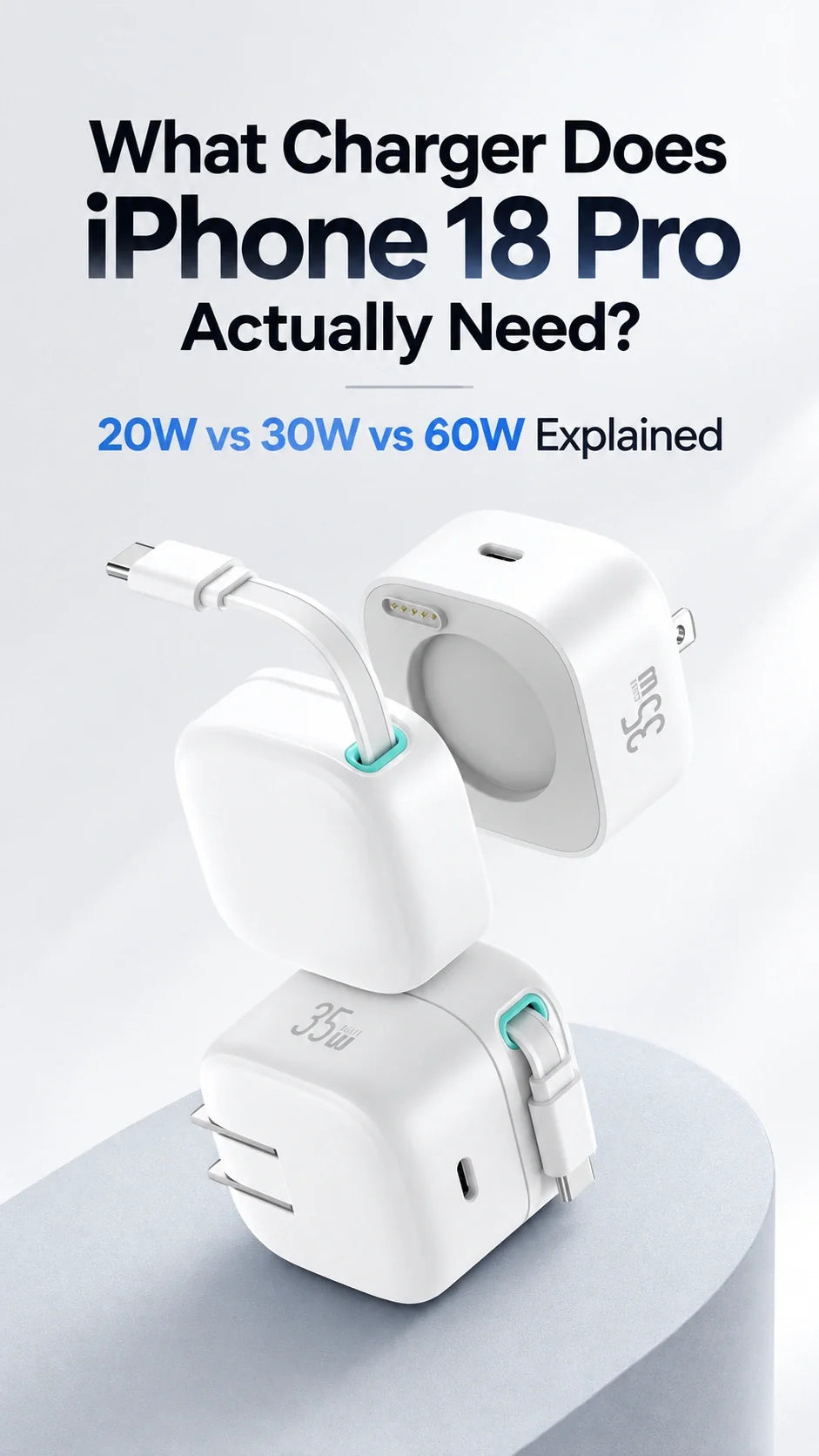
Compact travel kit: the ZEERA 35W modular GaN wall charger has a retractable USB-C cable module and US, UK and EU plug variants. It is convenient everyday PD charging; its 35W output is below Apple's fastest wired test requirement. Select the plug variant for your region.
Navigation and wireless charging: running maps, a bright display and wireless CarPlay in a warm car can reduce effective charging speed. SuVolt Gen5 offers a Qi2.2 25W variant with active cooling; select that specific variant and check the included power source. Cooling helps manage heat at the charging interface but cannot override the phone's thermal controls. See our MagSafe car mount guide for placement and compatibility.
FAQ
Can I use my old Apple 20W adapter with iPhone 18 Pro Max?
Yes. It charges normally through USB-C, but it does not meet Apple's 60W AVS fast-charge test condition.
Do I have to buy Apple's new power adapter?
No. For the fastest stated wired result, look for a reputable 60W-or-higher adapter that explicitly supports USB PD 3.1 AVS and a 60W-capable USB-C cable. A plain 60W/65W PD label does not prove AVS support.
Does the USB-C cable in the iPhone box support fast charging?
Apple lists a 1 m USB-C charge cable in the box. Check the cable's rating for the 60W test condition; when buying a replacement, choose one explicitly rated for at least 60W. Charging wattage and USB data transfer speed are separate specifications.
Will a 100W MacBook charger damage my iPhone?
A compliant USB-C PD adapter negotiates power with the iPhone; its 100W rating is capacity, not power forced into the phone. Check the individual port's output and AVS support if your goal is Apple's fastest result.
Can I get 25W Qi2 charging with a magnetic case?
A correctly aligned compatible magnetic case can work, but a thick case or wallet between the phone and charger may increase heat or reduce charging performance. Check the charger and case specifications.
Related reading
- Best MagSafe Car Mount for iPhone Duo and iPhone 18 Pro
- iPhone 18 Pro Max Overheating vs 17 Pro Max
- iPhone 18 Pro vs 17 Pro Max Battery Life
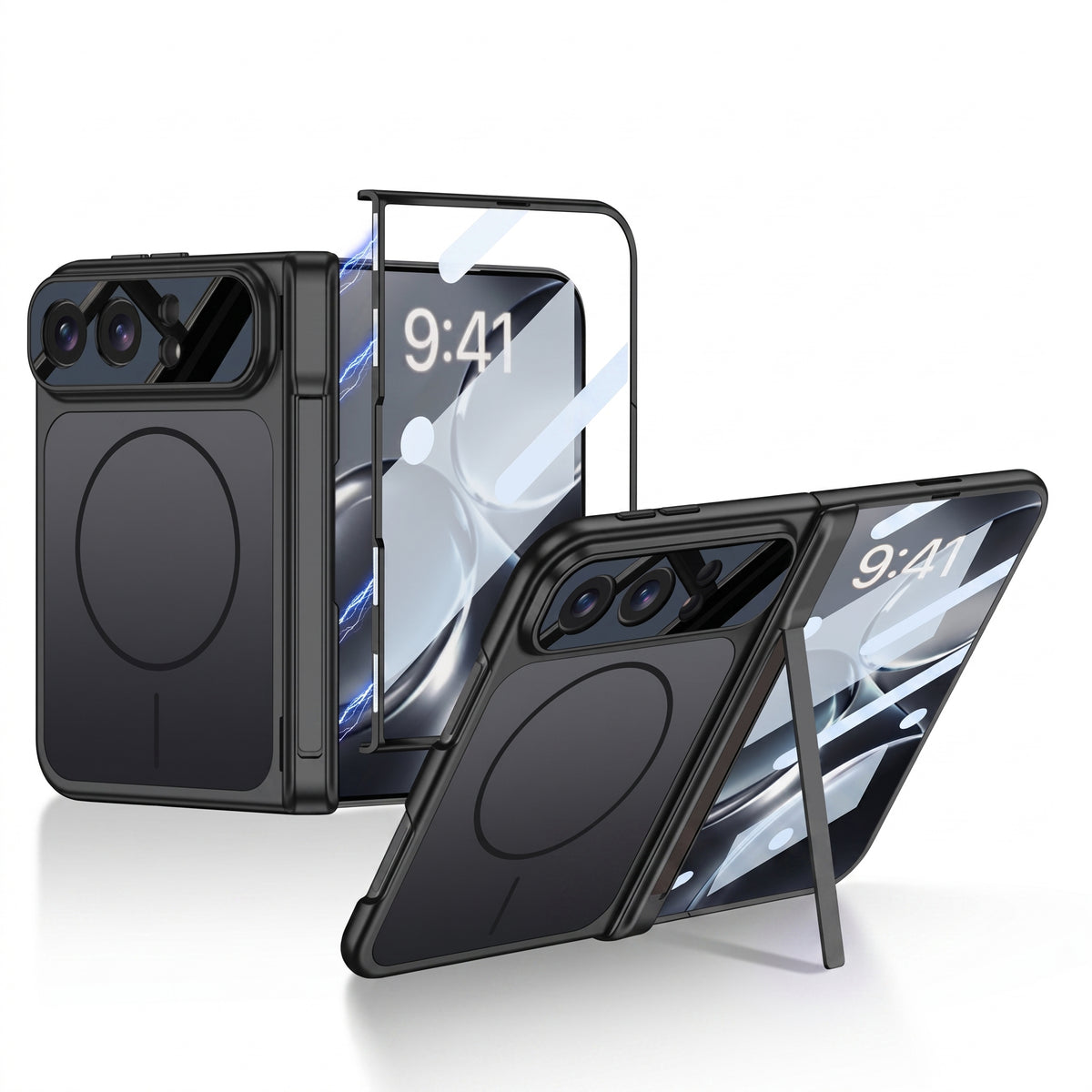
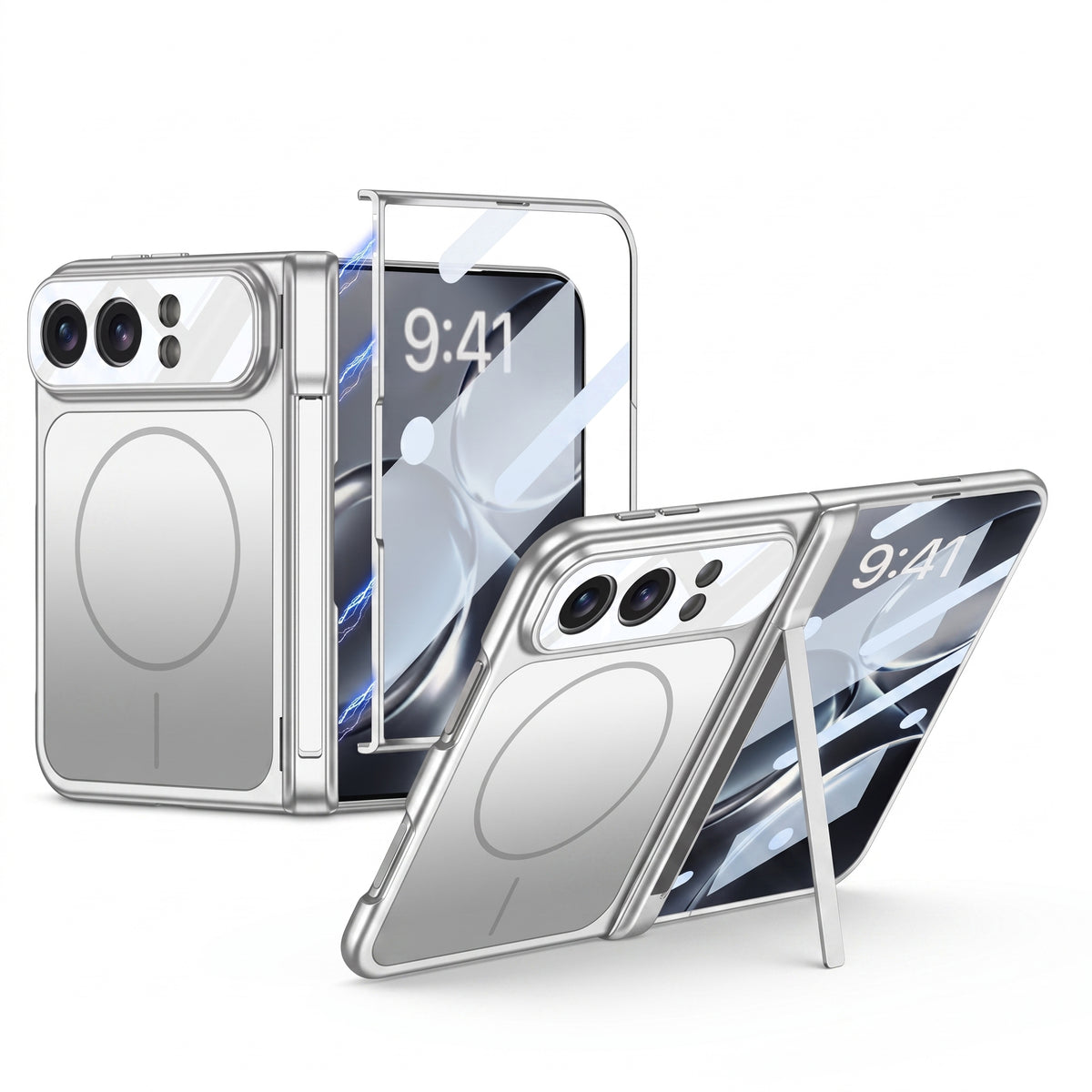
- iPhone 18 Pro Max Aluminum MagSafe Cooling Case
- iPhone 18 Pro 1TB vs 512GB Storage
- iPhone 18 Pro C2 Signal and Speed Test
Source for device charging limits and Apple's stated test equipment: Apple iPhone 18 Pro technical specifications. ZEERA measurements above describe our own iPhone 18 Pro Max setup and may vary with equipment and conditions.