Quick Answer
iPhone Duo has an extra center magnet inside its outer MagSafe ring.
WekiHome’s teardown shows the hardware, with Apple Watch and AirPods attachment demonstrated on the back.
The demonstration establishes magnetic attachment; reverse wireless charging remains a theory.
The larger-battery iPhone 18 Pro Max makes a battery-sharing explanation less straightforward.
A future Duo-specific accessory is another possibility worth considering.
What did WekiHome find inside iPhone Duo?
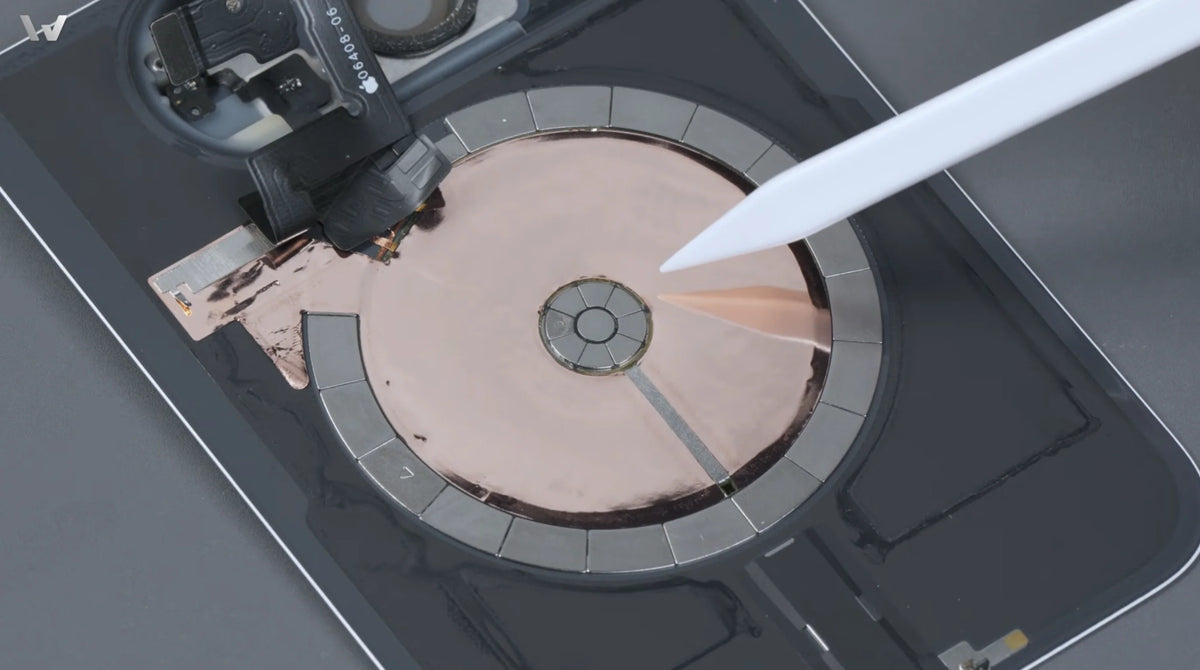
In its iPhone Duo teardown, WekiHome, a leading Chinese teardown channel, examines a small magnetic assembly at the center of the phone’s MagSafe area. Moving an Apple Watch toward the back makes it snap into place; the accompanying images also show an AirPods case attached there.
That matches the earlier attachment observation from Chinese creator 影视飓风 (Tim). WekiHome adds an internal view and a possible explanation: Apple could be preparing the phone for reverse wireless charging.
How is the iPhone Duo MagSafe ring different?
The distinctive detail is the small circular magnet assembly inside the larger outer array. The teardown image shows a segmented outer ring surrounding the charging area, with a separate, much smaller circular structure in the middle.

A second attachment point changes the question
The outer ring serves the familiar large circular accessory interface. The center adds a compact attachment point that a much smaller object can engage. Its position makes small-accessory alignment an interesting possibility, even before considering whether any power passes between the devices.
Gaps in the outer array are a separate detail: comparison Pro hardware can have interruptions too. Our earlier iPhone Duo versus iPhone 18 Pro MagSafe comparison looks at the ring patterns and magnetic pull readings. This teardown takes the discussion further by showing what sits at the center.
Why do Apple Watch and AirPods stick to the back?
The central magnetic structure provides an attraction point for the accessories shown in the demonstration. Notice how little of the large outer ring the Watch body or AirPods case occupies: a small accessory does not need to span the whole phone-sized ring to find a magnetic resting position.


That is why the placement is intriguing. It creates a usable physical relationship between the phone and smaller Apple accessories. A magnet can establish that relationship without revealing what Apple ultimately intends to do with it.
WekiHome’s reverse wireless charging theory makes sense
A phone that could hold a Watch or AirPods case in position would solve one practical problem with wireless battery sharing: keeping the receiving device aligned. For travel, a quick accessory top-up from the phone would also be an obvious convenience.
WekiHome suggests several possible paths: a feature enabled in a later software update, groundwork for a future generation, or an experimental design. The presenter explicitly treats these as hypotheses. The video does not demonstrate the phone transferring power to the attached accessories.
There is also an extra hurdle for Apple Watch: a future charging implementation would need to support the Watch’s charging requirements. Holding the Watch in position solves only the physical part of that problem.
Watch the original WekiHome teardown above for the internal hardware and attachment demonstration.
Why doesn’t the bigger-battery iPhone 18 Pro Max use the same design?
This is where a simple battery-sharing explanation becomes less convincing. If the main goal were to let an iPhone recharge small accessories, the iPhone 18 Pro Max would be an obvious candidate: it has more battery capacity than Duo, yet the same added center-magnet arrangement is absent from the Pro Max comparison described here.
More battery does not explain the Duo-only hardware
Apple’s EU product information lists a rated capacity of 5,391mAh for iPhone 18 Pro Max model A3717. WekiHome identifies Duo’s two cells as 1,921mAh + 2,962mAh = 4,883mAh.
Capacity alone therefore cannot explain why Duo gets this particular magnetic arrangement.
That does not rule out reverse charging. Different internal layouts, thermal limits and product schedules could lead to different implementations. It does, however, give us a reason to ask whether the central magnet serves something specific to the foldable phone.
Could the center magnet be for a new iPhone Duo accessory?
Our interpretation: a Duo-specific accessory is a credible alternative hypothesis. The foldable has a different back shape and changes its balance when opened. An accessory designed around those traits could benefit from an attachment layout that conventional iPhones do not need.
A compact power accessory
A small charging module or battery accessory could potentially use the central point for positioning, with the outer array providing another attachment surface. That would make the extra magnet part of a particular accessory interface, rather than proof that the phone can charge any device placed on its back.
A mechanical alignment feature
A purpose-built mount, grip or stand could potentially engage both magnetic areas. Whether that improves retention would depend on the matching accessory’s geometry and magnetic arrangement; a centered circular magnet alone does not establish resistance to rotation.
These are possible uses, not a report of an accessory in development. The useful clue is that Apple has added a physical attachment option. Its final role could involve charging, mounting, or a design that never becomes a separate product.
Duo already shows why a shared MagSafe name does not guarantee an identical accessory experience. We cover the practical shape issue in why some MagSafe wallets and battery packs do not fit iPhone Duo.
What does this mean for MagSafe accessories you can use now?
Apple’s US iPhone Duo specifications list MagSafe and Qi2 wireless charging up to 25W, together with the magnet array and alignment magnet. The center-magnet discovery does not change those published receiving capabilities.
Choose today’s charger, case or battery pack by its stated Duo compatibility, physical fit and behavior in your intended folded or unfolded position. For cases with a built-in stand, our Duo ring-stand case charging guide explains the different mechanisms.
The discovery makes Duo’s accessory design more interesting. It is still too early to make a purchase around a future function for that center magnet.
FAQ
Would an iOS update alone be enough to enable reverse wireless charging?
Only if the necessary transmitting hardware and compatible charging implementation were already present. The teardown’s magnet demonstration does not establish those requirements, so an OTA update is a possible route rather than a guaranteed upgrade.
Does the extra center magnet make every MagSafe accessory hold more strongly?
No. An accessory must engage the magnetic layout in a useful way. A phone-sized ring accessory and a small object attracted to the center can behave differently; total holding force depends on the complete pairing.
Related Articles
- iPhone Duo vs. iPhone 18 Pro: MagSafe Ring and Magnet Comparison
- Why Is There No Apple iPhone Duo MagSafe Battery Pack?
- Why Some MagSafe Wallets and Battery Packs Do Not Fit iPhone Duo
- Does MagSafe Charging Work with an iPhone Duo Ring Stand Case?
- Can a MagSafe Car Mount Hold iPhone Duo Unfolded?
- MagSafe Charger Stands for iPhone 18 Pro Max and iPhone Duo
- iPhone Duo Case Resource Hub: Materials, Protection and Fit