Quick Answer
The iPhone Duo / iPhone ultra will not necessarily need hinge protection for normal operation, but a hinge-cover case may be worth choosing if you often drop your phone, carry it loosely in a bag or use it outdoors.
Hinge protection is an external moving shield that covers the exposed spine when the phone is folded. It can reduce scratches and direct impact damage, but it cannot make the internal hinge dustproof or prevent every mechanical failure.
The best choice depends on one trade-off: stronger coverage versus extra thickness. If you want more complete protection, compare purpose-built iPhone Duo / iPhone ultra cases after the final device dimensions are confirmed.
What Is Hinge Protection on a Foldable Phone?
A foldable phone is easier to understand if you imagine a hardcover book.
The two sides of the phone are like the front and back covers. The narrow section connecting them is the spine. On a foldable phone, that spine contains a precision hinge that controls how the two halves open and close.
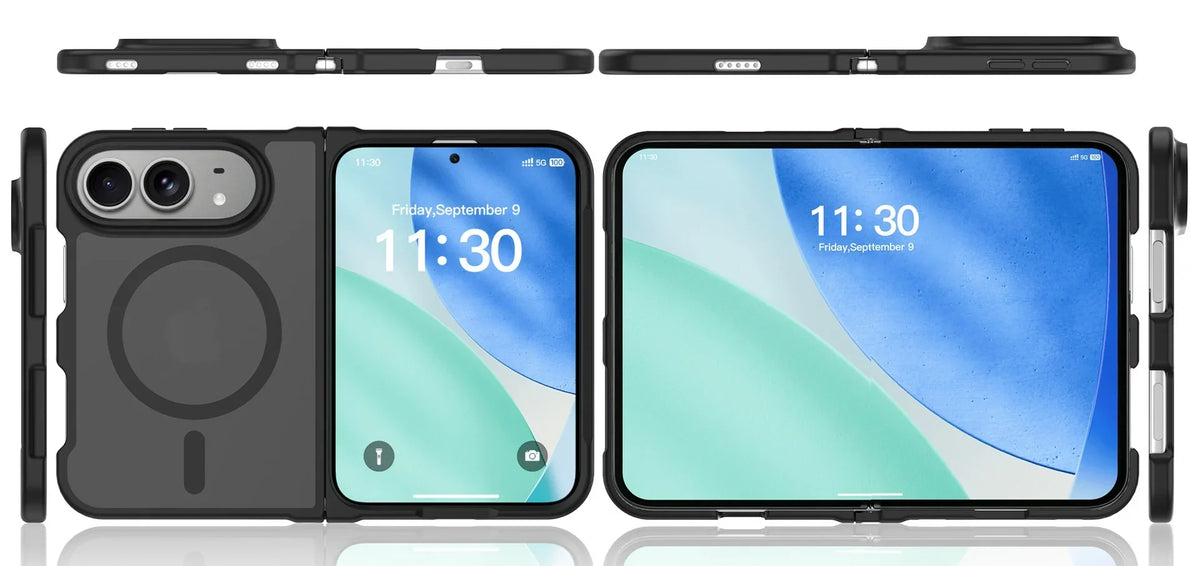
A normal iPhone case can use one continuous shell because the phone never changes shape. A foldable case usually needs separate front and rear sections so the device can still open.
That separation leaves the outside of the hinge exposed. A hinge-protection case adds a third part: a movable shield over the spine.
In simple terms: the phone hinge makes the iPhone fold. The case hinge protector is only an external cover placed over that moving area.
The protector does not replace, reinforce or control the iPhone’s internal hinge. Its main job is to place a sacrificial layer between the exposed spine and the ground, a desk, keys or other hard objects.
How Does a Hinge-Protection Case Work?
A hinge protector cannot remain fixed in one position. The shape and available space around the phone’s spine change as the device opens.
A well-designed case therefore uses a small mechanical system that lets the external shield move without resisting the phone’s own hinge.
Phone folded
The external shield sits over the exposed spine and helps absorb scratches or the first contact from a side impact.
Phone opening
A pivot, spring, sliding track or magnetic joint moves the shield away as the two halves rotate.
Phone fully open
The shield parks behind one half of the case or lies in a position that does not press against the phone.
The Main Parts Inside a Hinge-Protective Case
Although designs vary, most hinge-protection cases contain four basic elements:
- Front shell: surrounds the cover display and front frame.
- Rear shell: protects the back panel, corners and camera area.
- Hinge shield: covers the exposed spine when the phone is folded.
- Moving connection: uses a pivot, track, spring, magnet or flexible bridge to reposition the shield as the phone opens.
Common Hinge-Protection Mechanisms
| Case mechanism | How it moves | Main advantage | Possible trade-off |
|---|---|---|---|
| Spring-loaded cover | A small spring rotates or retracts the cover automatically. | Smooth one-step opening with consistent hinge coverage. | Adds moving parts and may become bulky if poorly designed. |
| Sliding-track cover | The shield glides along a short rail as the phone opens. | Can keep the protector close to the body of the case. | Dirt inside the track may affect movement. |
| Magnetic floating cover | Magnets hold the shield in position while a joint lets it move. | Can be simple, removable or combined with a kickstand. | Magnet strength and alignment must be carefully controlled. |
| Flexible bridge | A soft TPU section bends or compresses with the phone. | Uses fewer rigid mechanical parts. | May crease, bulge or add resistance over time. |
None of these mechanisms is automatically best. What matters is whether the protector moves freely through the phone’s entire folding range without rubbing against the frame or pushing on the display.
What Does Hinge Protection Actually Protect?
The most useful benefit is protection against direct contact.
If a folded phone lands on its spine, a hinge cover may take the first impact instead of the exposed metal hinge. It can also reduce cosmetic scratches caused by tables, zippers, keys and other objects inside a bag.
A cover may also block some larger particles and pocket lint from directly reaching the hinge area. However, it should not be treated as a dust seal.
What it may help with
- Scratches on the exposed hinge surface
- Minor knocks against hard objects
- Direct edge contact during some drops
- Loose lint and larger surface debris
What it cannot guarantee
- Complete protection from fine dust
- Protection from water entering the phone
- Prevention of internal hinge wear
- Protection from display creases or sharp objects
- Survival in every drop or impact
A hinge guard is therefore best viewed as an impact and scratch shield, not a complete mechanical seal.
Does the iPhone Duo / iPhone ultra Need Hinge Protection?
For most users, hinge protection will be optional rather than mandatory.
The easier decision is to think about how you carry and use your phone—not just how expensive it is.
Choose hinge protection if you:
- Have dropped previous phones more than once
- Carry your phone loosely in a backpack or handbag
- Work or travel in dusty outdoor environments
- Want coverage around every exposed edge
- Do not mind additional thickness and weight
A slimmer case may suit you if you:
- Mainly use the phone at a desk or at home
- Keep it in a clean, dedicated pocket
- Prioritize the thinnest possible folded size
- Dislike a raised section behind an unfolded phone
- Prefer easier access for magnetic accessories
A simple rule: if a direct drop onto the hinge worries you more than added case thickness, choose hinge protection. If thickness bothers you more than the risk of an exposed spine, choose a slim two-piece case.
Hinge protection can be especially useful on a book-style folding phone because the device is already thicker when closed. That extra weight may create more impact force during a drop, while the exposed spine remains one of the few areas a standard two-piece case cannot cover.
The trade-off is that the hinge guard makes an already thick device feel wider in a pocket. Some designs may also prevent the unfolded phone from lying completely flat on a table.
What Should You Check Before Choosing a Case?
A hinge protector is only useful when its geometry matches the phone precisely. Poor fit can create rubbing, trapped dirt or unwanted resistance during folding.
- Exact model compatibility: do not rely only on “iPhone Fold” or “iPhone Duo / iPhone ultra” in the product title. Confirm the released model and dimensions.
- Full opening range: the case should allow the phone to open fully and hold its normal intermediate angles.
- No frame contact: the moving shield should not scrape the metal spine or press against the rear panel.
- Smooth automatic movement: the cover should move out of the way without needing to be forced by hand.
- Protected inner surfaces: any section facing the phone should use a soft lining or sufficient clearance.
- Secure front and rear shells: the two case halves should remain aligned without shifting during repeated folding.
- MagSafe clearance: make sure the hinge cover, kickstand or metal components do not interfere with the charging area.
- Cleaning access: you should be able to remove lint and grit from underneath the hinge cover.
- Reasonable thickness: check the total folded size, not only the thickness of the rear case panel.
- Return or fit guarantee: this is especially important for accessories sold before Apple confirms the final hardware.
After installing the case, open and close the phone slowly several times. Stop using it if you hear scraping, feel a new hard stopping point or see the front shell lifting away from the frame.
It is also worth removing the case periodically. Dust trapped beneath a moving hinge cover can act like fine sandpaper if it remains pressed against the phone.
Looking for Full Hinge Coverage?
The ZEERA FoldArmor Pro for iPhone Duo / iPhone ultra combines full-frame protection with a dedicated magnetic hinge section, integrated screen protection, MagSafe support and a hinge kickstand.
Before ordering any pre-release iPhone Duo / iPhone ultra case, check the latest compatibility notice for the final released model.
View FoldArmor ProFrequently Asked Questions
Is hinge protection necessary for the iPhone Duo / iPhone ultra?
Not for every user. It is most useful for people who want stronger drop and scratch protection around the exposed spine and are willing to accept extra thickness.
Can a hinge-protection case damage a foldable phone?
A correctly fitted case should not damage the phone. A poorly fitted cover may rub against the frame, trap grit or resist the opening motion, which is why precise model compatibility matters.
Does a hinge cover keep dust out of the phone?
It may block some lint and larger particles, but it does not create a sealed or dustproof hinge. Fine particles can still enter around the edges of the cover.
Will hinge protection make the iPhone Duo / iPhone ultra thicker?
Yes. The protector adds material over the spine when the phone is folded. Spring-loaded and kickstand designs may add more thickness than simple flexible covers.
Can a hinge-protection case work with MagSafe?
Yes, if the case has correctly positioned magnets and keeps the charging surface clear. Check whether kickstand hardware or additional metal parts affect charger and wallet alignment.
Should I buy an iPhone Duo / iPhone ultra case before the phone is released?
Waiting for final dimensions is the safest option. If you order early, choose a seller that clearly states final-model compatibility and offers a return or replacement policy if the fit changes.