Quick Answer
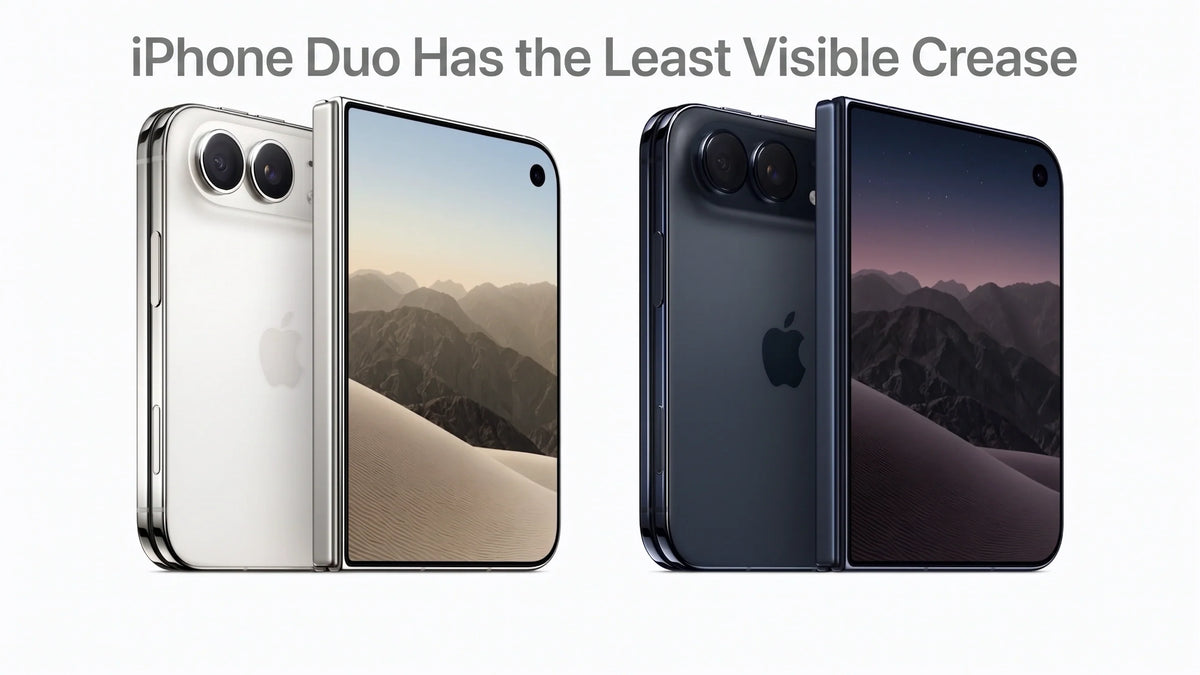
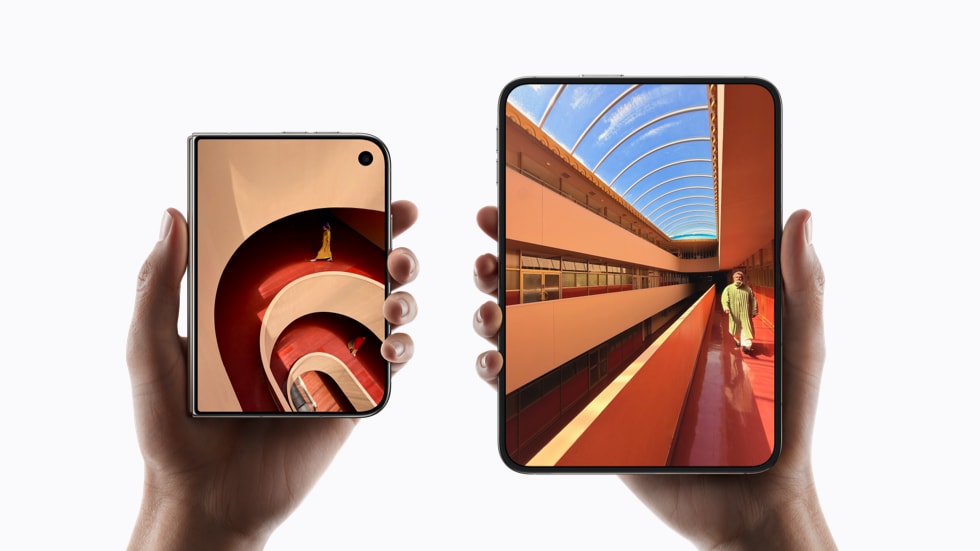
Based on Apple’s display design and early hands-on comparisons, iPhone Duo currently has the least visible crease among major book-style foldable phones.
The biggest reason is its matte nano-texture inner-display finish, which reduces the reflections that normally expose a fold line.
A precision hinge with more than 100 components also supports the center of the display and helps it sit flatter when fully opened.
The crease is not completely gone—you can still feel it—but it is harder to see than on Galaxy Z Fold 8 and Xiaomi 18 Fold in typical viewing conditions.
The first time you open iPhone Duo, the inner screen may look unusually flat for a foldable phone. That impression is not coming from the hinge alone.
Apple is controlling both the physical shape of the display and the way light moves across its surface. The result is a crease that is still physically present, but much less visible to the eye.
Does iPhone Duo Have a Crease?
Yes. Every commercially available folding OLED still has to bend, so iPhone Duo is not truly crease-free.
The important difference is visibility. Early hands-on reports describe the crease as barely visible in normal use, even though it can still be felt when a finger moves across the center of the screen.
That distinction matters. A fold line can be physically present without constantly catching your eye.
Why Does the iPhone Duo Crease Look So Small?
Apple attacks the problem in three layers: surface reflections, mechanical support and internal display stress.
The short version: the nano-texture finish hides the crease from your eyes, the hinge holds the center flatter, and the flexible display stack spreads bending stress across multiple layers.
1. The Nano-Texture Finish Weakens the Visual Crease
This is the part that makes the biggest difference to the first impression.
A glossy folding screen acts like a mirror. When overhead lights, windows or the sky reflect across the center, even a shallow dip bends those reflections and makes the crease easy to spot.
iPhone Duo’s inner display uses what Apple calls a premium nano-texture finish. It creates a matte surface that reduces glare and reflections, specifically helping minimize crease visibility.
In other words, Apple is not only reducing the physical fold. It is removing the strongest visual cue that tells your brain where the fold is.
This explains why the Duo can look flatter at first glance than a rival with a similarly shallow physical crease. The surface does not produce the same sharp band of distorted reflected light.
2. The Precision Hinge Supports the Center
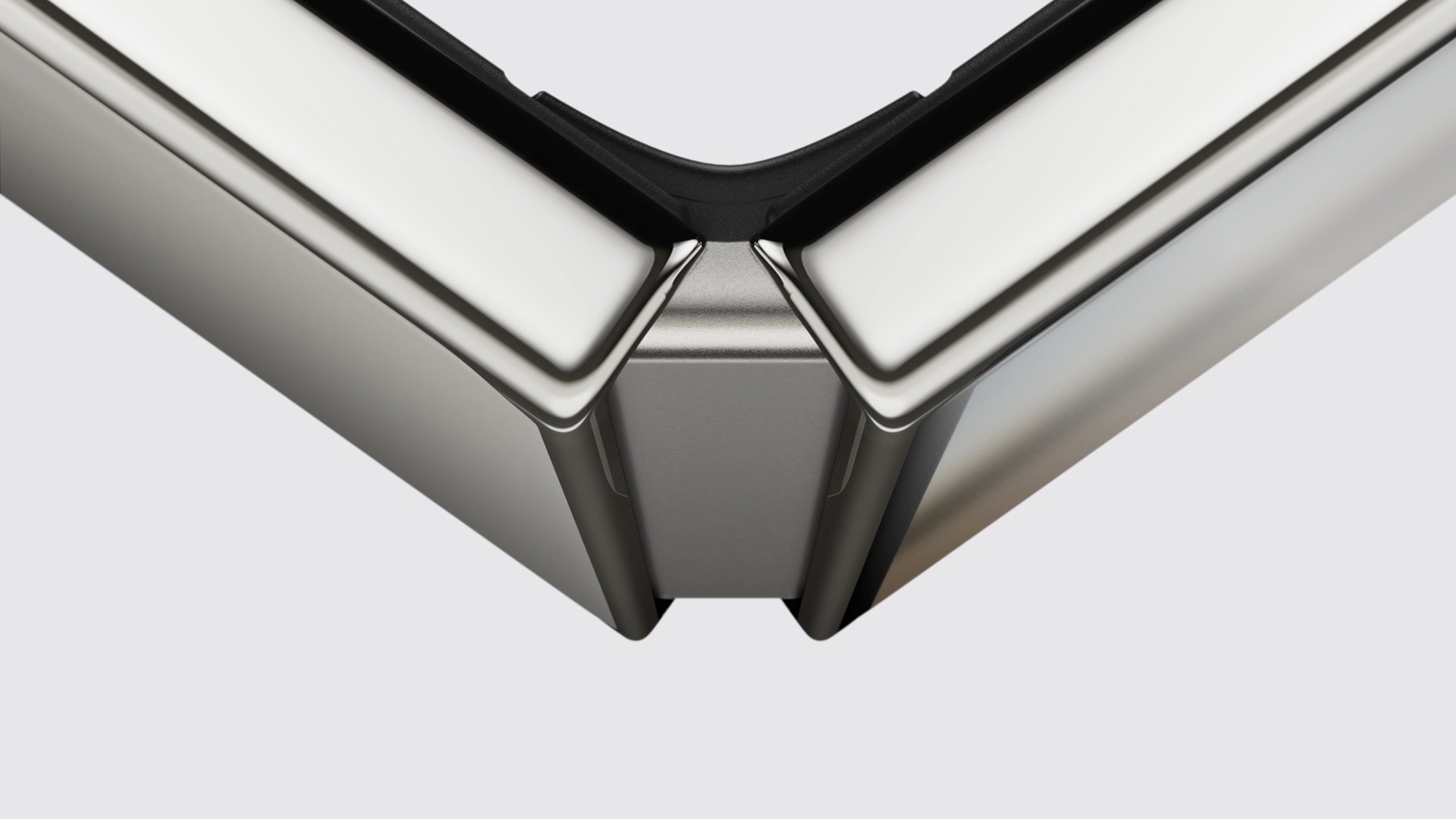
The display still needs a strong mechanical foundation. Apple says the iPhone Duo hinge contains more than 100 components engineered to control the opening and closing movement precisely.
When the phone is fully opened, the hinge supports the center of the display so it can remain flatter instead of sinking visibly into an unsupported channel.
An integrated magnet array also helps create a secure closure when the phone is folded. Internal support ribs add stiffness to the structure around the display.
3. The Display Layers Move Instead of Fighting the Fold
The inner screen is more than a flexible OLED panel with a protector on top.
Apple uses high-strength glass above and below the folding display panel. Custom adhesives allow the layers to slide past one another slightly—similar to pages moving in a book—rather than forcing every layer to bend along exactly the same path.
This helps relieve stress at the center. A titanium plate beneath the stack adds support, while the nano-textured polymer cover layer is claimed to be up to 40 percent stiffer than other materials used in the industry.
The surface also has a scratch-resistant coating. That does not make the flexible inner screen as hard as conventional cover glass, but it adds another protective layer for daily use.
iPhone Duo vs Galaxy Z Fold 8 vs Xiaomi 18 Fold Crease
| Phone | Inner-screen approach | Visual crease | Crease by touch |
|---|---|---|---|
| iPhone Duo | Matte nano-texture finish, center-supporting precision hinge, sliding adhesive layers and titanium support plate | Least visible in early hands-on comparisons | Still detectable, but described as subtle |
| Galaxy Z Fold 8 | Highly refined foldable display and hinge, but with a more reflective inner surface | Much improved, yet the center line remains easier to see under reflections | Still noticeable when swiping across the fold |
| Xiaomi 18 Fold | Dual-layer ultra-thin glass structure with a reflective inner surface | Fairly visible in early hands-on testing because reflections reveal the fold | Reported to be difficult to feel |
Among these three, iPhone Duo currently takes first place for visual crease control. That does not mean its physical fold is dramatically shallower in every measurement.
Instead, Apple’s advantage comes from the complete optical effect: the matte surface makes the center look calmer and more uniform, especially when the display is on.
The Galaxy Z Fold 8 remains one of Samsung’s best crease-control efforts. Xiaomi 18 Fold may feel impressively smooth under a finger, but its more reflective surface makes the fold easier to see.
When Can You Still See the iPhone Duo Crease?
You can still find it if you look from a low side angle, turn the screen off or place a strong light directly across the fold.
Dark content can also reveal subtle surface changes more easily than a bright, detailed image. And because foldable displays are flexible, appearance may vary slightly between units and can change with long-term use.
So “least visible” is the accurate description. “No crease” is not.
Should You Add a Screen Protector to the Inner Display?
Do not add a third-party tempered-glass or hydrogel protector to the inner folding screen unless Apple specifically approves it.
Extra layers can change how the display bends, add pressure near the hinge or interfere with the factory surface. The outer display can be protected normally, but the inner display should be treated as part of the phone’s engineered folding system.
The Bottom Line
iPhone Duo appears to have the least visible crease of the current mainstream book-style foldables because Apple solved an optical problem as well as a mechanical one.
The precision hinge, supported center, movable adhesive layers, stiffer polymer cover and titanium plate all matter. But the feature you notice first is the nano-texture finish: by suppressing glare, it prevents reflected light from outlining the fold.
That is why the iPhone Duo inner display can look closer to a flat tablet screen than Galaxy Z Fold 8 or Xiaomi 18 Fold—even though the fold has not physically disappeared.
FAQ
Is the iPhone Duo completely crease-free?
No. The center fold is still physically present and can be felt, but Apple’s matte nano-texture finish makes it unusually difficult to see in normal use.
Why is the iPhone Duo crease less visible?
The inner display reduces reflections, while the precision hinge supports the center and the layered display structure manages bending stress.
Is the iPhone Duo crease better than Galaxy Z Fold 8?
Early hands-on comparisons say the Duo’s crease is less visible. The difference is especially clear in reflected light because the Duo uses a matte inner-display finish.
How does iPhone Duo compare with Xiaomi 18 Fold?
Xiaomi 18 Fold’s crease reportedly feels shallow, but its reflective inner screen makes the fold easier to see. iPhone Duo currently looks flatter to the eye.
Will the iPhone Duo crease become worse over time?
Long-term retail testing is still needed. All foldable displays experience repeated bending, so crease appearance may change with use even when the hinge and display are designed for durability.
Can I put a screen protector on the iPhone Duo inner screen?
Avoid third-party inner-screen protectors unless Apple approves them. Added layers can interfere with the folding display stack. Protect the outer screen and hinge instead.
Sources
Apple Newsroom: Apple unveils iPhone Duo
The Wall Street Journal: iPhone Duo first impressions
The Verge: iPhone Duo hardware and crease observations
Android Central: Xiaomi 18 Fold hands-on