Updated September 16, 2026
Quick Answer
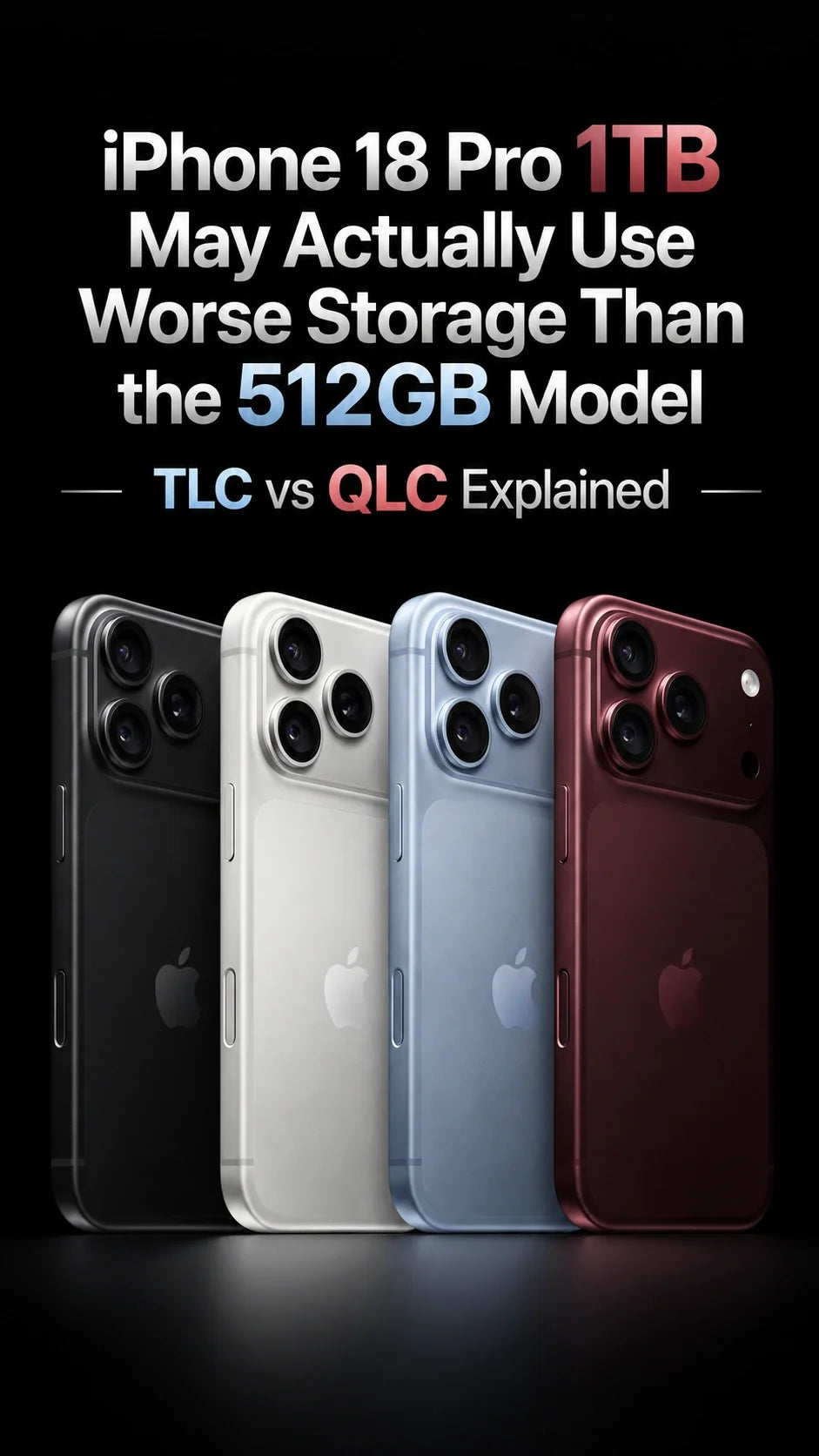
Does the 1TB iPhone 18 Pro use worse storage than the 512GB model? Chinese tech creator He Tongxue (何同学) says the 1TB iPhone 18 Pro his team obtained uses QLC NAND, while the 256GB and 512GB versions use TLC. That suggests a less favorable flash type in a more expensive configuration. Apple does not list NAND types by capacity, and one hands-on report does not prove that every retail 1TB phone uses QLC or runs slower. If 512GB meets your needs, it is the more compelling buy on the evidence available.
Key Facts: iPhone 18 Pro 512GB vs 1TB Storage
Did He Tongxue actually test a 1TB iPhone 18 Pro?
In his iPhone 18 Pro first-impressions video, He Tongxue says his team obtained a 1TB iPhone 18 Pro with QLC flash. At approximately 12:54–13:39, he says the 256GB and 512GB versions remain TLC; he expects the 2TB version to be QLC as well. The 2TB statement is a prediction in the video, not a test result shown for a 2TB unit.
His report adds a hands-on example to earlier component-sourcing claims. The video excerpt does not provide a matched 1TB-versus-512GB sustained-write benchmark, a sample size across suppliers, or a published endurance rating. ZEERA will update this article when more retail units and repeatable tests become available.
Apple lists all four capacities for iPhone 18 Pro and Pro Max, but does not identify TLC or QLC in its published technical specifications.
Why can a more expensive 1TB iPhone have QLC instead of TLC?
TLC stores three bits in each NAND flash cell; QLC stores four. Packing in an extra bit increases density, which helps make larger capacities possible. It also requires more precise control of the cell’s electrical states. Kingston’s NAND explanation describes the usual trade-off: TLC generally favors write endurance and sustained write performance; QLC favors density and cost per bit.
Storage is not RAM. TLC and QLC describe permanent NAND flash, not the phone’s working memory. Controller design, free space and caching also affect actual speed.
Will the 1TB iPhone 18 Pro be slower than the 512GB model?
That has not been demonstrated by the reported NAND identification alone. Short bursts can be absorbed by a fast cache, and a larger storage configuration may have its own performance advantages. A useful comparison needs the same iPhone model, comparable software, similar free-space conditions and repeated long writes after the initial cache is exhausted.
For everyday messaging, browsing and typical photo use, the difference may be invisible. A gap is more plausible during repeated large video writes, long file imports or exports, and work with storage nearly full. These are potential QLC pressure points, not measured slowdowns for the iPhone 18 Pro.
Does QLC mean the 1TB iPhone will wear out faster?
QLC generally has lower write endurance per cell than comparable TLC. That does not give us an iPhone lifespan figure: Apple has not published a per-capacity total-bytes-written rating, and the controller spreads writes across the storage. He Tongxue also says QLC should be sufficient for normal owners. It would be misleading to turn the NAND label into a prediction that a 1TB iPhone will fail early.
Compare multiple retail 512GB and 1TB units, identify the NAND in each, then repeat large sustained writes at matched free-space levels and temperatures. Record speed after the cache is exhausted, as well as any supplier differences. This would establish whether the reported component change affects real iPhone workflows.
Why does paying more for 1TB feel like a downgrade?
Because buyers reasonably expect a higher-priced configuration to include at least the same class of components. Apple’s launch announcement confirms 256GB, 512GB, 1TB and 2TB options, with U.S. starting prices of $1,199 for Pro and $1,299 for Pro Max. Buyers pay more to move up the storage tiers, yet the reported 1TB example uses denser QLC while smaller capacities are described as TLC.
“Worse” here means a less favorable NAND technology trade-off for heavy writing, not less usable storage. We cannot calculate Apple’s component savings or confirm that the company changed NAND to protect its margins from this report alone.
Should you buy the 512GB or 1TB iPhone 18 Pro?
Choose 512GB if your current phone stays comfortably below that limit and you can archive larger projects. On the evidence available now, it avoids paying for capacity you will not use and aligns with the reported TLC tier. See ZEERA’s iPhone 18 Pro price and storage guide.
Choose 1TB if you actually need it for offline media, a large photo library or regular on-device video work. Running out of storage mid-shoot is a real problem; a NAND classification by itself is not a reason to force your workflow into 512GB.
For ProRes and long recording sessions, make the decision based on required free space, the recording mode’s storage needs and a backup workflow. Wait for matched retail-unit tests before paying extra on the assumption that the 1TB model must be faster. Our iPhone 18 Pro vs Pro Max guide covers the larger purchase decision.
FAQ: iPhone 18 Pro storage questions
Does every 1TB iPhone 18 Pro use QLC?
Not established. He Tongxue reports QLC in a 1TB unit his team obtained. Apple has not published a capacity-by-capacity NAND specification, and supplier variation remains possible.
Is the 512GB iPhone 18 Pro TLC?
He Tongxue says the 256GB and 512GB versions use TLC. That is an independent report, not an Apple guarantee covering every batch.
Is QLC storage bad for normal use?
Usually there is no reason to assume it will cause a noticeable everyday problem. The technical concerns center on sustained writes and per-cell endurance; this iPhone still needs direct comparative testing.
Does the 2TB iPhone 18 Pro use QLC?
He Tongxue expects it to, but his cited segment identifies a 1TB unit. Treat the 2TB claim as unconfirmed until a 2TB device is independently checked.
Can I check TLC or QLC in iPhone Settings?
The ordinary Storage screen does not report NAND cell type. Capacity and benchmark speed alone also cannot reliably identify the physical flash in your individual phone.
Updated September 16, 2026. Evidence: He Tongxue’s first-impressions video, Apple’s published capacity list and Kingston’s NAND technology guide. NAND identification and measured iPhone performance are distinct questions.