November 4, 2026 · iPad mini (A20 Pro)
Quick Answer
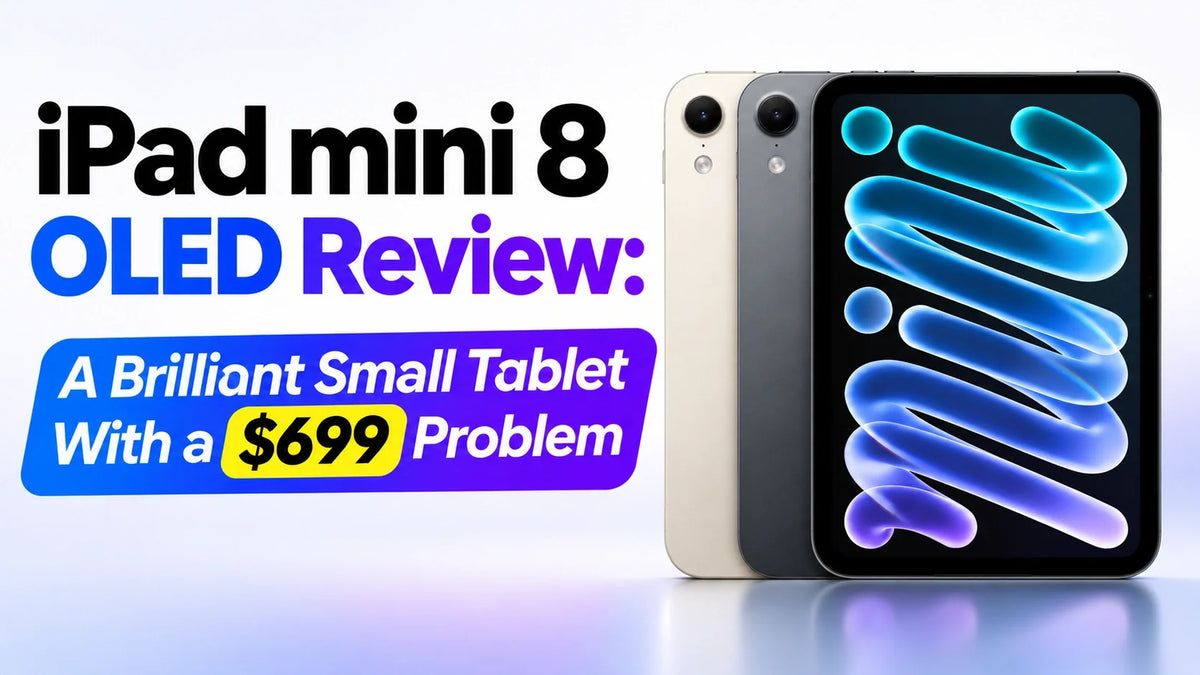
The iPad mini 8 is worth considering for its compact OLED screen, but its $699 starting price and 60Hz refresh rate make it a purchase for people who specifically want a small tablet.
The linked OLED review captures that tension: the reviewer loves the display, lighter body and improved sound, yet questions the value beside an 11-inch iPad Air costing $50 more. Storage upgrades, optional nano-texture glass and accessories can push the total higher. Choose the mini for how comfortably you will carry and use it; compare larger iPads if screen space is your priority.
The $699 problem: an iPad Air is only $50 more
The most useful question in The iPad Mini OLED Review — Here's the Problem is whether the mini's size justifies its price. Apple's US store lists the Wi-Fi mini from $699 with 128GB, while the 11-inch M4 iPad Air starts at $749 with 128GB, before tax.
That $50 gap makes the Air a serious alternative for documents, drawing and side-by-side apps. The mini's case is different: it gives you an OLED display in a much smaller device. If an 11-inch tablet is awkward to hold for reading or too large for your everyday bag, paying almost as much for the mini can still make sense.
OLED fixes the picture, but 60Hz still limits the experience
Against the 2024 mini, the review's strongest upgrade is immediately visible: darker blacks, brighter HDR highlights and a slightly larger 8.5-inch screen. The reviewer also finds the new screen more convincing at an angle, making it attractive for video, photos and even a camera-monitor setup.
What you see improves
The new display reaches 600 nits for full-screen content and up to 1,200 nits for HDR highlights. Those are different measurements: a bright HDR highlight can stand out without making every webpage twice as bright. For movies and supported games, contrast and highlight detail are the more meaningful changes.
What you feel is still 60Hz
The reviewer remains frustrated by scrolling and gaming on a premium tablet without 120Hz ProMotion. A faster chip can load an app sooner, but it cannot make the built-in display show 120 different frames each second.
OLED pixel response and display refresh rate are separate. Faster pixel transitions may reduce visible smearing, while refresh rate controls how frequently the image updates. The video offers approximate response-time figures rather than a measured panel test, so they are not a reason to treat this screen as equivalent to 120Hz.
If you regularly move between a ProMotion iPhone and an iPad, try the mini's scrolling and handwriting before ordering. The broader hardware changes are covered in our iPad mini 8 vs iPad mini 7 comparison.
Storage and nano-texture change the real purchase price
The reviewed unit is the 512GB model. That matters because the entry-level iPad does not have exactly the same A20 Pro configuration. Apple's technical specifications distinguish the versions below.
128GB or 256GB: the everyday choices
Both have a 5-core CPU, 7-core GPU and 16-core Neural Engine. US Wi-Fi prices start at $699 and $799 respectively. Choose between them around your apps, downloaded games and offline media; extra storage is useful when you will actually fill it.
512GB: more than extra capacity
The $999 Wi-Fi model adds a 6-core CPU and Dual 16-core Neural Engine, while retaining the 7-core GPU. The review's roughly 50% CPU benchmark improvement over the older mini comes from this higher configuration. It is not a measured result for every storage tier. For the configuration decision, see our 512GB vs 256GB A20 Pro guide.
Nano-texture: choose it for your lighting
The optional glass is available on 256GB and 512GB models. The reviewer likes its ability to disperse reflections while keeping the image more convincing than the matte inner surface of the iPhone Duo, in his comparison.
The cost includes moving beyond the 128GB base model as well as paying for the glass option. A matte screen protector can offer a different writing surface, but it is an added film rather than the same etched-glass treatment. Our nano-texture vs standard glass guide looks at the trade-off in more detail.
Why the reviewer still prefers the mini as a tablet
After questioning the price, the review returns to how pleasant the mini is to use. The body is 5.4mm thick, and Apple's listed weights are 255g for Wi-Fi and 263g for Cellular. That lightness is useful for holding a book, checking reference material or watching a film without balancing a larger tablet.
The sound also makes a stronger impression than the spec-sheet name suggests. In the review's side-by-side listening comparison, the Acoustic Display sounds fuller and has more bass than the older mini. Apple describes woofers coupled through the display and tweeters hidden between the glass and enclosure. The move away from familiar speaker grilles accompanies a redesigned audio system.
The reviewer would choose the mini over iPhone Duo for dedicated tablet use, while still appreciating the folding phone. That is a useful distinction for buyers: a folding phone combines devices; the mini gives tablet apps a dedicated screen and supports Apple Pencil. The right choice depends on whether you want one device in your pocket or a separate tablet you enjoy using.
Desk use improves; battery life is a familiar trade-off
One of the video's more practical demonstrations is an external monitor operating as a separate workspace. Apple's announcement confirms extended display mode with iPadOS 27.2, and its specifications list output up to 4K at 60Hz. This gives windowed apps more room when the mini is connected at a desk. Our external-monitor setup guide explains the connection and software requirements.
The review does not present battery life as a major leap. Apple rates it for up to 10 hours of Wi-Fi browsing or video, and up to 50% charge in around 30 minutes using a USB-C adapter rated at 35W or higher. The included 20W adapter is a separate consideration when budgeting for faster charging. The mini charges through USB-C; its magnetic Pencil attachment does not add MagSafe wireless charging.
Who should buy the OLED iPad mini?
Choose it when the small size is the point
It makes the strongest case for reading, travel, handheld games, notes and a compact creative companion. The OLED display and richer sound improve the things you experience directly, while the lighter body encourages you to carry it.
Compare the Air when most of your use is at a table
For long drawing sessions, layouts, spreadsheets or two apps you need to read comfortably at once, a larger canvas can matter more than the mini's portability. The Air's small starting-price premium makes that comparison worthwhile. For current mini owners, keeping the older model is also reasonable if the display and weight changes do not solve a problem you have.
The review's enthusiasm and frustration can both be true. This mini is easier to love when you know why you want an 8.5-inch tablet. If you are simply shopping for the most iPad for the money, the price and 60Hz screen deserve a closer look.
Watch the original review
Source video: The iPad Mini OLED Review — Here's the Problem. Specifications and US list prices checked November 4, 2026, against Apple's announcement, technical specifications and online store.
FAQ
Can you take iPad mini 8 into the shower?
The video raises wet-environment use, but IP67 is a controlled-test water-resistance rating, not a promise of shower safety. Apple specifies up to 1 meter for 30 minutes under test conditions, says resistance can decrease with wear and advises against charging a wet iPad.
Do you need Apple Pencil Pro for basic notes?
No. The mini supports both Apple Pencil Pro and Apple Pencil (USB-C). The USB-C model can serve basic note-taking; Pencil Pro adds features such as squeeze and barrel roll for compatible creative workflows. Both are sold separately.
Related Reading