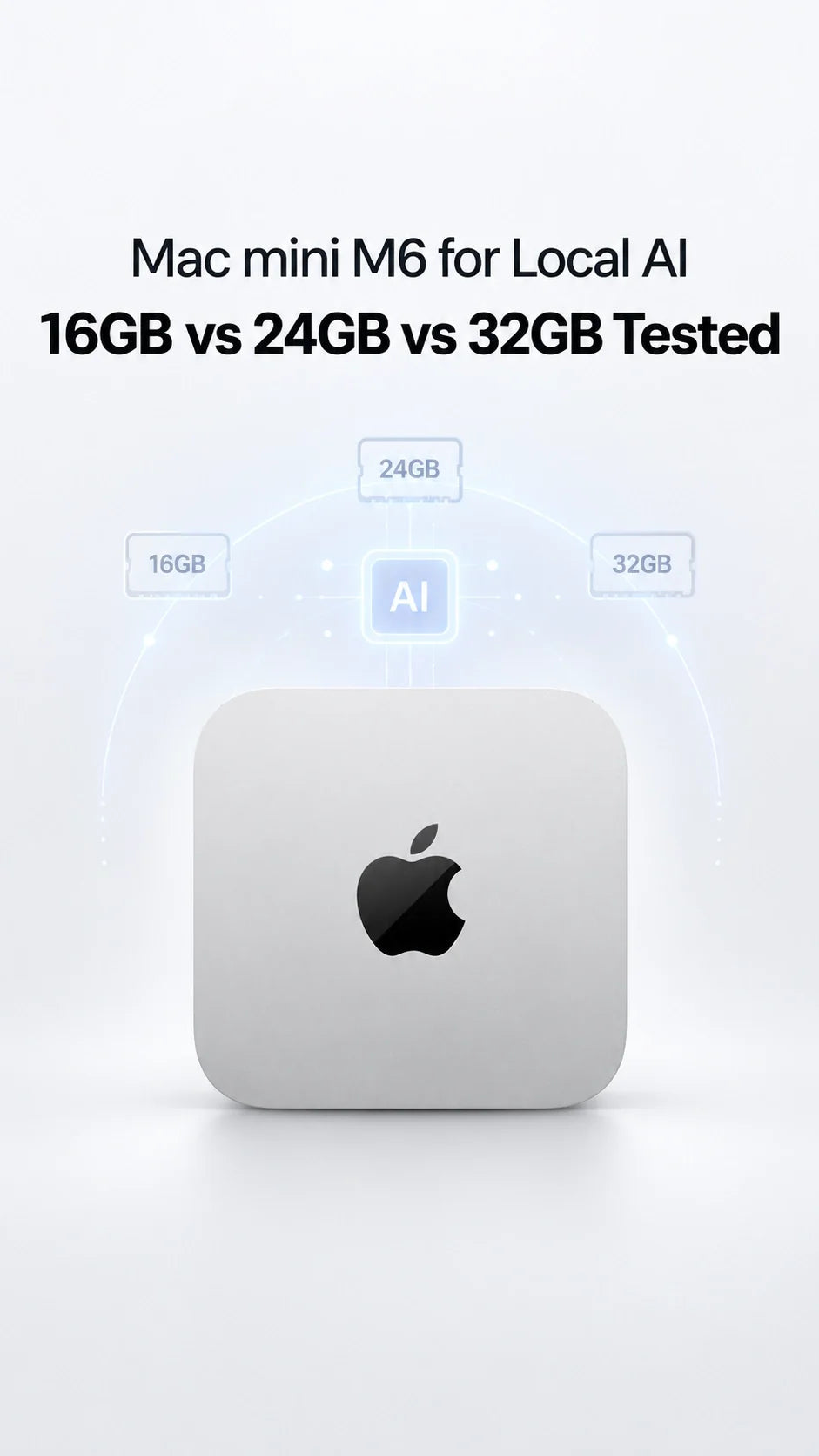
Quick Answer
Choose 16GB for occasional local chat with smaller quantized models and single-image generation.
Choose 24GB for regular 9B–16B LLM use, longer contexts and light agent workflows while keeping other apps open.
Choose 32GB if local AI is a primary reason for buying the M6 Mac mini, especially for larger quantized models, image batches or multi-tool agents.
The key limit is memory capacity, not only M6 compute. WIRED’s 16GB test ran local chat and a 9B image model well, but its file-based agent task did not finish after 30 minutes.
Testing disclosure: the measured results below come from WIRED and The Verge. ZEERA has not independently benchmarked these three memory configurations.
What Was Actually Tested?
The word Tested in this guide refers to published third-party testing, not a ZEERA lab test. The evidence is useful, but it is not a perfect three-way benchmark.
16GB M6
WIRED tested local image generation, local LLM chat and a basic document-agent workflow on the 16GB base model.
24GB M6
The Verge tested a 24GB/512GB model. Its most relevant memory result came from batch AI subject detection in Lightroom, not an LLM benchmark.
32GB M6
No comparable 32GB test was published in the sources reviewed. Our advice is based on memory fit, Apple’s specifications and the limits shown by the 16GB and 24GB tests.
Why this matters: a headline that says “16GB vs 24GB vs 32GB tested” can imply identical models, prompts and software were run on all three machines. That dataset does not yet exist publicly. This article separates measured results from practical estimates.
M6 Hardware Helps, but Unified Memory Sets the Ceiling
Apple’s M6 Mac mini combines a 12-core CPU, 12-core GPU with Neural Accelerators, a Dual 16-core Neural Engine and up to 170GB/s of unified-memory bandwidth. Apple offers 16GB as standard and up to 32GB on the M6 model.
That architecture is well suited to local AI because the CPU and GPU work from the same memory pool. It reduces the need to copy a model between separate system RAM and graphics memory.
Unified memory is still finite. macOS, the AI runtime, model weights, context cache, image tensors and every open app all compete for it. A model that technically loads can still leave too little headroom for long prompts, document retrieval, a browser or a second AI tool.
For the memory-bandwidth side of the decision, see our separate Mac mini M6 16GB vs 24GB vs 32GB memory guide.
16GB M6 Mac mini: What the Tests Show
WIRED’s 16GB M6 Mac mini averaged 1 minute 40 seconds to generate a 20-step image in Draw Things using a 9-billion-parameter Flux.2 model. An M4 Pro MacBook Pro with 48GB completed the same image about 20 seconds faster.
The same reviewer ran a 16B Llama 3.2 model and a 9B Qwen3.5 model in LM Studio. Both were responsive enough for conversational use. That is strong evidence that 16GB can be a capable entry point for smaller quantized models.
The limit appeared when the workload became agentic. Using a 9B Qwen3.5 model with access to 15 local text files, the M6 Mac mini had not completed a detailed-report task after 30 minutes. The reviewer’s 48GB M4 Pro system finished in 9 minutes 43 seconds.
16GB verdict
Good for learning and occasional local AI. It can run useful 9B-class models and even some larger quantized chat models, but it offers limited room for long context, retrieval, several open apps or multi-step agents.
How Much Memory Do Local LLMs Need?
Parameter count alone does not tell you whether a model will run. Quantization changes the size of the model weights, while context length changes the key-value cache. Runtimes such as MLX, LM Studio, Ollama and llama.cpp also reserve working memory.
A rough starting point is that 4-bit weights use about half a byte per parameter before metadata and runtime overhead. A 9B model may therefore begin around 4.5GB for weights, while a 32B model begins around 16GB. The real working set is higher, sometimes much higher with long context or multimodal input.
Best with 3B–9B
- Comfortable: 3B–9B quantized chat models
- Possible: selected 12B–16B quantized models with restrained context
- Avoid: 32B models, long-context agents and heavy multitasking
Best with 9B–16B
- Comfortable: 9B–16B quantized models
- Possible: some 20B–24B models with moderate context
- Tradeoff: large document sets or parallel apps can still trigger swap
Best with 14B–24B
- Comfortable: 14B–24B quantized models
- Possible: selected 32B 4-bit models with limited headroom
- Avoid: 70B-class models and memory-heavy fine-tuning
These ranges are planning guidance, not guaranteed compatibility. Model architecture, quantization, context window, vision input, batch size and software version can change memory use significantly.
16GB vs 24GB vs 32GB for AI Image Generation
Image generation has a different memory pattern from chat. The model, text encoders, image latents and intermediate tensors all need room. Resolution, batch size, ControlNet-style guidance and whether models remain resident can change the result.
Apple’s MLX examples show that quantized Stable Diffusion XL can generate on an 8GB Apple-silicon Mac without swapping, but the software must use memory-saving techniques. More memory lets the system keep more of the model resident and repeat generations more efficiently.
16GB and 24GB
16GB: suitable for occasional single-image generation with optimized or quantized models. WIRED’s 9B Flux.2 test proves it is workable, though not fast enough for every creator.
24GB: provides better working room for larger models, repeated generations and keeping a browser or editor open. It is the balanced choice for mixed creative work.
32GB
Choose 32GB for image batches, higher-resolution workflows, multiple guidance models or switching between local LLM and image tools without closing apps.
More memory does not automatically make a single generation proportionally faster. It mainly prevents memory pressure and expands what can stay loaded.
Which Memory Tier Is Best for AI Agents?
Agents are harder than a single chat prompt because they keep more state alive. A local agent may load an LLM, embeddings, retrieved files, a long conversation, tool outputs and a browser or code environment at the same time.
The WIRED result is an important warning: a 9B model that feels fast in conversation can still struggle when asked to read files and complete a longer multi-step report. The problem is not necessarily that the model cannot answer; the entire workflow may run out of practical memory and time.
16GB: experiment
Suitable for simple scheduled prompts, small document collections and one lightweight local model. Expect to limit context and close unnecessary apps.
24GB: light production
A better minimum for regular retrieval, code assistants and modest multi-tool workflows. It still is not generous for large files, vision and several agents.
32GB: safest M6
The best M6 choice for an always-on personal agent. If the workflow needs 48GB or 64GB, move to M5 Pro Mac mini instead of forcing the standard M6.
If the Mac will run automation continuously, memory is only one part of the system. Storage, logs, power recovery and thermal conditions also matter. Our Mac mini 24/7 server guide covers those operational risks.
Does Local AI Need Extra Cooling?
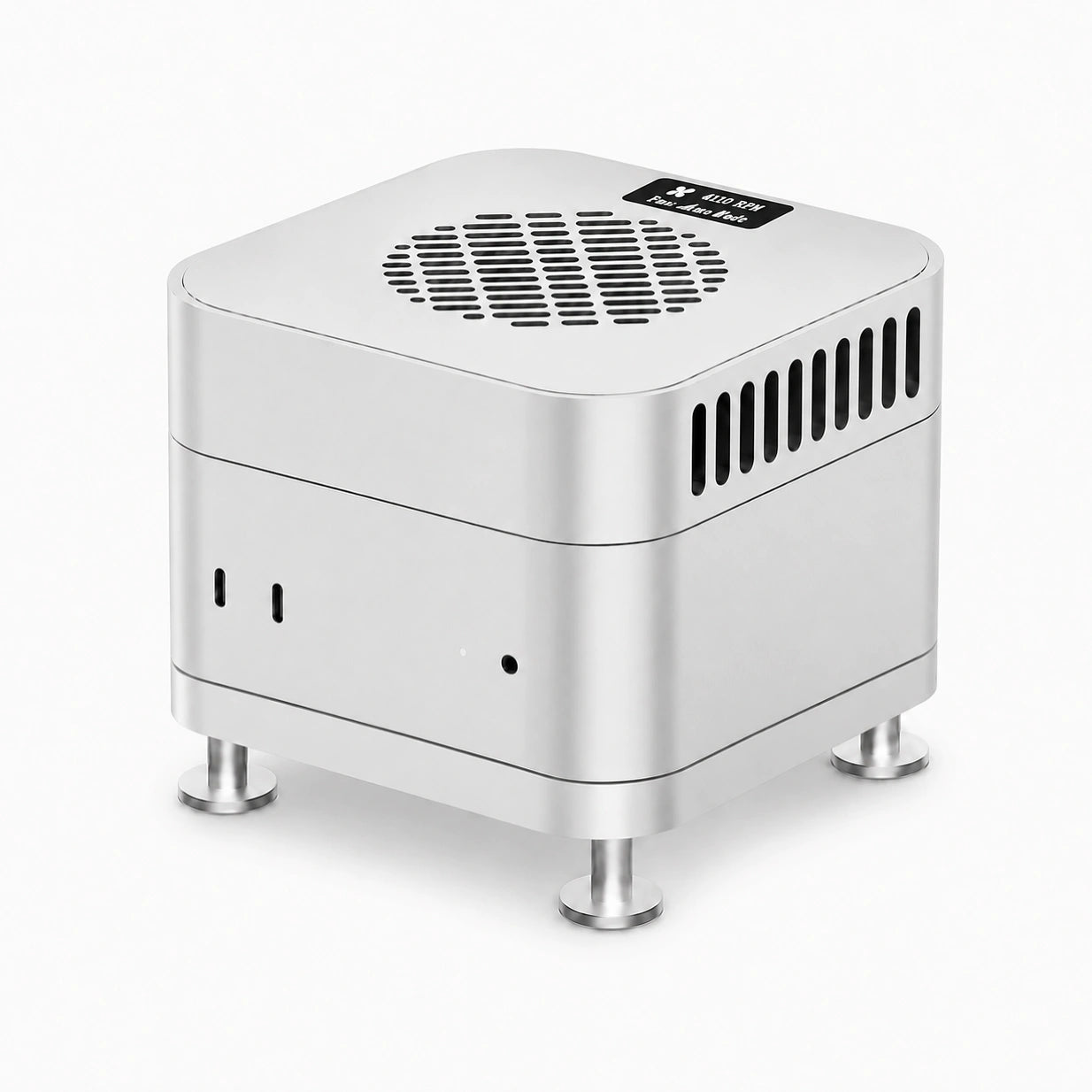
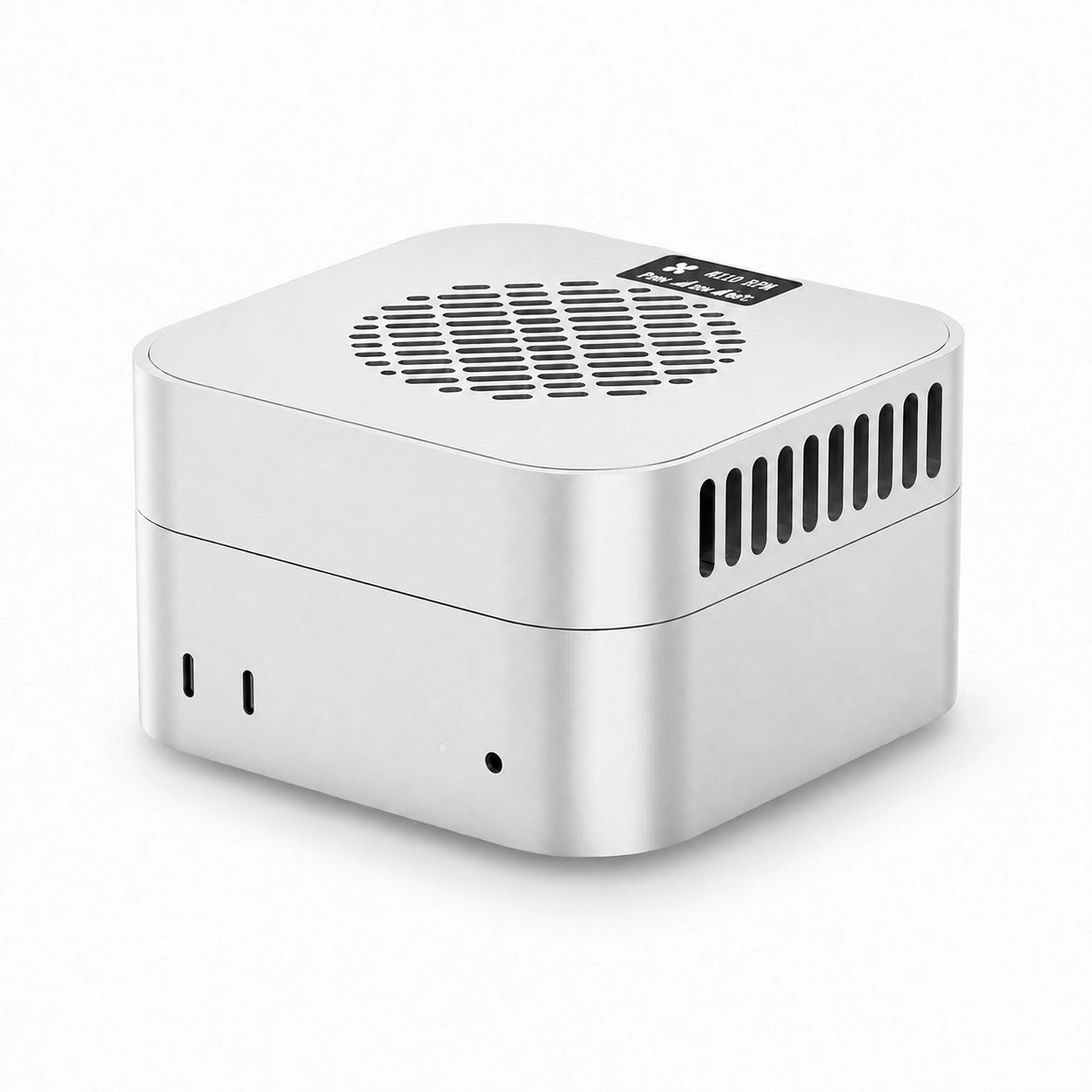
Short chats and occasional images do not automatically justify an external cooler. The Mac mini has active cooling, and normal fan noise under a demanding task is not proof of overheating.
Cooling becomes more relevant when inference, image batches or agent services hold the CPU and GPU under load for hours. Extra thermal headroom may help the setup remain more consistent, but it cannot solve insufficient memory or make an oversized model fit.
Start with the built-in system, watch memory pressure and temperatures under your real workload, then decide. See our detailed guide to Mac mini M6 cooling stands and sustained workloads.
Which M6 Mac mini Should You Buy for Local AI?
Buy 16GB if:
- Local AI is a secondary use
- You mainly run 3B–9B quantized models
- You generate one image at a time
- You accept shorter context and more app management
Buy 24GB if:
- You use local AI every week
- You want 9B–16B models with useful context
- You combine chat, coding and occasional image generation
- You want a balanced M6 configuration
Buy 32GB if:
- Local AI is a primary workload
- You want more context, retrieval and multitasking
- You run image batches or multi-tool agents
- You plan to keep the Mac for several years
Our recommendation for most local-AI buyers is 24GB. It avoids the base model’s tightest memory limit without pushing every buyer to the highest configuration.
Choose 32GB when AI is the reason you are buying the machine. Unified memory cannot be upgraded later. If your intended model or agent already needs more than 32GB, the correct comparison is M5 Pro Mac mini or Mac Studio—not a more expensive SSD on the M6.
Final Verdict
The M6 Mac mini is a strong small-model AI desktop, but its three memory tiers serve different users.
The 16GB version is more capable than its capacity suggests: published testing shows conversational local LLMs and a 9B image model are practical. It becomes restrictive when the job adds long context, files, tools and background apps.
The 24GB model is the best balance for regular local chat, coding assistants and occasional generative images. The 32GB model is the safer long-term choice for local AI enthusiasts and lightweight agent infrastructure.
Do not buy 32GB expecting it to turn the standard M6 into a large-model workstation. It expands the workable model range and reduces memory pressure, but 70B-class models, demanding fine-tuning and complex production agents still belong on a higher-memory Mac.
FAQ
Is 16GB enough for local AI on the M6 Mac mini?
Yes for smaller quantized LLMs, occasional image generation and learning. It is not ideal for long-context retrieval, heavy multitasking or complex agents.
Is 24GB or 32GB better for LM Studio and Ollama?
24GB is the better-value tier for regular 9B–16B use. Choose 32GB for larger quantized models, longer context, retrieval and more apps running beside the model.
Can a 32GB M6 Mac mini run a 70B model?
Not comfortably as a practical local setup. Even 4-bit 70B weights are roughly 35GB before runtime and context overhead, already beyond the M6 model’s 32GB unified-memory ceiling.
Does more memory make local AI faster?
It can prevent swapping and let larger models or contexts remain in memory. It does not guarantee a proportional speed increase when the same small model already fits comfortably.
Can the M6 Mac mini generate AI images locally?
Yes. WIRED generated a 20-step image with a 9B Flux.2 model in Draw Things on the 16GB M6 Mac mini in an average of 1 minute 40 seconds.
Should I buy M5 Pro instead of a 32GB M6 for AI?
Consider M5 Pro if you need 48GB or 64GB of memory, larger models, more demanding agents or heavier parallel workloads. Choose M6 for stronger value with small-to-medium local models.
Sources and Testing Notes
- WIRED: Apple Mac Mini M6 Review — 16GB local LLM, Draw Things and agent-workflow results.
- The Verge: M6 and M5 Pro Mac mini Review — 24GB configuration and AI-assisted Lightroom memory pressure.
- Apple Newsroom: M6 AI Compute — official chip, unified-memory and bandwidth claims.
- Apple MLX Stable Diffusion Examples — memory-constrained image-generation guidance.
Related