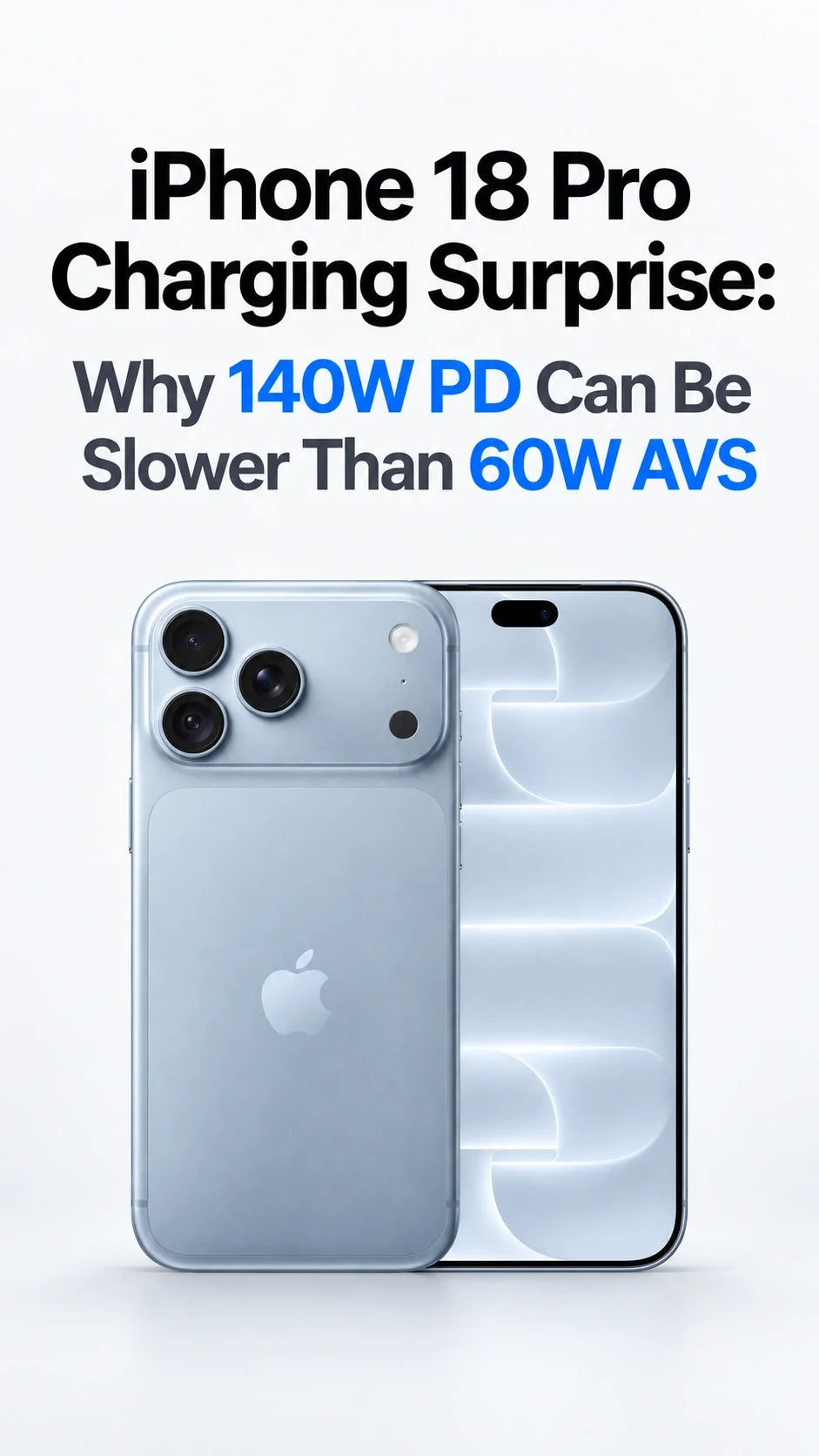
Yes—a 140W USB-C charger can charge the iPhone 18 Pro series more slowly during the first 50% to 80% than a 60W-capable AVS adapter.
In one controlled iPhone 18 Pro Max test, Apple's dynamic AVS adapter reached 50% in 15 minutes and 80% in 29 minutes. Apple's 140W adapter needed 17 and 32 minutes.
The reason is protocol support: the AVS adapter negotiated about 18V and more than 50W, while the 140W charger fell back to a fixed 15V PD profile at roughly 43–44W.
But the 140W unit was not slower from 0% to 100%—it finished two minutes earlier in that same test. AVS mainly improved short top-ups.
Why a 140W Charger Lost to a 60W AVS Adapter
The number printed on a USB-C power adapter is its maximum output capacity. It is not the amount of power an iPhone will automatically accept.
Apple says the iPhone 18 Pro and iPhone 18 Pro Max can reach up to 50% in around 15 minutes when used with a 60W-capable or higher adapter that supports Adjustable Voltage Supply, or AVS. For a comparable third-party adapter, Apple specifically calls for USB PD 3.2 and AVS.
iPhone 18 Pro Max · 25°C controlled test · third-party measurements
Dynamic 60W-capable AVS
52.9W
Peak in the full charging run
Apple 140W Fixed PD
~44W
Early power in the full charging run
ChargerLAB's compatibility snapshot recorded 51.23W from Apple's 40W Dynamic Power Adapter with 60W Max, versus 42.97W from Apple's 140W USB-C adapter. During the complete charging run, the AVS adapter held about 52.9W for the first nine minutes, while the 140W adapter stayed near 44W for roughly 14 minutes.
Was the 140W Charger Actually Slower?
It depends on which part of the charging session matters to you.
For a quick airport, office or coffee-shop top-up, the 60W-capable AVS adapter was faster. It reached 50% two minutes earlier and 80% three minutes earlier in the controlled test.
For a complete 0% to 100% charge, the result reversed: the 140W adapter finished in 70 minutes, compared with 72 minutes for the AVS adapter. That small difference occurred during the later tapering and trickle-charge stages, where peak wattage matters much less.
This is why the accurate conclusion is not “60W always beats 140W.” The accurate conclusion is that 60W-capable SPR AVS delivered faster front-loaded charging than a specific 140W charger that fell back to fixed PD.
Other published testing points in the same direction. iFanr measured about 54W for the iPhone 18 Pro Max during its first ten minutes and about 48W briefly on the smaller iPhone 18 Pro, followed by roughly 40W through the early part of the session. It also found that chargers without SPR AVS fell back to a fixed 15V profile.
What SPR AVS Changes on iPhone 18 Pro
Traditional USB PD charging commonly relies on fixed voltage levels such as 5V, 9V, 15V and 20V. The phone and charger choose a profile they both support.
AVS stands for Adjustable Voltage Supply. With the relevant Standard Power Range implementation, the phone can request an intermediate voltage instead of settling for the closest fixed step. In published iPhone 18 Pro series tests, the key charging point was around 18V at up to 3A.
USB-IF explains that USB Power Delivery lets a device request only the power it needs and supports adjustable voltage modes. For buyers, the important lesson is simple: protocol compatibility can matter more than the largest wattage printed on the box.
This also explains why “supports AVS” can still be too vague. Some older high-power chargers were designed around EPR AVS for higher-voltage laptop use. That does not automatically confirm the SPR AVS behavior used by the iPhone 18 Pro series.
Does Every 140W Charger Fail to Reach Full Speed?
No. The problem is not 140W itself.
In ChargerLAB's compatibility test, a Ugreen 160W adapter negotiated SPR AVS and reached 52.04W. A Lenovo 150W model also triggered SPR AVS and reached 51.25W. Several 60W to 100W models produced similar results.
So a high-power charger can be an excellent choice if the specific port supports the correct AVS mode. Conversely, a 60W, 100W or 140W label by itself proves nothing about the iPhone's fastest charging path.
Check the exact port, not only the product name
Multi-port chargers often change their power allocation and supported profiles when more devices are connected. A port that supports the required mode when used alone may behave differently while a MacBook, iPad or power bank is also charging.
Look for a manufacturer statement that identifies USB PD 3.2 SPR AVS on the port you plan to use. A model-specific iPhone 18 Pro or iPhone 18 Pro Max compatibility test is even more useful.
Should You Replace Your Existing 45W, 65W or 140W Charger?
Keep your current charger
If you normally charge overnight or have plenty of time, a reliable USB-C PD charger remains useful. The tested 140W adapter still reached 50% in 17 minutes and finished in 70 minutes.
Upgrade for short top-ups
If you regularly have only 10 to 20 minutes to charge, a verified 60W-or-higher SPR AVS adapter is the more relevant upgrade.
Buy for several devices
Choose enough total wattage for your MacBook, iPad and iPhone, but verify that the intended USB-C port keeps SPR AVS available under the port combination you use.
If you want a broader wattage comparison, read ZEERA's iPhone 18 Pro charger guide covering 20W, 30W, 60W, AVS and Qi2.
Do you need a 240W USB-C cable?
No, not just for the iPhone. Apple says the cable supplied with the iPhone 18 Pro models can be used for the advertised fast-charge result. Its testing notes call for a 60W-capable USB-C cable.
A 240W cable can still make sense if the same cable will also serve a high-power laptop, but it does not make the iPhone charge faster by itself.
Does AVS Protect Battery Health Better?
There is not enough long-term evidence to say that AVS charging automatically preserves more battery capacity than fixed PD charging.
The protocol gives the phone and adapter more precise voltage options, but battery aging still depends heavily on temperature, charge rate, time spent at a high state of charge, usage during charging and Apple's battery-management behavior.
In ChargerLAB's 25°C test, the iPhone 18 Pro Max stayed below 40°C during the measured AVS charging stages. That is useful short-term thermal data, not proof of better battery health months or years later.
For practical battery-care steps, see ZEERA's guide on how to protect iPhone 18 Pro Max battery health.
Wired AVS and 25W Qi2.2 Are Different Choices
Apple lists up to 25W for both MagSafe and Qi2 wireless charging on the iPhone 18 Pro and iPhone 18 Pro Max. That is a separate charging path from the 50W-plus readings seen over USB-C with SPR AVS.
Choose wired AVS when the priority is the fastest short top-up. Choose a magnetic wireless charger when placement, a clean desk, bedside use or charging several Apple devices matters more.
If wireless speed and heat management are part of your decision, ZEERA's Qi2 vs Qi2.2 guide explains the 25W upgrade and compatibility questions.
ZEERA Verdict
The iPhone 18 Pro series makes one charging rule clear: more adapter wattage does not guarantee faster phone charging.
In the most useful part of the controlled comparison—0% to 50% and 0% to 80%—Apple's dynamic 60W-capable AVS adapter beat Apple's 140W fixed-PD result. It did so because it negotiated the approximately 18V charging mode the phone wanted, not because 60W is inherently better than 140W.
Do not throw away a good 45W, 65W or 140W charger if its current speed works for you. But when buying a new adapter specifically for fast iPhone 18 Pro charging, verify 60W-or-higher output, SPR AVS support on the correct port and real model compatibility.
FAQ
Why does my 140W MacBook charger not charge iPhone 18 Pro at full speed?
The charger may have enough total power but lack the SPR AVS profile the iPhone uses for its fastest wired charging. In that case, the phone can fall back to a fixed PD voltage such as 15V.
Is Apple's 140W charger slow for iPhone 18 Pro Max?
No. In the cited controlled test it reached 50% in 17 minutes and completed the charge in 70 minutes. It was only slower than the dynamic AVS adapter during the early 0% to 80% stage.
What charger gives iPhone 18 Pro the fastest wired charging?
Apple recommends its 40W Dynamic Power Adapter with 60W Max, or a comparable third-party adapter rated for at least 60W that supports USB PD 3.2 and AVS. Verify SPR AVS compatibility for the specific port.
Will any 65W PD 3.2 charger work?
Not automatically. Confirm that the exact port supports SPR AVS and that the charger exposes the required profile correctly. Multi-port power sharing can also change behavior.
Does the iPhone 18 Pro actually charge at 60W?
“60W-capable” is an adapter requirement, not a promise that the phone draws 60W continuously. Published tests measured roughly 46–52W for the smaller Pro and about 52–54W for the Pro Max under suitable conditions.
Is AVS faster from 0% to 100%?
Not necessarily. In the cited Pro Max test, AVS was faster to 50% and 80%, but the 140W fixed-PD adapter completed the full charge two minutes sooner. Results vary with temperature, battery state, adapter and testing method.
Sources and methodology: Apple iPhone 18 Pro technical specifications and fast-charge support page; USB-IF's Power Delivery overview; ChargerLAB/Charging Head Network's iPhone 18 Pro Max compatibility and full-charge measurements; and iFanr's published iPhone 18 Pro series charging curves.
This is ZEERA's independent analysis of official information and third-party tests. The power and time figures cited here are not presented as ZEERA laboratory measurements. Results can vary with regional model, battery temperature, starting charge, cable, software, port allocation and ambient conditions.