Quick Answer
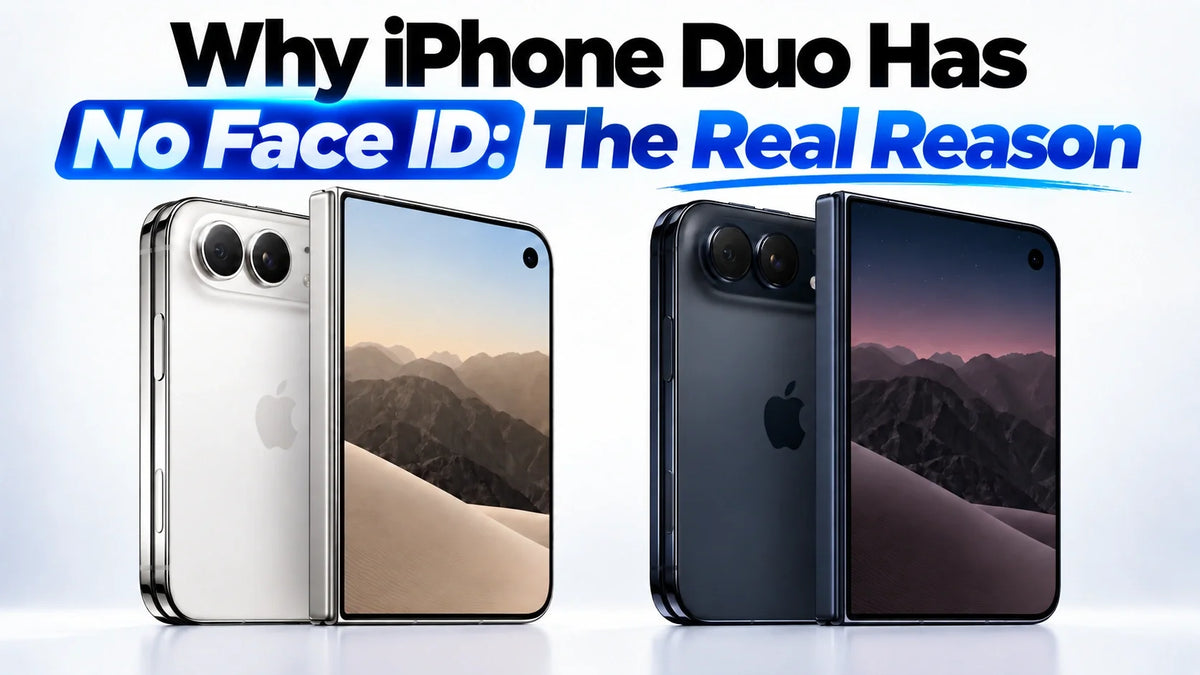
Why does iPhone Duo have no Face ID? The most convincing reason is not that Apple could not fit it. It is that a book-style foldable has two front-facing screens, while Face ID normally belongs to one clearly defined front.
According to information ZEERA received from supply-chain contacts, adding Face ID was technically possible. The harder question was where to put it: on the outer display, the inner display, or both.
Any one-screen solution makes facial unlocking inconsistent in the other state, while two TrueDepth systems add cost, components and display compromises. Side-button Touch ID gives iPhone Duo one predictable authentication point whether it is open or closed.
Face ID could still arrive on a future iPhone Duo if Apple first perfects a more compact, fully under-display 3D sensing system.
The iPhone Duo is Apple’s first iPhone with two displays and its first flagship in years to use a fingerprint sensor instead of Face ID. That immediately created a popular question: why would a $1,999 foldable iPhone lose Face ID?
Apple officially says the iPhone Duo uses a fingerprint sensor built into its side button. The company describes this as an easy, secure and consistent way to authenticate whether the device is closed or open. Apple has not publicly explained every engineering discussion behind the absence of Face ID.
Confirmed vs. ZEERA Insight
Confirmed by Apple: iPhone Duo uses side-button Touch ID, has a 5.4-inch outer display, a 7.6-inch inner display and a FaceTime camera hidden beneath the inner screen.
ZEERA supply-chain insight: Face ID was technically achievable, but its placement created a poor design decision across two operating states. Apple has not independently confirmed this internal reasoning, so it should be understood as supply-chain context rather than an official Apple statement.
Why Doesn’t iPhone Duo Have Face ID?
The short answer is interaction design. On a normal iPhone, the screen you look at is always the screen containing the TrueDepth camera system. The phone has one front, one primary viewing direction and one obvious place for Face ID.
iPhone Duo changes that relationship. Closed, the outer display is the front of the phone. Open it, and the larger inner display becomes the front while the outer screen faces away from you.
That creates a biometric problem that does not exist on the iPhone 18 Pro or iPhone 18 Pro Max: which screen should own Face ID?
The Three Face ID Layouts Apple Could Have Chosen
From an industrial-design perspective, Apple had three obvious options. None delivers the same simple behavior as Face ID on a conventional iPhone.
Face ID on both screens
This would preserve facial unlocking when iPhone Duo is folded or unfolded. It would also require two usable 3D sensing locations, raising component cost, internal-space pressure, calibration complexity and repair exposure.
Face ID outside only
This works naturally when the phone is closed. If iPhone Duo is open, active on the inner screen and then locks, the Face ID hardware would be facing away from the user. Opening a passcode keypad would feel slow and unintuitive.
Face ID inside only
This protects the large-screen experience, but everyday cover-screen use loses facial unlocking. Users would have to unfold a $1,999 phone simply to reach its Face ID sensor, which defeats the purpose of having a capable outer display.
Using two Face ID systems is the cleanest answer for behavior, but the worst answer for packaging. Using only one system is cleaner for hardware, but creates an authentication rule users have to remember.
Apple normally tries to make authentication disappear into the action a user is already taking. A mode-dependent rule—“Face ID works closed, but not open”—would do the opposite.
Why Side-Button Touch ID Fits the iPhone Duo Design
Touch ID solves the two-screen problem by moving authentication away from either display. The side button remains reachable whether iPhone Duo is folded like a normal phone or opened into its larger tablet-like form.
For many right-handed users, the thumb naturally approaches the side button during the same motion used to wake or grip the device. Other users can register the finger that best matches their normal hold.
The result is one physical target and one learned behavior:
Use the outer screen
Touch the side button and unlock without opening the phone.
Use the inner screen
The same sensor stays available without changing authentication methods.
One consistent confirmation
The same side-button fingerprint check can authorize purchases, passwords and protected apps in either posture.
This is why the iPhone Duo fingerprint sensor should not be dismissed as Apple using “old technology.” In this form factor, Touch ID is arguably the more coherent interface.
The Under-Display Camera Is Another Clue
Apple placed the iPhone Duo’s inner FaceTime camera beneath the foldable display to keep the 7.6-inch canvas visually uninterrupted. Adding a visible Face ID cutout to that same screen would weaken the reason for hiding the camera in the first place.
However, an under-display selfie camera is not the same as under-display Face ID.
A normal front camera captures a two-dimensional image. Face ID depends on a tightly integrated TrueDepth system that must project and read infrared information accurately enough for secure three-dimensional facial authentication. Putting that complete system behind an OLED panel introduces more demanding requirements for light transmission, sensor accuracy, calibration and display uniformity.
Was Face ID Removed Just to Reduce Cost?
Cost probably mattered, especially if the alternative was installing Face ID hardware for both screens. But calling this only a cost-cutting move misses the larger design problem.
Even if component cost were irrelevant, one Face ID system would still work in only one viewing direction. Two systems would still compete for valuable internal space in a device built around a thin folding structure, two batteries, a hinge, multiple displays and thermal hardware.
ZEERA’s supply-chain information indicates that Apple could have engineered Face ID into iPhone Duo. The company appears to have decided that the resulting product would be less elegant: either physically more complex or behaviorally less predictable.
That does not make the omission meaningless. Buyers moving from an iPhone 18 Pro Max may still prefer the convenience of glancing at the screen to unlock it. The design rationale explains the compromise; it does not erase the compromise.
Is Touch ID Better Than Face ID on a Foldable iPhone?
For the first-generation iPhone Duo, Touch ID is more consistent. Whether it is better depends on the situation.
It works in both postures
You do not need to think about which screen contains the biometric sensor.
Hands-free authentication
On a conventional iPhone, looking at the display can unlock the phone without deliberately touching a sensor.
Conditions still matter
Wet fingers or gloves can make Touch ID less convenient, while viewing angle, face coverage and sensor orientation can affect Face ID use.
So the fairest conclusion is not that Touch ID is universally superior. It is that Touch ID maps more cleanly to the iPhone Duo’s changing physical state.
Could Face ID Come to a Future iPhone Duo?
Yes. The first iPhone Duo does not prove that Apple has abandoned Face ID for foldables forever.
The most important development may come from Apple’s conventional iPhone line. If the rumored 2027 iPhone 20 generation achieves a fully hidden 3D structured-light Face ID system, Apple could gain smaller, less visually intrusive authentication hardware for later Duo models.
That would not automatically solve every dual-screen question. Apple would still need to decide whether to place the hidden system under both displays, combine it with Touch ID, or create software that makes one sensor feel natural in every posture.
But mature under-display Face ID would change the trade-off. It could make two sensing locations easier to package without adding visible cutouts to the outer or inner screen.
A later iPhone Duo could therefore add Face ID as part of a broader second- or third-generation upgrade, potentially alongside a triple-camera system, improved hinge engineering and more internal space efficiency. None of those future changes is confirmed.
For more context on Apple’s possible all-screen direction, read our guide to waiting for the 2027 iPhone 20 Pro Max.
Does the Missing Face ID Make iPhone Duo a Downgrade?
Compared with the iPhone 18 Pro and iPhone 18 Pro Max, it is a feature loss. Users who love Face ID should treat that as a genuine buying consideration.
But iPhone Duo is not designed as a direct specification upgrade from a Pro Max. It is a different device category built around a 5.4-inch outer screen, a 7.6-inch foldable inner screen and new open-versus-closed behaviors.
That is why the biometric decision makes more sense when viewed through industrial design rather than a checklist. Apple traded one familiar convenience for an authentication method that remains in the same place across both halves of the experience.
If you are choosing between Apple’s two flagship formats, see our full iPhone Duo vs iPhone 18 Pro Max comparison.
ZEERA Verdict
iPhone Duo has no Face ID because Touch ID is the cleaner answer to a two-screen identity problem. Face ID was not simply impossible. Installing it outside, inside or on both sides created compromises in usability, packaging, cost or display design.
The side button gives Apple one authentication point that works the same way when iPhone Duo is folded and unfolded. That is a deliberate design choice—but buyers who prefer hands-free unlocking are still justified in calling Face ID a missing feature.
iPhone Duo Face ID FAQ
Does iPhone Duo have Face ID?
No. Apple’s first iPhone Duo uses Touch ID integrated into the side button instead of Face ID.
Why did Apple use Touch ID on iPhone Duo?
Touch ID remains accessible whether iPhone Duo is open or closed. A Face ID sensor placed on only one screen would not face the user in the other posture.
Was Apple unable to put Face ID in iPhone Duo?
According to supply-chain information received by ZEERA, Face ID was technically possible. The main issue was choosing a placement that remained intuitive across both screens without duplicating hardware. Apple has not officially confirmed that internal reasoning.
Can Touch ID unlock iPhone Duo when it is unfolded?
Yes. Apple says the side-button fingerprint sensor provides consistent authentication when iPhone Duo is closed or open.
Does iPhone Duo have an under-display camera?
Yes. Its inner FaceTime camera is hidden beneath the display when not in use. That camera is not a complete under-display Face ID system.
Could the next iPhone Duo get Face ID?
It is possible, especially if Apple develops a smaller and fully under-display 3D sensing system for a future all-screen iPhone. Apple has not announced Face ID for a later Duo.
Does Touch ID work for Apple Pay and app authentication on iPhone Duo?
Yes. Touch ID is the device’s biometric authentication method for unlocking, confirming purchases and accessing supported apps and passwords.
Is iPhone Duo Touch ID less secure than Face ID?
They are different biometric systems. Touch ID still uses protected biometric enrollment and on-device authentication; buyers should focus mainly on the difference in daily interaction rather than assuming fingerprint authentication is merely a passcode shortcut.