Quick Answer
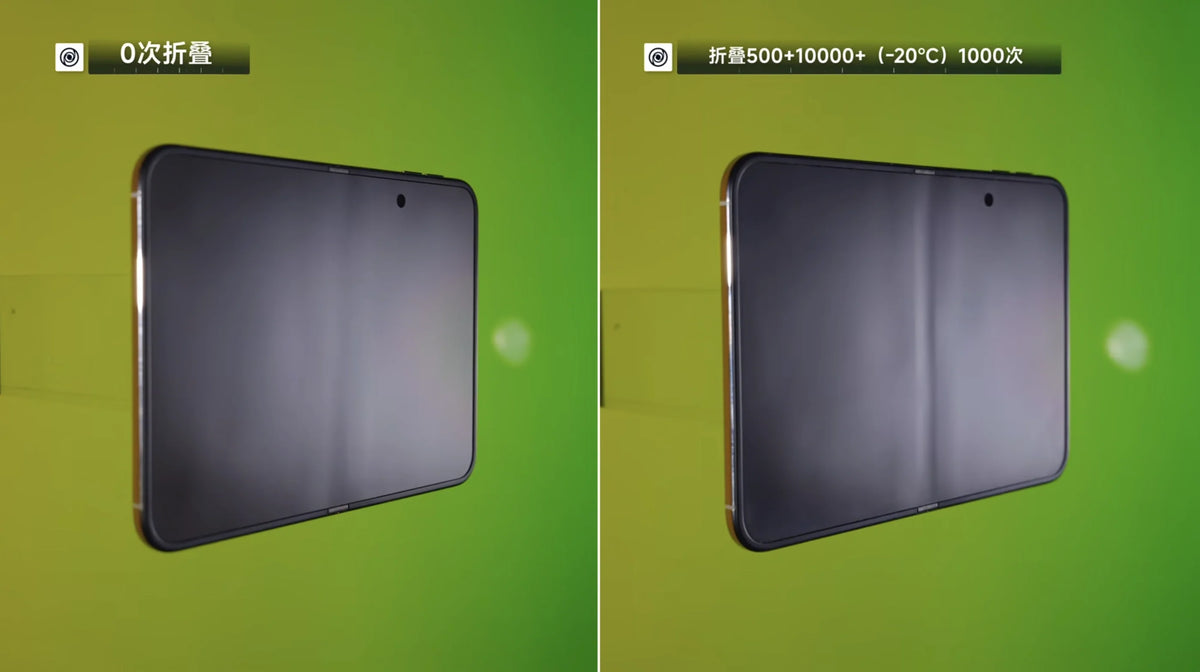
Mediastorm reported a visibly deeper iPhone Duo screen crease after 500 folds compared with its freshly unboxed baseline.
At that stage, the reviewer said the difference during screen-on use and touch felt much smaller than the visual comparison suggested.
The extended test involved 10,000 continuous folds at room temperature, plus 1,000 folds at −20°C (−4°F).
After that sequence, the crease was deeper, but the hinge reportedly remained smooth and retained its opening assistance, with no noticeable change from initial use.
These are observations from the tested device, without numerical crease-depth or hinge-torque measurements.
What Did Mediastorm Actually Test?
In its iPhone Duo in-depth review, Mediastorm / 影视飓风 first compared the inner display before and after 500 folds. It later reported the results of a custom folding rig running 10,000 room-temperature folds and another 1,000 folds at −20°C.
The screen and hinge produced different results: the crease became more pronounced, while the reviewer found the final hinge action essentially unchanged.

iPhone Duo After 500 vs 10,000 Folds: Results at a Glance
The headline comparison needs one qualification: the later assessment comes after the additional cold-temperature stage. It should not be described as a result measured exclusively at 10,000 room-temperature folds.
| Stage | Screen crease | Hinge feel |
|---|---|---|
| Unboxed baseline | Reference for the initial before-and-after comparison. | Initial feel used as the later reference. |
| After 500 folds | Visibly deeper under controlled comparison; smaller perceived difference with the screen on and during touch. | No separate 500-fold hinge assessment stated in the supplied subtitles. |
| After 10,000 room-temperature + 1,000 cold folds | Reported as deeper; no measured increase relative to the 500-fold stage provided. | Still smooth; opening assistance remained; reviewer noticed no difference from first use. |

What the comparison does not quantify
There is no numerical depth, width or percentage increase for the crease, and no torque curve for the hinge. The account does not establish that crease growth is linear, that it stops after a break-in period, or how much additional change occurred between 500 folds and the final assessment.
Video credit: Mediastorm / 影视飓风. Watch the original review on YouTube.
How Much Did the Screen Crease Change After 500 Folds?
Mediastorm's first result addresses a specific concern: can the crease change soon after unboxing? In its comparison, yes—the fold line looked deeper after 500 folds. The reviewer described the comparison as controlling the relevant variables, although the supplied subtitles do not spell out the full imaging setup.
Visible change in the comparison
The before-and-after footage was presented as showing a clear difference. That supports the observation that the folding area can become more visible with use. It does not supply a depth measurement or a threshold for display failure.
A smaller difference during ordinary interaction
The reviewer separately said the difference felt less substantial when the screen was lit and being touched. A revealing comparison shot and the experience of reading or swiping therefore need separate descriptions. This everyday-use comment belongs to the 500-fold stage; it should not automatically be extended to the final test.
For background on the initial appearance of the folding strip, see why the iPhone Duo crease is still present even when it is difficult to see. The question here is how that appearance changes after repeated folding.
Did the Hinge Become Loose or Rough After 10,000 Folds?
Mediastorm did not report a noticeable deterioration in the hinge's mechanical feel after the full room-temperature and cold-folding sequence. Its description highlights two specific qualities.
Smooth movement remained
The reviewer described the hinge as remaining very smooth, with no noticeable difference from the first use. That is a positive hands-on assessment of movement, rather than a measured statement that every mechanical property remained identical.
Opening assistance remained
The mechanism still provided assistance as the device opened. The report does not quantify the assisting force, resistance at each angle, lateral play or the ability to hold every intermediate position.
For buyers asking whether the iPhone Duo hinge feels worn out after repeated folding, this result is encouraging. It supports retained smoothness and opening assistance on the tested device. It does not establish identical results across all units or a guaranteed service life.
It also helps explain why a deeper crease and a smooth hinge can coexist in the same review: crease appearance describes the display surface, while hinge feel describes the opening mechanism. One observation cannot substitute for the other.
What Does This Folding Test Mean for Everyday Ownership?
Expect the display's appearance to evolve
If your buying decision depends on the inner screen looking exactly as it did when unboxed, the 500-fold comparison is relevant. The review documents an early visible change even though the reviewer found a smaller difference in ordinary interaction at that point.
Read the cold test as a separate stress condition
The −20°C stage adds context to the final hinge observation. It is a reviewer's stress test, not a manufacturer-approved temperature rating or a reason to reproduce the experiment. The supplied account does not isolate how much of the final crease change came from room-temperature folding versus the cold stage.
A fold count does not equal years of use
Continuous rig testing does not reproduce a complete ownership history. Pocket debris, time spent closed, impacts and changing conditions are separate variables. The result cannot tell us when a typical Duo will fail, or establish a failure rate across the model.
ZEERA's assessment: the strongest practical finding is that a visibly changing crease did not coincide with a noticeable loss of hinge smoothness in this test. Buyers who want a display with no folding line may still prefer a conventional iPhone. The following case collection is for iPhone 18 models.
Can an iPhone Duo Case Prevent the Crease from Getting Deeper?
The Mediastorm results do not establish that a case prevents crease development or changes the hinge's internal wear. Choose a case for its stated exterior coverage, grip and accessory features; the folding test offers no evidence for a crease-prevention promise.
When comparing options, distinguish hinge coverage from a slim rear shell, and check which screen a supplied protector covers. Our iPhone Duo case comparison explains the available protection and stand configurations.
The separate report about softness and pressure-induced wrinkles around the crease concerns a different test. Pressing the folding strip is not a substitute for assessing how it looks and works during normal use.
What Evidence Would Make the Next Folding Test More Useful?
The most helpful follow-up would measure the display and hinge separately at the same checkpoints, using more than one device. That would make it easier to distinguish a visible change, a change in mechanical feel and a functional fault.
Three measurements to look for
- Crease profiles: depth and width measured at baseline, 500 folds, 10,000 folds and after the cold stage.
- Hinge resistance: opening and closing torque recorded at the same angles and temperatures.
- Display function: consistent image and touch checks across the folding strip at each checkpoint.
Until those data are available, Mediastorm's review provides a useful observation: the crease became deeper, while the reviewer continued to find the hinge smooth. The size and pace of any further change remain open questions.
Frequently Asked Questions
Does the test show that 10,000 folds is the iPhone Duo's maximum?
No. It is a reported test stage, not a maximum lifetime rating or a failure threshold. The final hinge assessment followed 10,000 room-temperature folds plus another 1,000 cold folds.
Did Mediastorm say the hinge improved as it broke in?
No. The reviewer described the final hinge feel as essentially unchanged from first use. The supplied subtitles do not establish a break-in period that makes the hinge smoother.
Does a deeper crease mean the screen has failed?
A crease becoming more visible does not by itself establish a display failure. This comparison does not provide a crease-depth threshold for failure, and the hinge's smoothness is not a complete test of image or touch performance.
Can this test explain which screen layer caused the deeper crease?
No. The supplied folding-test account does not isolate the contribution of the cover layer, glass, adhesive or supporting structure. Assigning the change to one layer would go beyond the evidence presented here.
Related Articles
- The iPhone Duo Crease Is Still There: Why It Can Be Harder to See
- iPhone Duo Crease Compared with Galaxy Z Fold 8 and Xiaomi 18 Fold
- iPhone Duo Screen Feels Soft at the Crease: Kang's Wrinkle Test
- iPhone Duo Reverse Bending Test: Hinge and OLED Observations
- iPhone Duo Folio Teardown: Kang's Hidden Sliding Mechanism Report
- Best iPhone Duo Cases: MagSafe, Wallet and Hinge Protection
Source and editorial note: Mediastorm / 影视飓风, “折1万次,会坏吗?iPhone Duo深度评测,” via the Chinese subtitle transcript supplied for this article. Original video. Hinge-feel descriptions are the reviewer's subjective observations. ZEERA has not independently repeated the test. Product recommendations are ZEERA promotional modules and are separate from Mediastorm's findings.