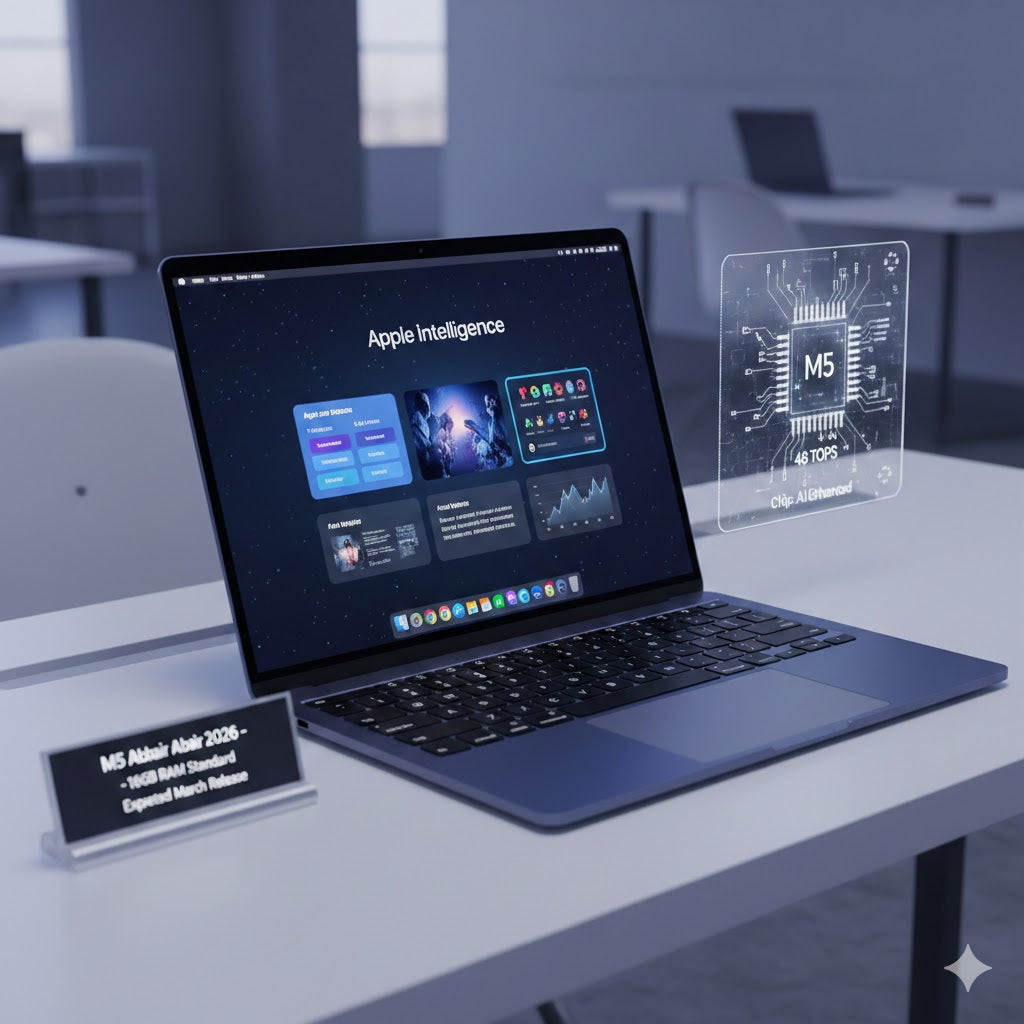
As we approach Apple’s officially announced March 4 special event, the biggest hardware story may not be core counts or clock speeds — it’s the silicon substructure underneath.
Apple is widely expected to introduce new MacBook Pro models powered by M5 Pro and M5 Max chips, and based on reports from The Mac Observer and Wccftech, the real breakthrough could be a packaging overhaul built on TSMC’s advanced SoIC-MH technology.
Packaging is the new Moore’s Law. Even if Apple remains on an advanced 3nm-class node, a shift in packaging alone can unlock 15–20% better sustained performance through improved thermals, density, and interconnect efficiency.

Apple M5 Pro / M5 Max Chip Packaging: The SoIC-MH Leap
From InFO to SoIC-MH: A Structural Redesign
Previous Apple Silicon generations (M1 through M4) primarily relied on TSMC’s InFO (Integrated Fan-Out) packaging with a largely monolithic die structure.
For M5 Pro and M5 Max, reports indicate Apple may adopt SoIC-MH (System on Integrated Chips – Molding Horizontal) — a 2.5D chiplet-based architecture that fundamentally changes how silicon blocks are assembled.

Instead of one massive piece of silicon, Apple could move toward a modular layout:
-
Separate CPU, GPU, and Neural Engine chiplets
-
Horizontally arranged on an interposer
-
Ultra-short, high-density interconnects
-
Optimized heat distribution zones
This is not just a performance tweak — it’s an architectural philosophy shift.
SoIC-MH vs InFO Packaging: What’s the Difference?
Here’s where it gets interesting.
SoIC-MH leverages solder-free hybrid bonding technology. Unlike traditional bump-based packaging that uses micro-solder balls between dies, hybrid bonding enables:
-
Direct copper-to-copper connections
-
Much tighter bump pitch (interconnect spacing)
-
Higher interconnect density
-
Lower electrical resistance
-
Reduced signal latency
Compared to InFO packaging, this dramatically increases inter-die communication bandwidth while lowering power leakage.
For high-performance laptop silicon, that translates to:
-
Faster data movement between CPU and GPU
-
More efficient AI acceleration
-
Higher sustained clock speeds under load
This is the type of backend engineering detail that matters to AnandTech-level readers.
2026 Best MagSafe Case for iPhone 17 Pro Max


Why Packaging Matters for M5 Pro and M5 Max
While chip architecture (core counts, GPU performance, AI acceleration) usually gets the spotlight, packaging technology plays a crucial role in real-world performance.
Here’s why the shift to SoIC-MH is important:
1. Improved Thermal Management
One of the biggest challenges in high-performance laptop chips is heat concentration.
With 2.5D packaging, chiplets can be physically distributed to reduce thermal hotspots. Reports suggest that this could:
-
Lower thermal interference between CPU and GPU blocks
-
Allow sustained higher performance under load
-
Improve overall efficiency in MacBook Pro chassis designs
For professional users running AI workloads, video rendering, or 3D simulations, this could translate into more stable peak performance.

2. Greater Scalability Between Pro and Max Variants
Industry analysis cited by Wccftech suggests that the M5 Pro and M5 Max may share a unified base design, with differentiation achieved through chiplet activation or binning strategies.
In practical terms:
-
Apple could enable additional GPU or CPU chiplets in the Max version
-
Pro and Max might share similar silicon foundations
-
Manufacturing yield optimization becomes more flexible
This modularity could simplify Apple’s product segmentation strategy while improving production efficiency.
2025 Best MagSafe Chargers for iPhone 17 Pro Max
3. Lower Electrical Resistance and Higher Bandwidth
Compared to InFO packaging, SoIC-MH offers:
-
Shorter inter-die communication paths
-
Lower signal latency
-
Reduced power leakage
-
Potentially higher memory bandwidth scalability
For AI-driven workflows — especially those leveraging Apple’s Neural Engine and large unified memory pools — this could be a foundational upgrade rather than a minor refinement.

How M5 Pro / Max Compare to Previous Apple Silicon
| Feature | M1–M4 Series | M5 Pro / M5 Max (Expected) |
|---|---|---|
| Packaging | InFO (Monolithic SoC) | 2.5D SoIC-MH (Chiplet-based) |
| Architecture Style | Single large die | Multi-chiplet modular design |
| Thermal Distribution | Centralized | Distributed chiplets |
| Product Segmentation | Separate die designs | Possibly shared chiplet base |
| Scalability | Limited by die size | Higher modular flexibility |
If these reports prove accurate, the M5 generation could represent the biggest backend engineering change in Apple Silicon history — even if outward performance gains appear incremental at launch.
FAQ: M5 Pro / M5 Max Packaging Explained
Q1: Will M5 Pro be faster than M4 Max?
Potentially, yes — especially in sustained workloads. While peak single-core performance may be similar, improved thermal distribution and interconnect density could allow M5 Pro to match or exceed M4 Max in long-duration performance tasks.
Q2: What is SoIC-MH?
SoIC-MH is TSMC’s advanced 2.5D packaging technology that uses solder-free hybrid bonding to combine multiple chiplets horizontally within a single package. It enables tighter interconnect spacing, lower resistance, and better thermal efficiency.
Q3: Does this mean the new MacBook Pro will be thinner?
Probably not. The chassis thickness may remain similar. However, within the same thermal envelope, users could see improved sustained performance and reduced throttling — which matters far more for professionals.