Quick Answer
Kang’s iPhone Duo Folio teardown report describes a hidden sliding mechanism inside the outer-screen cover.
It lets the fabric connection accommodate the changing distance between the covers as the phone folds.
Thin composite panels, magnets and a separate kickstand hinge reportedly share the remaining space.
The engineering helps explain the Folio’s appeal, but its exposed sides and corners limit impact coverage.
Kang also raises an outer-screen tempered-glass fit concern; the report does not establish universal incompatibility.
What did Kang’s iPhone Duo Folio teardown report reveal?
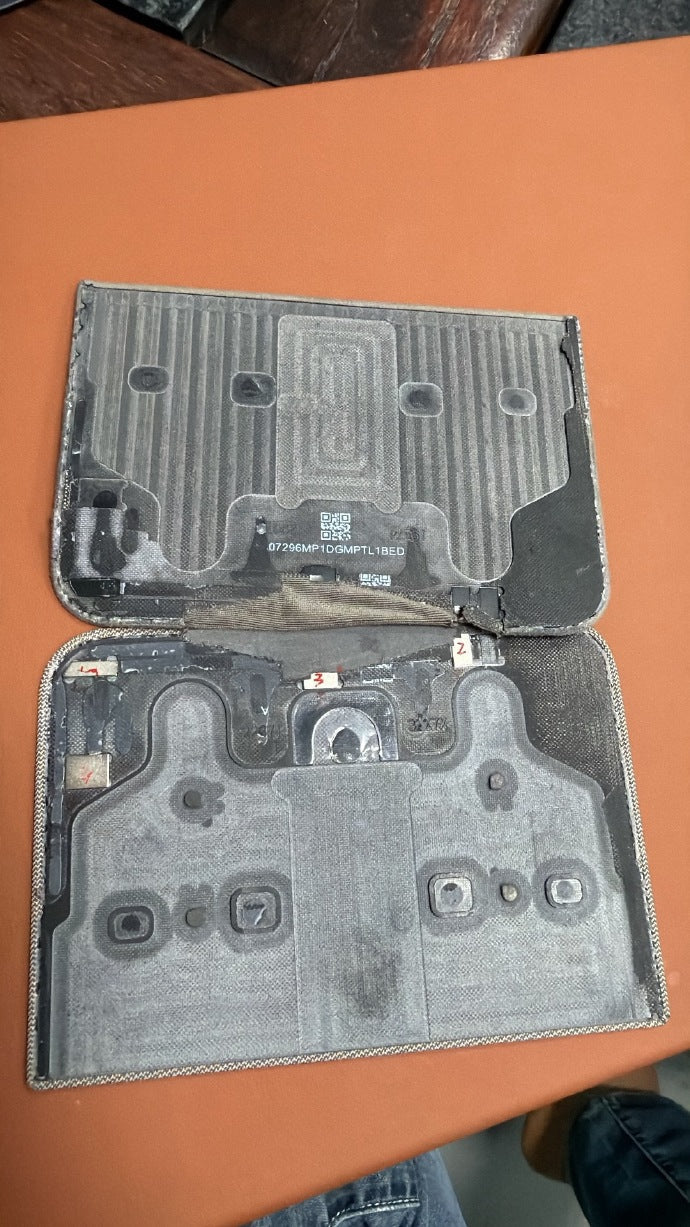
In the account supplied for this article, Weibo accessory commentator Kang describes a friend’s teardown and explains what he learned from its photos and video. The standout detail is an extension mechanism concealed in the front cover, paired with a rear section that houses magnets and the kickstand pivot.
Kang calls the accessory a “work of art” for fitting so much mechanism into a thin cover. This article analyzes his account; ZEERA has not independently dismantled this Folio or inspected the original teardown media. Apple’s public listing confirms the TechWoven exterior, stand and magnetic charging features, but does not document the slider or identify its reinforcement fibers.
Apple iPhone Duo Folio: the details that matter here
Official product: iPhone Duo Folio with Kickstand.
Price: $129 in the U.S.; RMB 999 in Apple’s mainland China shopping listing. These are separate regional prices, not a currency conversion.
Published exterior and functions: TechWoven technical fabric, an integrated adjustable stand and built-in magnets.
Reported internal construction: three main sections, thin composite structures and a guided sliding connection.
Still unverified: exact internal fiber composition, measured panel thicknesses, magnetic holding force and long-term cycling performance.
Three sections divide the Folio’s mechanical jobs
Kang separates the accessory into an outer-screen cover, a rear cover and a rear kickstand. Understanding those roles makes the hidden mechanism easier to follow.
| Section | Role described in Kang’s report |
|---|---|
| Outer-screen cover | Covers the outer display and houses the mechanism that accommodates changes in connection length. |
| Rear cover | Provides coverage around the camera opening, encloses the magnetic structure and supports the kickstand pivot. |
| Rear kickstand | Rotates on its own hinge below the camera opening to provide viewing support. |
The kickstand pivot is separate from the phone’s folding hinge. Kang notes a small horizontal ridge where that pivot needs room for its axis and rotational clearance. He considers the ridge visually well integrated rather than completely eliminated.
Why hide the sliding mechanism inside the front cover?
The outer surfaces travel around the phone’s hinge when it closes. A connection between the two covers therefore needs to accommodate a different path length when folded and unfolded. A fixed-length bridge could pull on the panels or bunch up unless some part of the design allows that movement.
The reported solution: a flexible fabric bridge works with a sliding structure concealed on the outer-screen side.
The packaging benefit: that keeps the extension mechanism away from the rear section’s magnets, camera opening and stand pivot.
The practical goal: distribute the hardware across both sides while keeping the opened covers as even and thin as possible.
This is more specific than saying the fabric simply stretches. Kang’s description points to controlled sliding that changes the available connecting length; it does not establish that elastic deformation of the fabric alone produces the movement.
Panel thickness also matters. A bridge can look flush across the middle while the two adjoining covers still sit at different heights. Kang praises Apple for apparently considering both the moving connection and the thickness of the panels on either side. No flatness measurements accompany the supplied account.
How do the guides keep a wide, thin slider moving straight?
A wide sliding part can skew if one edge moves ahead of the other. In a thin enclosure, that could increase friction, rub against nearby layers or make the cover feel uneven.
According to Kang’s reading of the teardown images, the Folio combines a main central guide with additional symmetrical guidance and travel-limiting features toward the sides. He describes the movement in the video as orderly.
Guidance: keeps the moving part on its intended path.
Balanced support: helps resist sideways skew as the wide cover moves.
Travel limits: constrain how far the mechanism can extend or retract.
Those are the likely engineering purposes of the reported features. Smooth movement in a teardown video does not establish how the mechanism will behave after months of pocket debris, uneven handling or repeated opening and closing.
Does the Folio use aramid fiber or carbon fiber inside?
The supplied report does not confirm either material. Kang describes thin, multilayer composite construction and draws a comparison with his experience developing aramid-fiber accessory shells and laminated finishes. He explicitly leaves the Folio’s exact fiber material unresolved.
That comparison explains his interest: reinforcement and layered construction can help a designer manage stiffness and local loading within a small thickness allowance. The actual result depends on the materials, layer arrangement, bonding and component geometry.
It would be inaccurate to turn that reasoning into an “Apple uses Kevlar” claim. TechWoven identifies Apple’s exterior fabric; it does not identify every internal structural layer. Likewise, the report does not prove that a particular thin PC alternative would fail.
Could tempered glass affect the Folio’s fit and magnetic attachment?
Kang raises a potentially useful buying concern: adding tempered glass to the outer display may change how the front cover sits. He suggests that the opened covers could become uneven and that the front section’s effective magnetic hold could decrease.
What could change: an added glass-and-adhesive layer may introduce spacing or prevent the front panel from seating as intended.
What that could affect: cover alignment and the effective holding force at the attachment interface.
What has not been established: a tested protector thickness limit, a measured pull-off-force reduction or a finding that every glass protector causes detachment.
This is a fit-and-spacing concern, rather than evidence that ordinary glass permanently weakens the magnets. Its effect will depend on the installed geometry, protector thickness and how the cover contacts the phone.
The reported unevenness concerns the Folio panels; it should not be presented as proof that the phone’s hinge cannot fully open. Before choosing this combination, look for fit confirmation for the exact outer-screen protector and check for rocking, lifting or resistance without forcing the assembly.
For the broader seating problem, see our iPhone Duo case falling-off and loose-front-frame guide. A magnetically attached cover and a magnetic car mount also create separate retention interfaces; charger attachment alone does not validate the whole assembly for driving.
Does clever construction make it a protective drop case?
Kang’s praise is directed at the mechanical design. His account also stresses that the Folio leaves the sides and corners without the cushioning structure found in a conventional wraparound case.
Its appeal: surface coverage, everyday scratch separation and an integrated viewing stand in a restrained design.
Its limitation: exposed edges and corners have less intervening case material when they strike a surface.
The buying implication: frequent droppers should prioritize secure fit, grip and suitable edge coverage rather than treating the Folio’s price or engineering complexity as an impact rating.
No controlled drop-test results are supplied with this account. That means we cannot quantify the protection difference or promise that a thicker alternative will survive a particular fall.
The design also does not tell us whether Apple’s designer personally prefers using a bare phone. Exposed edges show a product trade-off; they do not establish the designer’s habits or prove that protection was never considered.
Can you still use MagSafe charging with the Folio?
Apple’s official Folio listing says the accessory can stay installed for compatible magnetic or Qi charging. It describes charger placement on the exterior or behind the opened stand.
The hidden slider does not establish a new charging capability. Charger certification, power supply, alignment, temperature and physical clearance still determine the usable setup. Check the exact charging arrangement separately from the front-cover fit issue.
Why the construction is impressive—and what the teardown cannot prove
Kang’s strongest point is the integration. Thin panels must hold the magnets, carry the stand pivot, accommodate sliding movement and support an exterior fabric layer without obvious bulges or mismatched thickness.
Each mechanism is recognizable on its own. Combining them while controlling friction, bonding, clearance and surface finish is the more demanding task. A similar-looking woven exterior would not by itself establish that another product reproduces the internal design or manufacturing precision.
Durability remains open: the supplied account provides no cycle count, wear measurements or controlled contamination testing.
Cost remains open: structural complexity is relevant to manufacturing, but no bill of materials or assembly-cost breakdown establishes how much of the retail price it explains.
Supplier secrecy remains speculation: Kang suggests different suppliers may make separate components before final assembly. The account does not identify or verify that production arrangement.
For readers interested in compact hardware design across their Apple setup, the following sponsored Mac mini accessory is a separate desktop product.
What should buyers take from this report?
The reported slider makes Apple’s Folio more interesting as an engineered accessory. Its value to you still depends on whether you want a slim magnetic folio and adjustable stand, and whether its exposed perimeter suits your routine.
If the woven finish and hands-free viewing are the functions you want at a lower price, our separate Apple iPhone Duo Folio alternative guide to ZEERA FoldTex Pro compares that option. It does not establish identical internal construction, fiber materials or durability.
If protecting the phone’s sides matters more, compare the exact coverage of each case. A fabric folio, a partial PC frame and a full-perimeter shell serve different priorities. For the official accessory comparison, use our Apple iPhone Duo Case vs Folio guide.
ZEERA’s assessment: Kang’s account offers a compelling explanation of the Folio’s concealed mechanics. The strongest buying concern is whether its coverage and installed fit match your needs. Long-term wear and protector-specific magnetic retention still need direct testing.
FAQ
Is this a teardown of the iPhone Duo itself?
No. The report concerns Apple’s iPhone Duo Folio with Kickstand accessory. Its sliding parts and kickstand pivot should not be confused with the phone’s internal hinge mechanism.
Does this report apply to Apple’s regular iPhone Duo Case?
No. The Folio is a separate accessory. Its reported hidden slider and fabric bridge should not be attributed to the regular Case without separate evidence.
Does the hidden mechanism retract the kickstand?
Kang describes it as accommodating the flexible connection between the front and rear covers. The kickstand uses its own rear pivot; the supplied report does not establish a mechanical linkage between the two.
Is there a confirmed screen-protector thickness that works?
No tested thickness threshold is provided. Look for confirmation for the exact protector-and-Folio combination. This discussion concerns outer-screen glass, not a recommendation to place rigid glass on the folding inner display.
Does the Folio make the phone dustproof?
The supplied report establishes no dust-sealing rating. Fabric coverage over a moving area should not be treated as a sealed barrier.
Does the teardown prove the Folio is worth $129?
It helps explain why someone might admire its design. Whether it earns its price depends on the stand, finish, fit and coverage you will actually use; internal complexity alone does not settle that decision.
Sponsored desktop accessory · For readers also organizing a Mac mini workstation.
Related Articles
- Best Apple iPhone Duo Folio Alternative: ZEERA FoldTex Pro for Less
- iPhone Duo Without a Case: AppleCare, Slim Cases and Everyday Trade-Offs
- Do All iPhone Duo Cases Need Adhesive?
- iPhone Duo Case with a Built-In Screen Protector: Can You Add Extra Glass?
- iPhone Duo Case Keeps Falling Off? Front Frame and Adhesive Problems
- Can a MagSafe Car Mount Hold iPhone Duo Unfolded?
- Does MagSafe Charging Work with an iPhone Duo Ring Stand Case?
Sources and reporting basis
- Kang’s Weibo account: the Chinese teardown commentary supplied for this article. The link identifies the account, not a verified permalink to the specific post. Kang attributes the dismantling to a friend.
- Apple U.S.: iPhone Duo Folio with Kickstand: official name, U.S. price, TechWoven exterior, stand and charging description.
- Apple mainland China: iPhone shopping listing: RMB 999 accessory listing.
Prepared October 21, 2026. Internal construction and fit observations are attributed to the supplied report. Engineering explanations are ZEERA’s interpretation of that account, not independent measurements. Product advertisements are ZEERA promotions and do not validate the teardown findings.