QUICK ANSWER
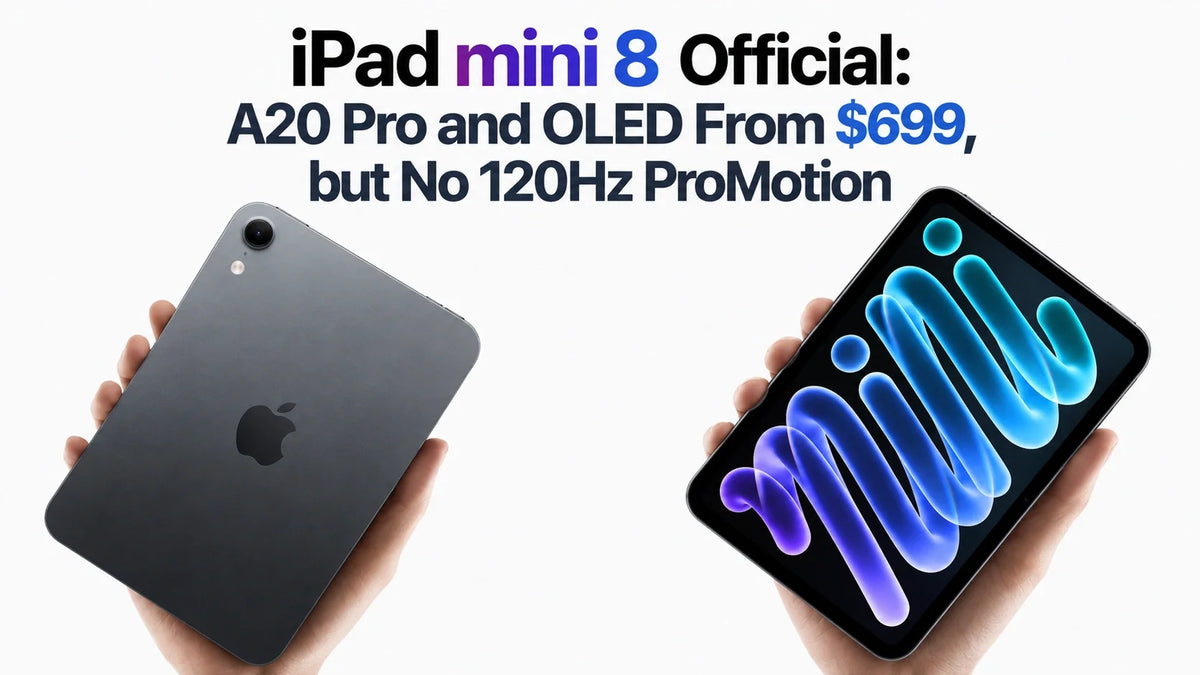
Apple has officially announced the new iPad mini with A20 Pro, commonly called iPad mini 8, starting at $699 in the US.
Its headline upgrades are an 8.5-inch OLED display, a thinner body and faster processing.
The biggest disappointment: no 120Hz ProMotion.
US pre-orders begin October 28, 2026, with availability from November 6.
iPad mini 8 specifications at a glance
US STARTING PRICE
$699 Wi-Fi / $849 Cellular
128GB, standard display glass.
DISPLAY
8.5-inch OLED
Super Retina XDR · P3 wide color · True Tone.
THE BIGGEST OMISSION
No 120Hz ProMotion
Apple’s comparison lists no ProMotion technology.
BRIGHTNESS
600 nits / 1,200 nits
600 nits full screen; up to 1,200 nits peak for HDR content. Minimum: 1 nit.
RESOLUTION & CONTRAST
2316 × 1512 · 326 ppi
2,000,000:1 contrast ratio.
128GB / 256GB CHIP
A20 Pro · 5-core CPU
7-core GPU · 16-core Neural Engine.
512GB CHIP
A20 Pro · 6-core CPU
7-core GPU · Dual 16-core Neural Engine.
DESIGN
5.4mm thin · 255g
Wi-Fi model: 255g. Wi-Fi + Cellular: 263g. Midnight or Starlight.
DURABILITY
IP67 resistance
Dust and water resistance: tested at up to 1 meter for 30 minutes.
CAMERAS
12MP rear + 12MP front
Wide rear camera with 4K video; landscape Center Stage front camera.
WIRELESS
Wi-Fi 7 · Bluetooth 6
N1 networking chip and Thread. Cellular models add C2 and 5G.
APPLE PENCIL
Pencil Pro + USB-C
Both supported; Apple Pencil hover is also supported. Pencils sold separately.
DISPLAY GLASS
Optional nano-texture
Available on 256GB and 512GB models.
BATTERY & CHARGING
Up to 10 hours
Wi-Fi browsing or video. Up to 50% charge in around 30 minutes with a compatible 35W-or-higher USB-C adapter.
SOFTWARE & PORT
iPadOS 27 · USB-C
Apple Intelligence and Siri AI; USB 3 transfers up to 10Gb/s. Siri AI is available in English.
Specifications: Apple iPad mini, technical specifications and US Apple Store.
No 120Hz ProMotion is the biggest disappointment
The OLED upgrade answers one long-running wish for the iPad mini. The refresh-rate omission leaves another unresolved. Apple’s shopping comparison explicitly marks the new mini as having no ProMotion technology, even though its chip carries the Pro name.
That is the awkward part of the $699 starting price. A compact tablet is something you constantly touch, scroll and write on. Faster processing helps demanding apps, but it cannot supply the higher display refresh rate that makes those everyday interactions look more fluid.
READING & BROWSING
Scrolling is the missed opportunity
Long webpages, feeds and PDFs are where a higher refresh rate can make motion easier to follow. Better contrast alone does not provide that benefit.
HANDWRITING & DRAWING
Pencil support is only part of the experience
A higher display refresh rate can make moving ink appear more continuous. Actual end-to-end Pencil latency also depends on the app and input system.
GAMING
A powerful GPU deserves a fluid screen
The 7-core GPU adds graphics headroom. Rendering power and the number of refreshes a display can show remain separate limits.
ZEERA’s take: for readers who have been waiting specifically for a small iPad with 120Hz, this is the feature that matters most—and this launch does not deliver it. For books, photos and video, the OLED upgrade has a stronger case.
What the OLED display actually improves
The move to Super Retina XDR brings deeper blacks, stronger contrast and brighter HDR highlights to the mini. Dark scenes in films and photos should benefit directly from OLED’s pixel-level lighting control. The larger canvas also fits inside the same footprint, helped by bezels Apple says are 24% thinner.
The brightness numbers need to be read separately: 1,200 nits is peak HDR brightness, while full-screen brightness is 600 nits. The 1-nit minimum is useful for dim rooms. Nano-texture glass adds a glare-reducing option for the two larger storage tiers.
Our earlier Apple OLED roadmap coverage explains the wider transition. On the mini, the practical distinction is clear: OLED improves how the image looks; ProMotion would improve how motion looks.
A20 Pro: the 512GB model gets more than extra storage
There are two A20 Pro configurations. The 128GB and 256GB versions pair a 5-core CPU with a 7-core GPU and a 16-core Neural Engine. The 512GB version adds a sixth CPU core and a Dual 16-core Neural Engine, while keeping the same GPU core count.
That makes the top model a different buying decision. For a large offline library, you may need the capacity anyway. For heavier on-device AI work, the additional Neural Engine hardware also matters. Buying 512GB solely for ordinary reading and web browsing is harder to justify.
Apple advertises gains of up to 60% in CPU performance and up to 2.7× in GPU performance over the A17 Pro generation. These are Apple’s performance claims; the configuration split above is the more useful detail when choosing what to order.
US prices: how quickly does the $699 mini get expensive?
The following prices are for standard display glass, before sales tax. Nano-texture is an additional-cost option on the 256GB and 512GB models.
128GB
$699 Wi-Fi
Wi-Fi + Cellular: $849. The lowest entry price; 5-core CPU and 16-core Neural Engine.
256GB
$799 Wi-Fi
Wi-Fi + Cellular: $949. Twice the base storage; the same CPU and Neural Engine configuration as 128GB.
512GB
$999 Wi-Fi
Wi-Fi + Cellular: $1,149. The 6-core CPU and Dual 16-core Neural Engine configuration.
The official entry price comes in below the earlier $799 estimate. Still, adding storage and cellular can move a compact tablet well beyond the headline number. Choose the capacity and connection you will use, then judge the total against the experience you want.
Should you buy the new iPad mini 8?
A STRONGER REASON TO UPGRADE
You want a lighter OLED reading and travel tablet
The smaller body, improved image quality and landscape video-call camera are practical changes. The appeal is strongest if portability is the reason you choose a mini.
A REASON TO PAUSE
Your main requirement is 120Hz
If scrolling and handwriting fluidity are your priority, the faster chip does not replace the missing feature. Try the display in person before spending $699 or more.
FOR CURRENT A17 PRO OWNERS
Decide around the screen and design
Keep your usual apps in mind. If they already run well, OLED and the lighter enclosure are clearer reasons to upgrade than performance claims alone.
The new iPad mini is a substantial upgrade with one conspicuous gap. Apple has brought a much better display technology and a newer processor to its smallest tablet. At this price, however, leaving out 120Hz ProMotion makes an otherwise attractive redesign harder to recommend without reservation.
Two more things to know before ordering
Can iPad mini 8 connect to an external monitor?
Yes. Its USB-C connection supports DisplayPort and one external display at up to 4K at 60Hz. That external-display specification does not indicate ProMotion support on the built-in screen.
Does the cellular model accept a physical SIM?
No. It uses eSIM rather than a physical SIM card. Check that your preferred carrier supports iPad eSIM before choosing cellular.
Related reading
Background coverage from before the announcement:
- iPad mini 8 vs. iPad mini 7: the earlier upgrade debate
- iPad mini 8: earlier release-date and water-resistance reports
- The pre-launch $799 iPad mini price estimate
- Apple’s wider OLED display roadmap
- Apple October 2026: the pre-launch product roundup
- Apple’s October 28 “Pro and Tell” event
Source: Apple’s October 26, 2026 announcement, product page, technical specifications and US store.