Quick Answer
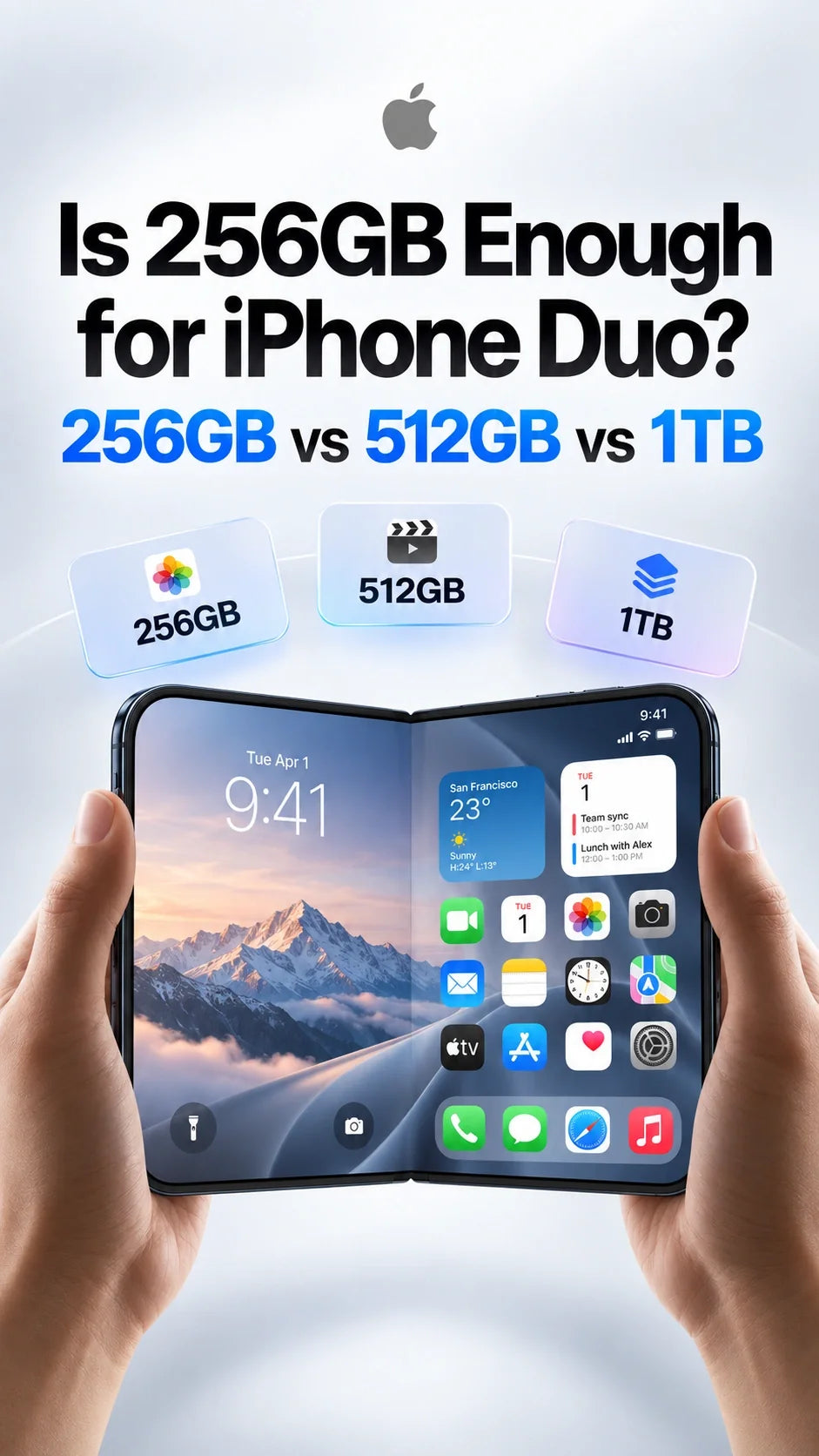
Yes, 256GB is enough for many iPhone Duo buyers who stream media, use iCloud Photos and do not keep a large video library on the phone.
512GB is the safest default if you shoot frequent 4K video, download media or plan to keep the Duo for several years.
Choose 1TB for a large existing local library or regular offline creative work; Apple also offers 2TB for unusually large needs.
Check Settings → General → iPhone Storage on your current phone. Buy for your actual usage and expected growth, not the size of the foldable screen.
U.S. list prices are $1,999 / $2,199 / $2,599 for 256GB / 512GB / 1TB before tax.
iPhone Duo storage and U.S. prices at a glance
Apple lists four capacities, including a 2TB tier outside this article's main three-way comparison. The phone opens for pre-order October 16 and becomes available October 23, 2026. These are U.S. Apple Store list prices, before tax, trade-in or carrier offers. Check Apple's current configuration page before ordering.
256GB · $1,999
Best value when your current usage is modest and you are comfortable with cloud storage and occasional cleanup.
512GB · $2,199
Pay $200 more for another 256GB. The practical choice for a growing photo library, several large games and frequent 4K clips.
1TB · $2,599
Pay $400 more than 512GB. Best for people who already need several hundred gigabytes on-device and cannot regularly offload it.
2TB · $3,199
A further $600 beyond 1TB. Consider it only if a real storage audit shows that 1TB would constrain your workflow.
Capacity is an advertised maximum, not free space out of the box: iOS, built-in apps, downloaded models and system data use part of it. Apple's technical specifications confirm all four tiers.
Is 256GB enough for iPhone Duo?
For everyday messages, browsing, streaming, social apps, cloud-synced photos and some offline downloads, 256GB can be a sensible way to keep the already-expensive Duo at its entry price. A foldable display does not by itself require extra storage.
256GB makes sense if…
Your present iPhone uses roughly 100GB or less; you have no rapidly growing video archive; and you are willing to review downloads or use optimized cloud photos.
Think twice if…
Your present iPhone is already near 150–180GB used, you keep originals locally, or you rely on large offline files and games. Those are planning thresholds, not Apple limits.
iPhone Duo records high-resolution photos and up to 4K Dolby Vision video at 120 fps with its main camera. Actual file sizes vary by resolution, frame rate, format and scene. Its listed recording formats are HEVC and H.264; do not buy a 1TB Duo solely on the assumption that it offers the iPhone 18 Pro's ProRes workflow.
Who should buy 512GB instead?
512GB is the middle ground for buyers who want the Duo's large screen for travel, games, editing or offline reading without managing storage every month. The $200 jump from 256GB buys headroom that may matter more over a three- or four-year ownership period than it does on day one.
Good 512GB candidates
Current phone usage of about 120–250GB; frequent 4K recording; large downloaded movies and maps; or a local Files library used in the Duo's unfolded workspace. These are ZEERA buying guidelines, not guaranteed capacity forecasts.
If you already pay for iCloud Photos, 512GB still gives you room for offline originals and app data. If you do not want a cloud subscription, it offers more freedom, but it does not replace a separate backup.
When is 1TB worth the extra $400?
1TB becomes a rational purchase when the working files must live on the phone: a big photo library with originals retained, long high-quality video projects, extensive offline media and games, or frequent travel without dependable connectivity.
Buy 1TB for a measured need
If you already use more than about 300GB locally and expect that to grow, 512GB may feel tight over several years. If you use only 90GB today, the extra $400 buys unused capacity rather than a faster screen, better camera or longer battery life.
Apple does not publish a Duo-specific speed advantage for the 1TB version. Capacity alone is not evidence of a different NAND type or better real-world performance. The 2TB model is a specialist option for users who have already outgrown 1TB.
Does iCloud make 256GB enough?
It can help a lot with photos. With iCloud Photos and Optimize iPhone Storage, full-resolution originals remain in iCloud while smaller device copies can be kept locally as needed. Apple describes this behavior in its iCloud Photos guide.
What iCloud helps with
A synced photo library and files you can download when needed. It can lower pressure on the phone's local capacity if you have enough iCloud space and a reliable connection.
What iCloud cannot replace
Installed apps, game assets, offline maps, media you need on a flight, active editing files and the free space needed for updates. iCloud capacity does not add physical storage to the Duo.
Apple's iOS 27 support page gives device-dependent Apple Intelligence storage allowances of up to 8GB or 14GB; it does not provide a separate Duo figure there. Leave room for system data and updates rather than subtracting an assumed “14GB Siri AI tax” from every Duo model. For a separate copy of important photos, see our iCloud photo and video export guide.
If your plan is to move large video projects off the Duo to a Mac after each shoot, set up that transfer and backup workflow before choosing the smaller phone capacity.
How to choose your size in two minutes
- On your current iPhone, open Settings → General → iPhone Storage and record used space. Check Photos, apps, Messages and Downloads separately.
- Ask whether you currently optimize photos or keep originals. Note any media you want accessible without Wi-Fi.
- Estimate growth from the last 12 months and how many years you intend to keep the Duo. Leave comfortable free space for downloads and updates.
- Choose 256GB if usage is modest; 512GB if your library is growing or the answer is close; 1TB only when local work already demands it.
A useful decision check: if you are spending $400 more to get 1TB, compare that cost with your actual storage habits and backup plan. Storage upgrades cannot be added later, but files can be offloaded if you are willing to manage them.
Could the iPhone 18 Pro Max be a better buy?
If you are considering 1TB mainly for camera work, first compare the camera systems. The Duo's folding workspace may be the reason to buy it, but the iPhone 18 Pro Max offers dedicated Pro camera features that storage alone cannot add to a Duo. Read our Duo vs iPhone 18 Pro Max guide before paying more for capacity on the wrong device.
FAQ
Can I add storage to iPhone Duo later?
No internal capacity upgrade is offered after purchase. Cloud services and external drives can help with certain files, but they do not expand built-in storage for apps.
Will 256GB slow down the Duo?
Apple does not list a lower processor specification for 256GB. Keeping almost any phone completely full can make updates, downloads and recording inconvenient; choose enough room for your own files.
Is 512GB enough for 4K video?
Often, yes, for casual or moderate shooting with periodic exports. The right size depends on recording settings, duration and how long you keep footage locally.
Does iCloud Photos count against Duo storage?
Yes, some device space is still used for local copies, caches and recently accessed media. Optimize iPhone Storage can reduce the local footprint; it does not make it zero.
Is 2TB available?
Yes. Apple lists 2TB at $3,199 in the U.S. It is outside the 256GB–1TB comparison because most buyers will not need that much local space.
Related guides
- Is iPhone Duo worth $2,000? Five compromises
- iPhone Duo vs iPad mini 8
- iPhone Duo AppleCare costs and estimates
- Best iPhone Duo cases
- iPhone Duo MagSafe wallet fit
- Best MagSafe chargers for Duo and 18 Pro Max
- iPhone Duo Apple Pencil compatibility
Sources: Apple iPhone Duo tech specs; Apple U.S. pricing; Apple Intelligence requirements; Apple iCloud Photos guide. Prices and recommendations checked September 29, 2026.