Quick Answer
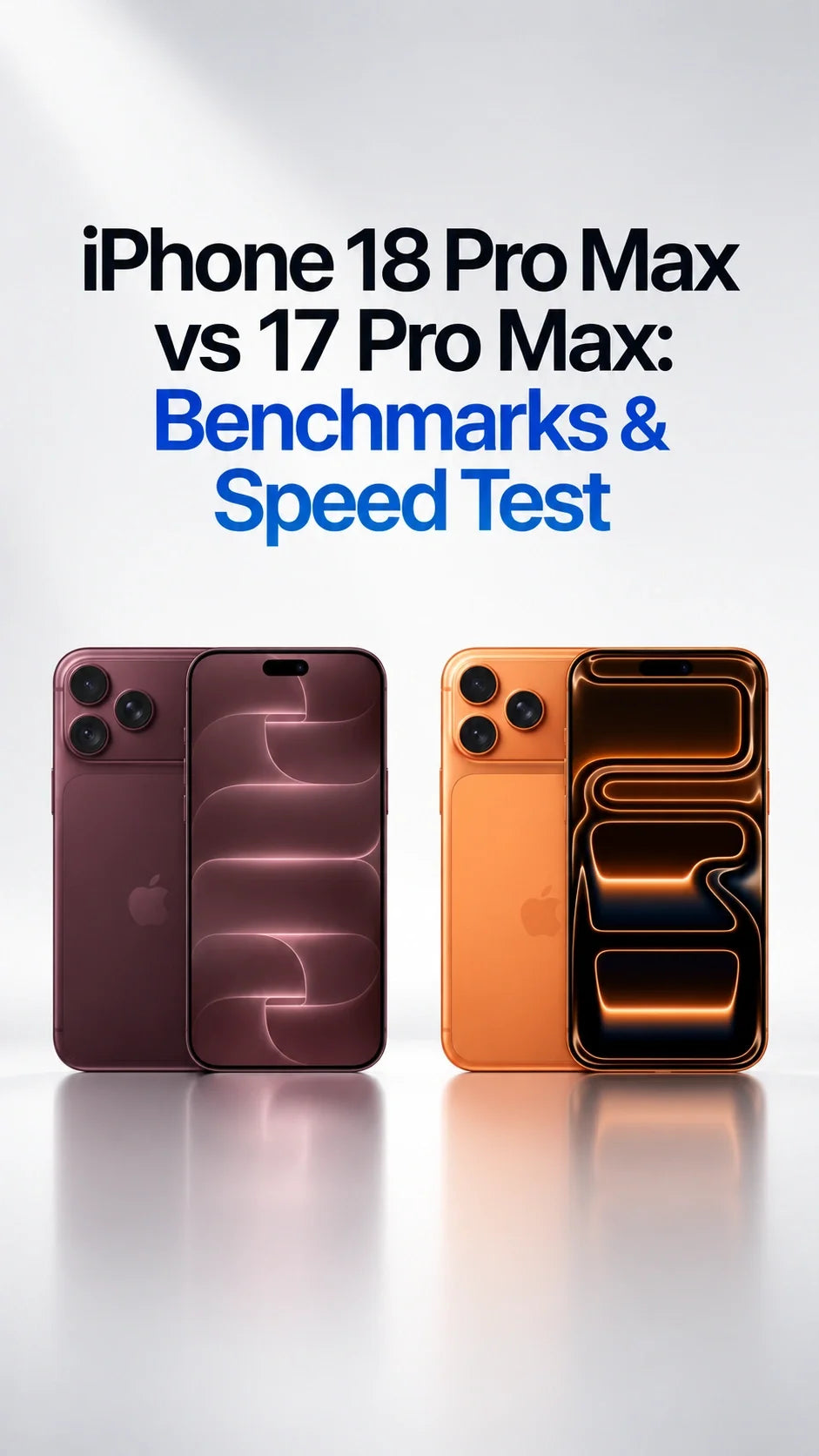
How much faster is the iPhone 18 Pro Max vs iPhone 17 Pro Max? In the linked side-by-side video, A20 Pro posts approximately 25% higher single-core CPU, 29% higher multi-core CPU, 48% faster graphics, and 51% higher sustained gaming performance in the tester's chosen benchmarks.
Measured memory bandwidth rises from 66.5 to 111.8 GB/s (+68%), while a tested on-device AI model rises from 33.5 to 55.4 tokens/s (+65%).
Apple separately rates eSIM-only video playback at 45 vs 39 hours (+15%) and a fast wired 0–50% top-up at around 15 vs 20 minutes.
Important: Benchmark percentages describe the video creator's tests, not ZEERA's own measurements or guaranteed gains in every app. The official Apple figures and observed results are labeled separately below.
Updated September 19, 2026. US-market eSIM-only battery comparison where specified. All gains are measured against iPhone 17 Pro Max, and rounded to the nearest whole percentage where practical.
iPhone 18 Pro Max vs 17 Pro Max: Actual Benchmark Results
ZEERA reviewed Max Tech's side-by-side video and cross-checked the hardware and battery claims with Apple's iPhone 18 Pro specifications. Each blue percentage card compares the metric immediately beneath it; higher scores are not interchangeable with a percentage improvement in real-world app speed.
Geekbench 7 · single-core
+25%Stronger one-thread results matter most for short computational bursts; they do not mean Safari opens 25% faster.
Video-reported percentage; exact comparative scores are not fully transcribed.Geekbench 7 · multi-core
+29%A larger CPU gain is relevant to work that can distribute across cores, such as supported exports and processing.
Video-reported percentage; full per-device numeric scores not provided.Reported peak CPU clock
+15.5%About a 15.5% clock increase in the video. Clock rate and app performance are different metrics.
Third-party video testGPU core count
+16.7%One additional GPU core is a 16.7% increase in core count, not a 16.7% prediction for gaming frame rates.
Apple specifications and video.Graphics benchmark
+48%The creator reports a 48% higher graphics benchmark score. Apple separately advertises up to 40% GPU gains under its own criteria.
Third-party video testMeasured memory bandwidth
+68.1%The video’s ≈68.1% test gain is higher than Apple’s separate 50% memory-bandwidth specification claim; these are different measures.
Third-party video testVisual bars normalize each pair to the larger measurement. They are not a cross-category speed scale. Percentage formula: (iPhone 18 result ÷ iPhone 17 result − 1) × 100.
Storage and AI: Where the Gains Are Uneven
Storage read speed barely moved in the video, while write throughput and the tested local language model rose sharply. Do not confuse the latter with an independently measured Siri AI response-time gain.
Storage read throughput
≈0%Nearly identical readings in this test; faster storage should not be assumed across every operation.
Approximate numbers as reported by the video.Storage write throughput
+71.4%About 71.4% higher sequential write throughput in the tested configuration; NAND capacity and fill level may change results.
Approximate figures from the video; not a guarantee for all capacities.Neural Engine core total
+100%Apple specifies 32 total Neural Engine cores, compared with 16 on A19 Pro. Twice the core count is not equivalent to all AI tasks being twice as fast.
Apple-announced hardware configuration.Local LLM generation
+65.4%The sampled MLX-compatible model produced about 65.4% more tokens each second. The tester did not establish that the model was fully optimized.
One third-party on-device AI test; not a Siri AI benchmark.Gaming, Ray Tracing and Thermal Throttling
Peak graphics performance is only half the story. The video also compares 3DMark frame rates and a 20-minute stress run to show how much speed remains after heat builds up.
3DMark Steel Nomad Light
+43.3%Around 43.3% more frames in this graphics-heavy test. Actual in-game fps depends on the title, resolution, settings and frame-rate cap.
Third-party video test3DMark Solar Bay Extreme
+59%The reviewer reports a 59% ray-tracing benchmark improvement; exact side-by-side numeric scores are not stated in the supplied transcript.
Third-party video test20-minute stress · reported overall score
+61%The creator describes a 61% result from the stress test. Because this mixes peak and subsequent loops, it should not be read as the continuous-performance gain.
Video-reported comparison; old model’s exact score not fully transcribed.Lowest loop · sustained performance
+51%The most relevant number for prolonged gaming is the lowest-loop comparison after 20 minutes. Apple’s independent claim is up to 40%.
Video-reported +51% vs Apple-advertised up to +40%.Vapor-chamber surface area
3× areaThree times the surface area = +200% area. It does NOT mean the body is 200% cooler, or the chip temperature falls by any fixed percentage.
Apple design specification.The video’s thermal images show the 18 Pro Max spreading warmth more broadly, while the 17 Pro Max exhibits a concentrated hot spot. That is consistent with a different heat path, not proof that the 18 Pro Max feels cooler in your hand; its surface can still be hot and the display can still dim under heavy load.
For additional thermal context, see ZEERA’s vapor-chamber and overheating comparison.
Battery and Charging: Real Gains Beyond the Chip
Battery-life claims need comparable regional models and test methods. These cards use Apple’s eSIM-only playback ratings and its stated wired-charge conditions; they are not claims that both phones were drained in the same independent field test.
Apple video-playback rating
+15.4%Six additional rated hours on the comparable eSIM-only models. Real endurance varies with display brightness, signal, gaming and camera use.
Apple manufacturer estimates; eSIM-only configuration.Wired 0–50% charging time
−25% timeReaching 50% in five fewer minutes is a 25% shorter wait, not 25% more total battery capacity.
Apple estimates under separately specified adapters and test conditions.Fast-charge adapter requirement
+50% ratingApple’s tested adapter rating increases 50%. The phone does NOT draw 60W constantly; USB PD AVS support is needed for the new advertised result.
Adapter rating, not actual sustained phone input.MagSafe / Qi2 phone output
0% changeThe on-phone wireless charging ceiling remains 25W on compatible equipment; 35W refers to the specified MagSafe power-adapter input.
Apple specifications.Already have a 20W or 30W USB-C adapter? It still charges the iPhone 18 Pro Max. It simply cannot replicate Apple’s shortest advertised top-up. Read ZEERA’s 20W vs 30W vs 60W charging guide before replacing your charger.
Camera, Display, 5G and Size: What Changed?
Not every upgrade fits into a clean speed percentage. These are official or observed specification differences, not synthetic benchmark gains.
Main-camera physical aperture
New controlFour selectable aperture positions add creative control over light and depth of field. An aperture f-number cannot be translated into a universal “X% better photo” claim.
Apple specifications.Max Cinematic-mode recording
+100% fpsDouble the listed Cinematic mode frame-rate ceiling, although quality and support can still depend on camera and recording mode.
Apple specifications; video did not benchmark this feature.Pro Max chassis weight · US spec
+6.9% weightThe 18 Pro Max is 16 g heavier. A case adds more weight; body dimensions remain essentially unchanged.
Apple listed US model weights.Display size and refresh
0% changeScreen size and refresh rate remain the same, while the Dynamic Island is visibly narrower.
Apple specifications and video observation.What about Wi‑Fi and 5G? Both models support Wi‑Fi 7, and the video saw broadly similar Wi‑Fi speed on its particular router. In the US model examined, the creator identifies a Qualcomm X80 modem in the 18 Pro Max and 17 Pro Max; Apple explicitly lists C2 for the smaller 18 Pro but not the Pro Max on its US specification page. A single network test cannot justify a universal cellular-speed percentage.
The 48MP main camera’s new aperture changes the shooting workflow more than the megapixel count. If you photograph glass, water or bright night lights, see ZEERA’s camera-glare and lens-flare guide.
Should You Upgrade From iPhone 17 Pro Max for Performance?
For everyday browsing, messaging and short camera sessions: both remain fast, so a 25% synthetic CPU gain will not necessarily feel 25% quicker. Keep the existing device if it meets your needs.
For sustained gaming, on-device AI experiments or long exports: the combination of higher graphics scores, wider tested memory bandwidth and improved thermal performance may matter considerably more.
For battery and camera work: the six-hour increase in Apple’s eSIM-only video rating, shorter wired top-ups and variable aperture are independent reasons to consider the new model. Weigh them against its higher cost and extra weight. For a broader buying comparison, visit ZEERA’s iPhone 18 Pro Max vs 17 Pro Max upgrade guide.
How ZEERA Calculated the Percentage Differences
We calculated exact percentages only where both numeric values were present. For example, (111.8 ÷ 66.5 − 1) × 100 = 68.1% for the measured memory-bandwidth pair. For single-core, multi-core, GPU and sustained tests, we reproduce the video creator's rounded comparison rather than fabricate raw scores for the 17 Pro Max. Apple's 40% sustained claim, official playback ratings and hardware specifications are labeled separately.
Single-run benchmarks can shift with phone temperature, iOS version, storage size, benchmark revision and background activity. The video’s local LLM model was not confirmed to be fully optimized, and its Wi‑Fi/5G tests were performed in one environment. These are useful early results, not a pooled multi-device laboratory average.
iPhone 18 Pro Max vs 17 Pro Max: FAQ
How much faster is A20 Pro than A19 Pro?
In the cited video: approximately 25% single-core, 29% multi-core and 48% graphics in the selected benchmark tests. Actual app gains vary.
Is iPhone 18 Pro Max 51% faster for every game?
No. The 51% figure compares the lowest loops in one 20-minute stress test. Game engines, settings, fps caps and temperature affect real results.
Does 68% more memory bandwidth mean 68% faster Siri AI?
No. That is a measured bandwidth gap. The video reports a separate 65.4% gain for one local model, not a general Siri benchmark.
Does iPhone 18 Pro Max need a 60W charger?
No for routine charging. Apple specifies a 60W-or-higher AVS adapter for its approximately 15-minute, 0–50% wired result; lower-powered chargers still work.
Does iPhone 18 Pro Max have better battery life?
Apple rates the comparable eSIM-only models at up to 45 versus 39 hours of video playback, about 15.4% higher. Everyday results vary.
Can I use an iPhone 17 Pro Max case on iPhone 18 Pro Max?
Do not assume a precise fit despite similar overall dimensions. Check the case's explicit model compatibility, especially around camera and button openings.
Related Reading
- iPhone 18 Pro Max vs 17 Pro Max: Buying and Specs
- iPhone 18 Pro Max Overheating and Vapor Chamber
- 20W vs 30W vs 60W: iPhone 18 Pro Charger Guide
- Fix iPhone 18 Pro Max Camera Glare and Lens Flare
- A20 Pro Chip: 2nm Performance and Battery Life
- iPhone 18 Pro vs 17 Pro Max: Battery Life
- iPhone 18 Pro Max Cases
Primary sources: Video benchmark comparison · Apple iPhone 18 Pro technical specifications · Apple iPhone 17 Pro Max technical specifications · Apple iPhone 18 Pro announcement. ZEERA evaluated the published figures but did not conduct the third-party benchmark run.