Quick Answer
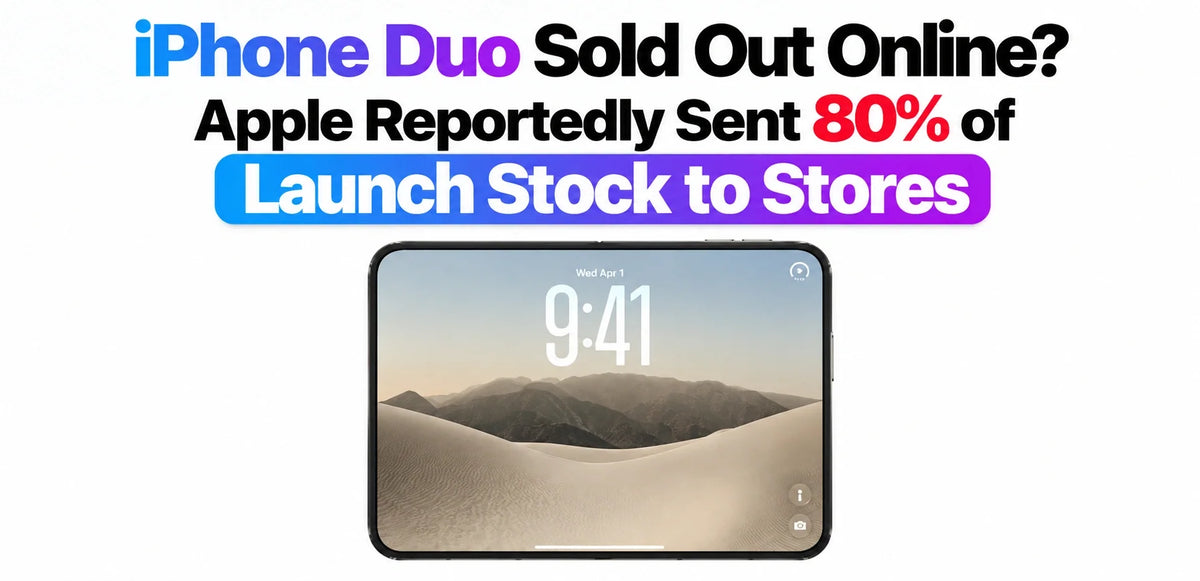
Apple reportedly directed about 80% of its initial iPhone Duo inventory to Apple Stores, according to Mark Gurman, as reported by MacRumors. Apple has not publicly confirmed that proportion.
That allocation helps explain how online buyers could face long delivery estimates while some launch-day shoppers left a store with a phone.
Online fulfillment, store sales, display devices and service replacements serve different purposes. After-sales replacement needs also belong in launch planning, although the report does not identify a Duo service reserve.
ZEERA’s view: the central issue is how Apple balances new purchases, existing orders and support for owners—not what a sold-out webpage alone says about demand.
What the Launch Stock Report Reveals
In its October 30 report, MacRumors says Gurman cited sources close to Duo logistics: some stores received around 50 units, flagships up to roughly 250, and Fifth Avenue received an unusually large allocation for a launch attended by Apple executives.
The useful distinction is between where stock was allocated and how many phones Apple produced. The figures describe a reported launch distribution decision; they are not a current store inventory list or a worldwide sales total.
Why Online Delays and Store Availability Can Coexist
A customer naturally sees one Apple and expects one queue. Operationally, a phone assigned to one purpose is not automatically available to satisfy every other request. These are useful distinctions, rather than a disclosed map of Apple’s internal inventory system.
Online order fulfillment
Units committed to delivery orders fulfill existing purchases. A new order’s estimate reflects the availability offered for that order, configuration and destination; it does not count every device elsewhere in Apple’s network.
Store retail inventory
Phones allocated for local sale can support purchases at that location. A store may have a configuration that is unavailable for near-term home delivery without that phone having been taken from a particular customer’s confirmed order.
Display devices
Showroom phones let customers try the product. A working Duo on a display table is not evidence that an equivalent sealed retail unit is available to purchase.
Service and replacement devices
Inventory available for an approved repair or replacement serves an existing owner. It may be managed separately from retail sale stock, and access depends on the service process and matching device availability.
This explains why “sold out online” is too broad to describe the whole launch. For the ordering mechanics, see our separate iPhone Duo delivery and pickup guide.
Stores Also Need Stock to Support Existing Owners
There is another reason the conversation should extend beyond launch-day sales: after-sales support needs replacement capacity. Once someone owns a Duo, an approved exchange can become more urgent than another new purchase, especially if the phone is their main device.
From a service-planning perspective, retaining access to replacement units is sensible. Selling every available phone immediately could leave the next customer with a defective device waiting for a solution. This is a reason to plan a service reserve, even during a constrained launch.
Where the evidence stops
The reported store allocation does not reveal how many units, if any, were held for Duo replacements, or whether service inventory was counted separately. We cannot label part of the reported 80% as a confirmed after-sales reserve.
Apple’s iPhone service information says service options vary with parts availability and location. A retail availability page therefore cannot settle an individual replacement case. Our Duo replacement inventory guide covers that problem separately.
Is This Fair to Customers Who Preordered?
The frustration is understandable. An early online buyer has already committed to the purchase, yet someone with access to a well-stocked store may receive the same product sooner. The difference rewards location and time available to visit a store, rather than simply the time an order was placed.
That does not establish that Apple broke an individual delivery commitment. It does raise a customer-experience question: how clearly did the ordering experience explain that different channels could offer very different waits?
The case for allocating phones to stores
A new folding format benefits from hands-on demonstrations, guided setup and local support. Giving stores saleable stock also preserves an option for people who want to see the device before buying. These are plausible business reasons, not motives established by the allocation report.
The case for giving preorders more weight
Customers who order early reasonably expect their commitment to matter. Apple could reduce frustration by making channel differences clearer and, where feasible, offering a straightforward way to move an existing order to a genuinely available local unit without losing priority.
ZEERA would assess fairness by the accuracy of the original promise, the clarity of the alternatives and how existing orders are treated when supply improves. Visible queues outside stores cannot answer those questions on their own.
What the Allocation Cannot Tell Us About Sales
A percentage needs a denominator. The same store share could describe a small launch batch or a much larger one. Without a reliable total, multiplying an allocation percentage produces no usable sales estimate.
Allocated does not mean sold
A shipment assigned to a channel is a supply decision. Customer purchases are a separate outcome. Neither a store shipment nor an online wait time establishes worldwide sell-through.
Uneven availability does not prove deliberate scarcity
Channel planning can make one route look much more constrained than another. Proving that Apple intentionally restricted supply to create hype would require evidence about intent and production decisions beyond this distribution report.
The stronger reading is narrower: launch availability depends partly on allocation, so long online estimates should not be treated as a complete measure of demand. Actual sales, production output and channel distribution need separate evidence.
ZEERA’s Take: A Launch Must Work After Checkout
For us, the most consequential tradeoff is between three legitimate needs: fulfilling early orders, keeping stores useful for new buyers and supporting people who already own the phone.
Giving stores substantial stock can serve all three only if the allocation and service processes work together. A successful sale is a weak result if the buyer later cannot obtain an approved replacement; a lively launch queue is equally hard to celebrate for someone still waiting on an early order.
The test is whether Apple turns limited supply into reliable ownership. Clear delivery commitments, sensible access to local stock and adequate replacement capacity matter more to customers than which channel looks busiest.
FAQ
Is an online pickup order necessarily part of the online delivery allocation?
No. The customer-facing ordering method does not establish which internal inventory pool supplies the phone. A website can offer a store pickup transaction. The report does not disclose how pickup orders were classified in its allocation figure.
Does the report explain stock at carriers and other retailers?
It does not provide a complete allocation breakdown for those channels. Apple Store figures should not be extrapolated into carrier availability or a country-by-country stock map.
Related Reading
- iPhone Duo Sold Out? Shipping Delays and Apple Store Pickup Explained
- iPhone Duo Replacement Out of Stock? What to Ask AppleCare
- iPhone Duo Walk-In Restrictions in Japan and Korea
- iPhone Duo Production Increase: What It Means for Availability
- Should I Keep My iPhone Duo or Return It for an iPhone 18 Pro Max?
- iPhone Duo Preorder and Delivery Guide
By Guichang Chen · ZEERA WIRELESS · October 31, 2026