Quick Answer
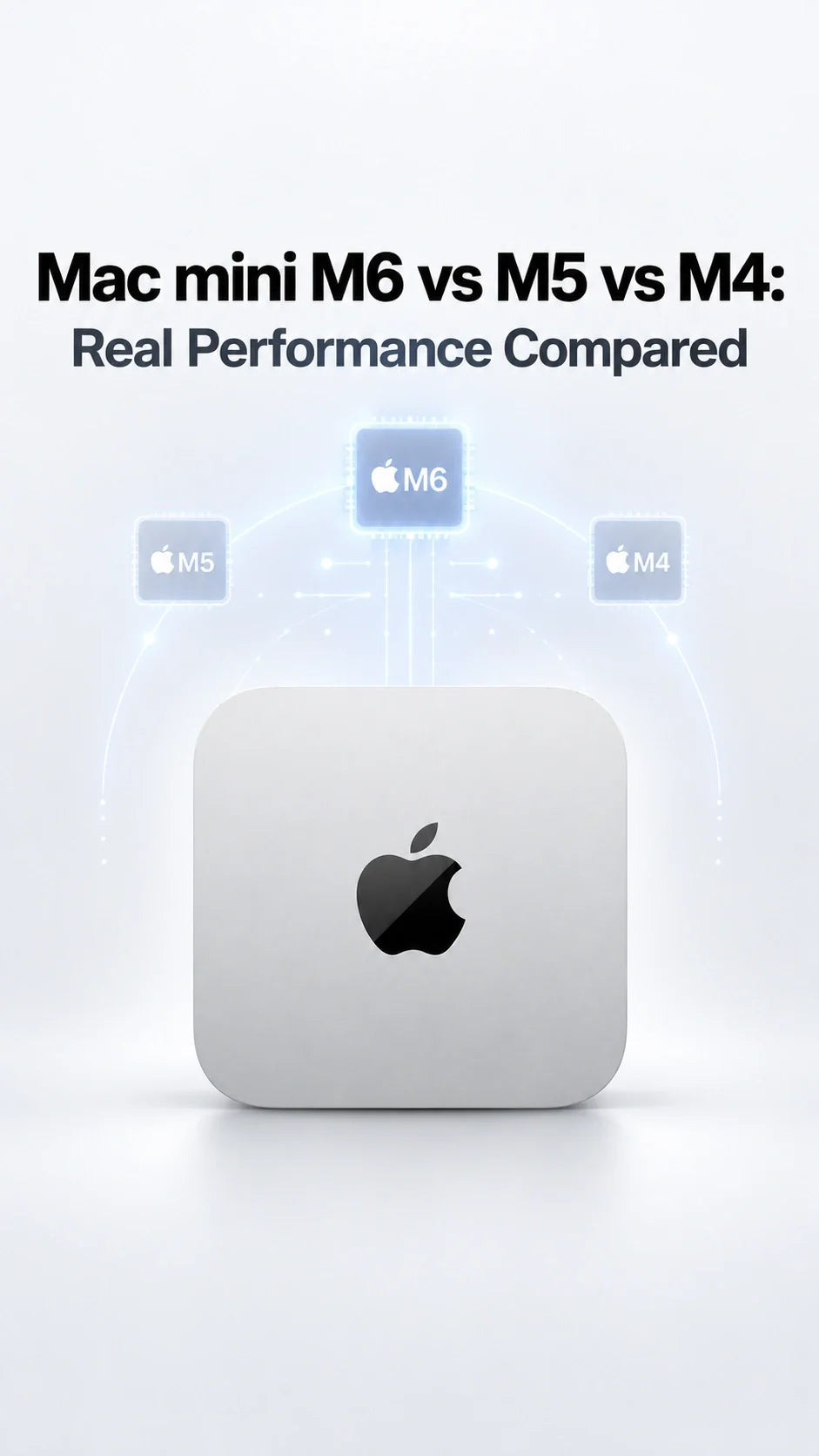
The M6 Mac mini is substantially faster than the M4 and delivers a clear—but smaller—gain over the regular M5 chip.
In Geekerwan's third-party tests, M6 multi-core CPU performance was more than 50% ahead of M4, while 3DMark raster and ray-tracing results improved by roughly 80% and 85%.
Against M5, M6 gained about 25% in Blender CPU rendering, 33% in raster graphics and 25% in ray tracing.
Most M4 owners still do not need to upgrade for everyday work. M6 makes more sense for local AI, code compilation, GPU rendering, modern games and other sustained workloads.
What Was Tested—and Who Is the Original Reviewer?
This performance comparison is based on the video “Mac mini M6 Performance Test: More Cores, but How Much Faster?”, originally produced and published by Geekerwan (极客湾).
Testing disclosure: all SPEC, Cinebench, 3DMark, Blender, local AI, game and power figures attributed to the video are Geekerwan's third-party results—not ZEERA lab testing.
ZEERA checked the product-level specifications against Apple's M6 and Mac mini announcements, then used the video results to explain practical buying differences.
The video tests a 32GB M6 Mac mini and compares its results with Geekerwan's previous M5 and M4 data. The M5 numbers represent the regular M5 chip generation; Apple did not release a regular M5 Mac mini. The current higher-end Mac mini uses M5 Pro, which is a separate, more powerful class of chip.
M6 vs M5 vs M4 Specs: What Changed?
Apple M4
10-Core CPU
10-core GPU
4 performance + 6 efficiency CPU cores, 120GB/s unified memory bandwidth and a 3nm-class process.
Apple M5
10-Core CPU
10-core GPU
The intermediate generation improves CPU, GPU and AI performance, but keeps the conventional two-tier CPU arrangement.
Apple M6
12-Core CPU
12-core GPU
2 super + 4 performance + 6 efficiency CPU cores, up to 170GB/s bandwidth and Apple's 2nm process.
M6's biggest architectural change is not simply two extra CPU cores. Apple divides the 12-core CPU into three performance tiers, allowing two high-frequency super cores to handle peak single-thread work while four smaller performance cores add multi-core throughput more efficiently.
Apple officially rates M6 multi-threaded CPU performance at up to 1.2× the M5, while the 12-core GPU adds two graphics cores and Neural Accelerators inside every GPU core. M6 also introduces a Dual 16-core Neural Engine and increases maximum unified memory bandwidth to 170GB/s.
CPU Performance: M6 Is More Than 50% Faster Than M4
Geekerwan's SPEC testing shows that M6 continues Apple's advantage in single-core IPC. Its super core runs at roughly 4.8GHz, while the new performance core reaches about 4.5GHz and delivers performance comparable with much larger high-end mobile CPU cores.
The more important improvement is multi-core performance. Replacing part of the previous large-core configuration with four compact performance cores gives M6 more total throughput without requiring an equally large increase in chip area or power.
Cinebench Multi-Core
50%+
M6 compared with M4 in Geekerwan's test.
Blender CPU
~25%
M6 compared with the regular M5.
Apple's M6 Claim
Up to 1.2×
Multi-threaded performance compared with M5.
M6 also showed clear gains in 7-Zip compression, Xcode compilation and Adobe Photoshop. The video does not provide exact percentages for every application, so it would be misleading to convert those results into a single “overall performance” number.
Practical meaning: everyday browsing and office work will not feel 50% faster. The gain becomes more visible in code builds, CPU rendering, file compression, batch photo processing and workloads that can keep all 12 cores busy.
GPU and Ray Tracing: The Biggest M6 Upgrade
The GPU grows from 10 to 12 cores and moves to Apple's newer graphics architecture. In Geekerwan's 3DMark testing, M6 delivered one of the largest generation-to-generation graphics gains seen in a base M-series chip.
3DMark Raster Graphics
+33% vs M5
Nearly +80% vs M4
A major improvement for conventional GPU rendering and games.
3DMark Ray Tracing
+25% vs M5
About +85% vs M4
The newer architecture produces an even larger advantage over M4.
Blender GPU Rendering
30%+
Improvement over the preceding regular M-series generation in the video's ray-traced render test.
GPU Core Count
10 → 12
Core count rises 20%, while architecture and frequency improvements add further performance.
This does not mean the M6 Mac mini replaces a discrete gaming GPU or the M5 Pro Mac mini. The standard M6 remains limited to 32GB unified memory, a narrower memory interface and Thunderbolt 4. But it moves the base Mac mini much closer to entry-level professional performance in optimized applications.
Productivity: Where M6 Feels Like a Real Upgrade
Across Blender, Xcode, Photoshop and Premiere Pro, the M6 Mac mini benefits from improvements in all three major areas: CPU throughput, GPU capability and dedicated media hardware.
Xcode
Clearly Faster
More CPU cores reduce compilation time, especially in larger projects and parallel builds.
Photoshop
Strong Single-Core
High IPC and clock speed help filters, edits and interface responsiveness.
Premiere Pro
Balanced Gain
CPU, GPU and media-engine improvements combine in export and timeline workloads.
Blender
CPU + GPU
Around 25% faster CPU rendering than M5, with more than 30% improvement in the tested GPU render.
The biggest caveat is memory. The M6 Mac mini supports up to 32GB, while the M5 Pro model supports more memory and substantially higher bandwidth. If a project already exceeds 32GB or depends on several high-bandwidth Thunderbolt devices, M5 Pro remains the more appropriate machine.
For a broader desktop comparison, see our M6 Mac mini vs M4 Max Mac Studio real-world guide.
Local AI: Model Architecture Matters More Than Parameter Count
Geekerwan tested local models on the 32GB M6 Mac mini. The most useful lesson is that a larger headline parameter count does not automatically produce slower generation.
27B Dense Model · 4-bit
~8 tokens/s
Prefill: more than 200 tokens/s
Decode is constrained by memory bandwidth and is too slow for a fluid interactive workflow.
35B-A3B MoE Model
~68 tokens/s
Only a subset of parameters is active per token.
The tested speed is practical for local assistants and some agent workflows.
Model names are reproduced from the video's captions. Exact model build names and runtime settings should be checked before using these numbers as a purchasing benchmark.
The Neural Engine reached about 53.8 TOPS in FP16 and 81.7 TOPS in INT8 in the video. However, the tested 27B model ran faster through the GPU with MLX 4-bit quantization than through the Neural Engine's INT8 path. For current local LLM workflows, unified memory capacity and GPU-accessible bandwidth remain critical.
Our separate Mac mini M6 16GB vs 24GB vs 32GB local AI guide explains which capacity fits local LLMs, image generation and agent workflows.
Gaming: Nearly Twice the M4 Performance in Some Titles
M6 is still limited by macOS game availability, ports and driver optimization, but its raw GPU improvement is large enough to produce meaningful frame-rate gains.
Cyberpunk 2077
+20% vs M5
The advantage increased to more than 30% when ray tracing was enabled in the video's test settings.
Baldur's Gate 3
+42% vs M5
Approximately twice the M4 frame rate under the tested settings.
Control
+21% vs M5
Measured without ray tracing; M6 became more competitive after ray tracing was enabled.
Resident Evil 9
Nearly 2× M4
A strong result despite the game running through a translation layer.
These are not universal averages. Resolution, upscaling, quality settings and whether a game is native or translated can change the ranking. A Windows PC with a suitable discrete GPU remains the safer choice if gaming is the primary reason for buying a computer.
Power and Thermals: Does the M6 Mac mini Throttle?
Geekerwan also measured power during CPU, GPU and combined stress tests. The results show that the compact Mac mini shares its available power between the CPU and GPU under simultaneous load.
CPU-Only Load
~25W
Around 55W total system input during Cinebench R23.
GPU-Only Load
~19W
A little over 50W total input during the 3DMark test.
CPU + GPU Load
~65W
CPU and GPU each fell to roughly 15W as they shared the system budget.
During the combined load, the super cores dropped to roughly 3.75GHz and the GPU to about 1.55GHz. The video reported that core temperature remained reasonable. That frequency reduction shows power sharing under an artificial dual load, but it does not by itself prove abnormal thermal throttling.
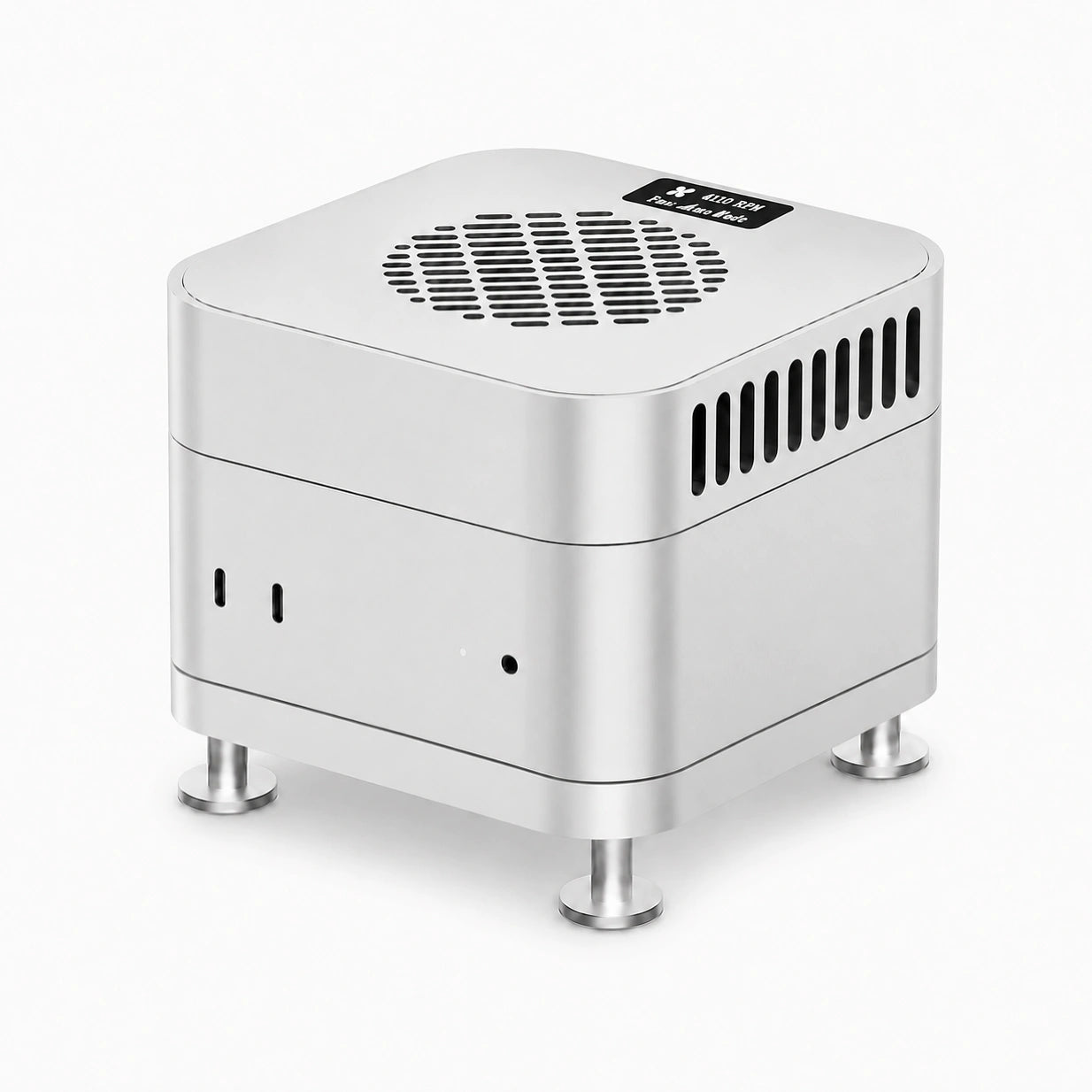
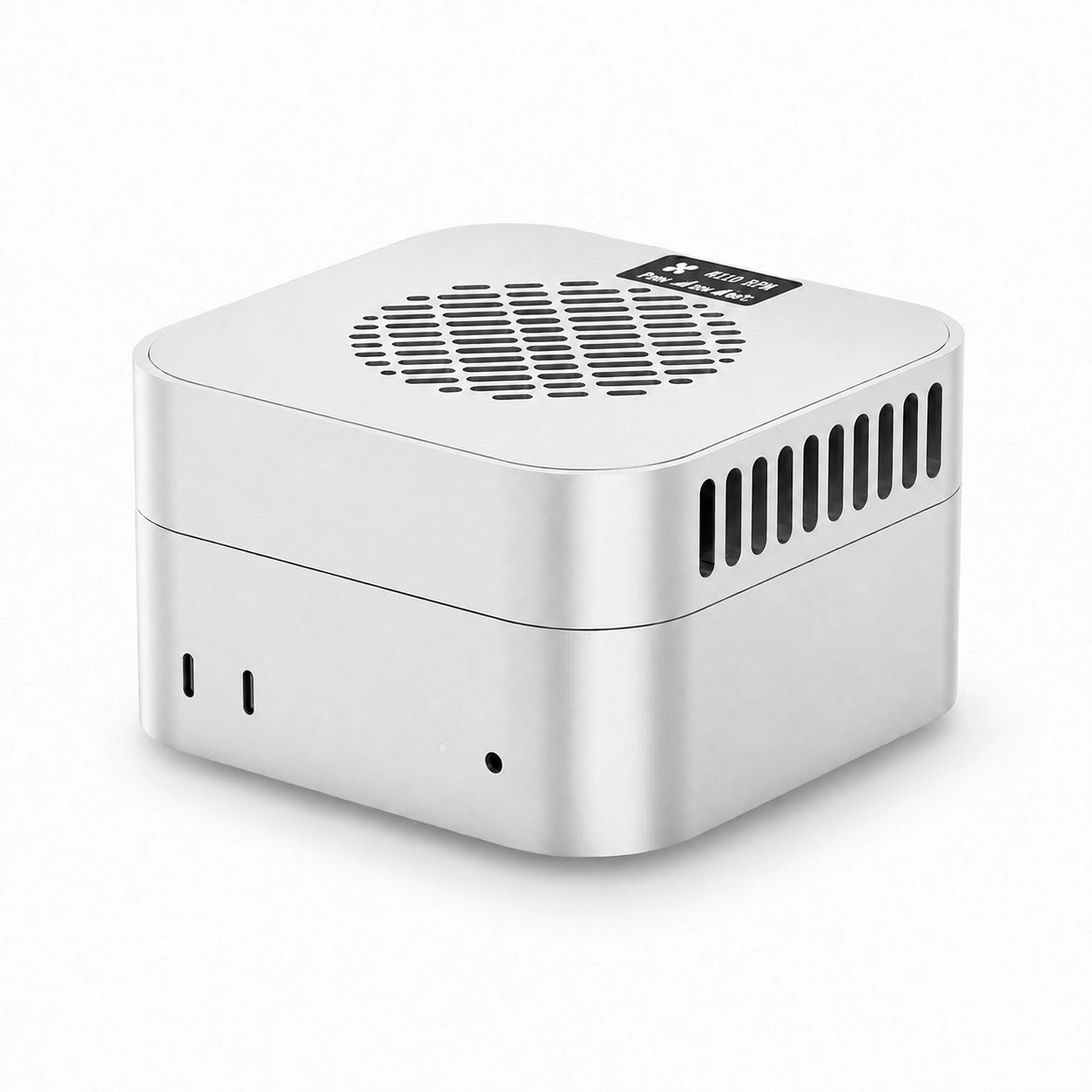
Light users do not need external cooling. Active cooling is more relevant for repeated long renders, around-the-clock agents, local AI inference or workloads where stable sustained output matters. See our Mac mini M6 cooling stand guide for the difference between normal heat and a real cooling bottleneck.
Should You Upgrade From M4 or M5 to M6?
Buy or Upgrade to M6
Your workload can use the new hardware.
- You run local LLMs, image generation or AI agents.
- You compile large projects or render frequently.
- You need much stronger ray tracing and GPU performance.
- Your current Mac is Intel, M1, M2 or an older desktop.
- Wi-Fi 7 and standard 2.5Gb Ethernet are useful to you.
Keep Your Current Mac
Your M4 or M5 machine is already fast enough.
- You mainly browse, stream and use office apps.
- Your current creative workflow has no measurable delay.
- You do not use local AI or modern Mac games.
- You would remain on 16GB and a 256GB SSD.
- You need more than 32GB memory or Thunderbolt 5.
For most M4 Mac mini owners, the answer remains keep the M4. M6 produces impressive benchmark gains, but ordinary tasks rarely saturate the M4 CPU or GPU. The $899 starting price also makes the upgrade harder to justify when the base model still has 16GB memory and 256GB storage.
If you are buying a new Mac mini, 16GB with 512GB storage is the more balanced everyday configuration. For local AI and heavier multitasking, 32GB with at least 512GB storage makes better use of the M6 chip. Choose the M5 Pro Mac mini when you need more than 32GB memory, Thunderbolt 5 or sustained Pro-class GPU bandwidth.
Final Verdict: M6 Is a Major M4 Upgrade, but Not a Mandatory One
The M6 Mac mini is clearly faster than M4 and meaningfully faster than the regular M5. The largest improvements appear in multi-core CPU work, GPU rendering, ray tracing, games and AI-accelerated workloads.
Its real limitation is not raw chip performance. It is the surrounding configuration: a 32GB memory ceiling, Thunderbolt 4 and a $899 base price with only 256GB storage. Those trade-offs prevent the standard M6 from replacing the M5 Pro Mac mini for every professional user.
For new buyers, M6 is a powerful compact desktop with far more performance than most daily workflows require. For existing M4 owners, upgrade only when a specific M6 result—AI speed, GPU performance, code compilation or sustained production work—solves a bottleneck you already experience.
Sources
- Geekerwan (极客湾): Mac mini M6 Performance Test
- Apple: M6 architecture, CPU, GPU, Neural Engine and memory bandwidth
- Apple: M6 and M5 Pro Mac mini announcement
- Apple: Current Mac mini technical specifications
- Apple: Mac mini M4 technical specifications
Frequently Asked Questions
How much faster is the M6 Mac mini than M4?
In Geekerwan's tests, M6 was more than 50% faster in Cinebench multi-core performance, nearly 80% faster in 3DMark raster graphics and about 85% faster in ray tracing. Results vary by application.
How much faster is M6 than M5?
The video measured about 25% higher Blender CPU performance, 33% higher 3DMark raster performance and 25% higher ray-tracing performance. Apple rates M6 multi-threaded CPU performance at up to 1.2× M5.
Was there an M5 Mac mini?
No regular M5 Mac mini was released. Apple moved the base Mac mini from M4 to M6. The current higher-end Mac mini uses M5 Pro, which should not be confused with the regular M5 comparison data in the video.
Is the M6 Mac mini good for local AI?
Yes, especially with 32GB memory and efficient MoE models. Dense 27B-class models may still be limited by memory bandwidth, while the tested 35B-A3B MoE model reached about 68 tokens per second.
Does the M6 Mac mini need an active cooling stand?
Not for browsing, office work or light creative tasks. Active cooling is most relevant during repeated long renders, continuous AI inference, extended gaming or around-the-clock agent workloads.
Should M4 Mac mini owners upgrade to M6?
Most should keep the M4. Upgrade when local AI, GPU rendering, ray tracing, code compilation or faster sustained production work can save meaningful time.
Should I buy the M6 or M5 Pro Mac mini?
Choose M6 for mainstream work, coding, moderate creative workloads and smaller local AI models. Choose M5 Pro for more than 32GB memory, Thunderbolt 5, larger AI models, heavier 3D work and sustained professional workflows.
Related Mac mini Guides
- Mac mini M6 vs M4: Full Benchmark and Upgrade Guide
- Mac mini M6 for Local AI: 16GB vs 24GB vs 32GB
- M6 Mac mini vs M4 Max Mac Studio
- Do You Need a Cooling Stand for the Mac mini M6?
- Turn Your Mac mini M6 Into a Mini Mac Pro
- Best Mac mini M6, M5 Pro and M4 Accessories
- Why Does the Mac mini M6, M5 Pro or M4 Get Hot?