Updated September 2026: Apple has now answered the biggest question surrounding the rumored M5 Mac mini. The company did not release a standard M5 Mac mini. Instead, Apple announced a new Mac mini lineup with the M6 chip in the base model and the M5 Pro chip in the higher-performance model. Preorders opened on August 25, 2026, with availability beginning September 22.
Quick Answer: There is no standard M5 Mac mini in Apple’s 2026 lineup. The earlier M5 Mac mini rumors ultimately pointed toward a split update: the mainstream Mac mini moved directly from M4 to M6, while the professional configuration upgraded from M4 Pro to M5 Pro. Both models retain the compact 5-by-5-inch design introduced with the M4 generation. For accessories, the current ZEERA MacForge Gen3 case and ZEERA MacFrost Pro active cooler are designed for Mac mini M6, M5 Pro and M4.
The 2024 Mac mini with M4 and M4 Pro introduced Apple’s much smaller desktop design, front-facing ports and a new generation of compact Mac mini accessories. During 2025 and early 2026, reports repeatedly referred to M5-era Mac mini identifiers and an expected M5 update. Those reports were directionally correct about a new professional chip, but the final product naming was different from the early prediction.
Apple’s official announcement now gives us a clear answer: the current lineup consists of Mac mini with M6 and Mac mini with M5 Pro. This article preserves the original M5 Mac mini rumor history while replacing outdated predictions with the confirmed release details shoppers need today.

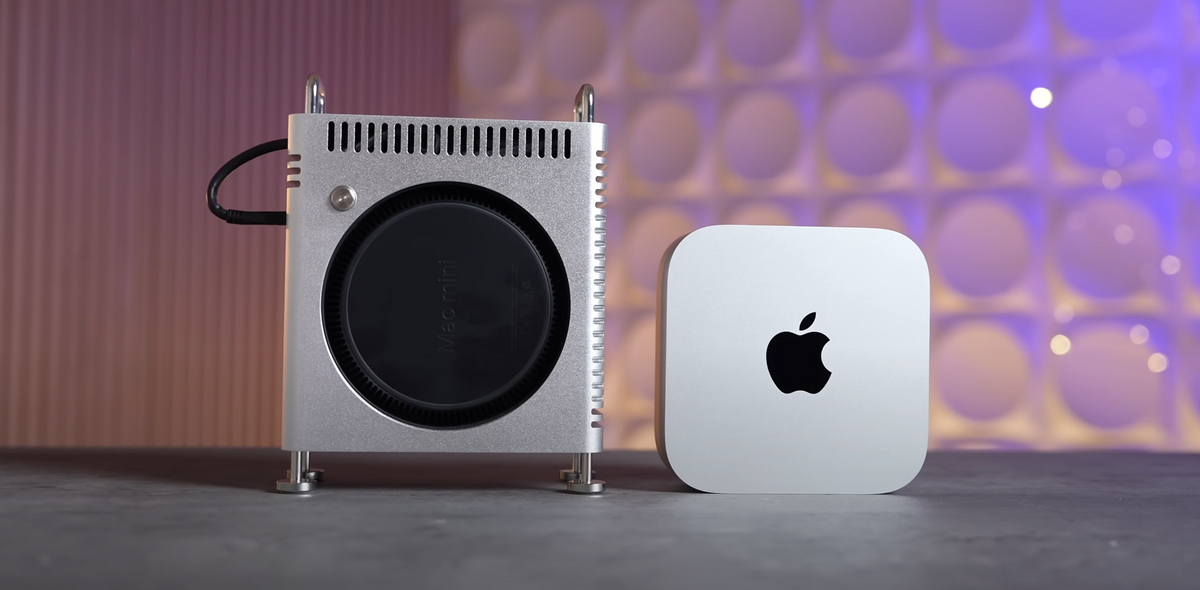
Earlier MacForge generation shown. The current enclosure has been upgraded to MacForge Gen3.
Was the M5 Mac mini Released?
Yes and no. Apple released a Mac mini with the M5 Pro chip, but it did not release the standard M5 configuration many buyers expected. The base model skipped directly from M4 to M6.
Apple announced the new lineup on August 25, 2026. Orders opened the same day, and Apple said the computers would begin arriving to customers and stores on September 22, 2026. Until that availability date, it is more accurate to describe the new models as announced and available for preorder rather than already shipping.
This unusual naming split explains why earlier reporting can look both correct and incorrect. A higher-end M5-generation Mac mini was real, but the product that had often been described as the “base M5 Mac mini” arrived with the newer M6 name instead.
What Happened to the Rumored J873s and J873g Models?
Before Apple’s announcement, internal identifiers J873s and J873g were widely interpreted as development references for M5 Pro and standard M5 Mac mini models. The assumption was reasonable because Apple had used related identifiers for the previous M4 generation.
Internal model numbers, however, are not retail product names. They can identify hardware projects without proving which chip name Apple will use when the product reaches the market. The final 2026 lineup demonstrates that limitation: the professional model did arrive with M5 Pro, while the mainstream model launched with M6.
The useful lesson for future Apple rumors is simple: leaked identifiers can show that hardware is in development, but they do not independently confirm the final chip, release date or marketing name.

M6 Mac mini vs M5 Pro Mac mini: Confirmed Specifications
The two current Mac mini configurations share the same compact exterior, but they target different workloads. The M6 model is the mainstream choice for everyday productivity, development, photo editing and many local AI tasks. The M5 Pro model adds substantially more CPU, GPU, memory and I/O headroom for sustained professional work.
| Feature | Mac mini with M6 | Mac mini with M5 Pro |
|---|---|---|
| Position in lineup | Mainstream Mac mini | Professional Mac mini |
| CPU / GPU | 12-core CPU and 12-core GPU | Up to 18-core CPU and 20-core GPU |
| Unified memory | 16GB standard, configurable up to 32GB | Configurable up to 64GB |
| Memory bandwidth | Up to 170GB/s | 307GB/s |
| Rear Thunderbolt ports | Three Thunderbolt 4 ports | Three Thunderbolt 5 ports |
| Wireless | Wi-Fi 7 and Bluetooth 6 | Wi-Fi 7 and Bluetooth 6 |
| Ethernet | 2.5Gb standard; 10Gb option | 2.5Gb standard; 10Gb option |
| Starting price (U.S.) | $899; $799 education | $1,699; $1,599 education |
| Availability | Preorder now; available September 22, 2026 | Preorder now; available September 22, 2026 |
Apple says M6 brings a 12-core CPU, a 12-core GPU with Neural Accelerators in every GPU core and a Dual 16-core Neural Engine. The M5 Pro configuration is designed for heavier workflows such as large local AI models, video production, 3D rendering, scientific work and app development.
For the complete pricing and configuration breakdown, read our Mac mini M6 price, specifications and release date guide. Apple’s confirmed specifications are also available in the official Apple announcement.
Which Mac mini Should You Buy: M6 or M5 Pro?
Choose the M6 Mac mini if your work centers on web browsing, office apps, general coding, photo editing, music production or occasional video projects. It offers the newest base chip, strong everyday performance and up to 32GB of unified memory.
Choose the M5 Pro Mac mini if you need more than 32GB of memory, Thunderbolt 5 or consistently higher multicore and GPU performance. It is the more appropriate configuration for long 4K or 8K exports, large software builds, complex 3D scenes, large local AI models and high-bandwidth professional storage.
If you already own an M4 Mac mini, the upgrade is workload-dependent. A faster chip alone may not transform light everyday tasks. The strongest reasons to move are a need for more performance, faster networking, Thunderbolt 5 on the M5 Pro model or greater AI acceleration. Our dedicated M6 Mac mini buying guide covers those decisions in more depth.
Did Apple Change the Mac mini Design?
No major exterior redesign was introduced. The M6 and M5 Pro models retain the ultracompact 5-by-5-inch form that debuted with the M4 generation. They continue to place two USB-C ports and the headphone jack on the front, with Thunderbolt, HDMI, Ethernet and power connections at the rear.
That continuity matters for accessories. Products built around the current compact Mac mini footprint can support M4, M6 and M5 Pro when their port access and airflow paths are correctly aligned. Always check the accessory maker’s stated compatibility rather than assuming every older case will fit.
MacForge Has Been Upgraded to Gen3
The Mac mini enclosure shown in parts of this original article belonged to an earlier MacForge generation. The current model is now the ZEERA MacForge Gen3 CNC Aluminum Mac Mini Case, designed for Mac mini M6, M5 Pro and M4.
MacForge Gen3 is more than a name change. It introduces a wider and more balanced Mac Pro-inspired form, increased internal air volume, refined passive airflow channels and a top I/O extension that relocates the Mac mini’s two front USB-C ports and headphone connection for easier access.
Buyers can choose a clean minimal version or a version with dedicated space for an external SSD enclosure up to 120 × 60 × 19mm. The CNC-machined aluminum body uses a brushed, hard-anodized finish, while the open internal layout is designed to preserve the Mac mini’s original airflow instead of sealing the computer inside a decorative shell.


What Is MacFrost Pro, and Who Needs It?
For normal browsing, office work and short creative tasks, the Mac mini’s internal cooling system is usually sufficient. Users running sustained workloads may want more thermal headroom, especially during long video exports, local AI generation, 3D rendering or large code compilations.
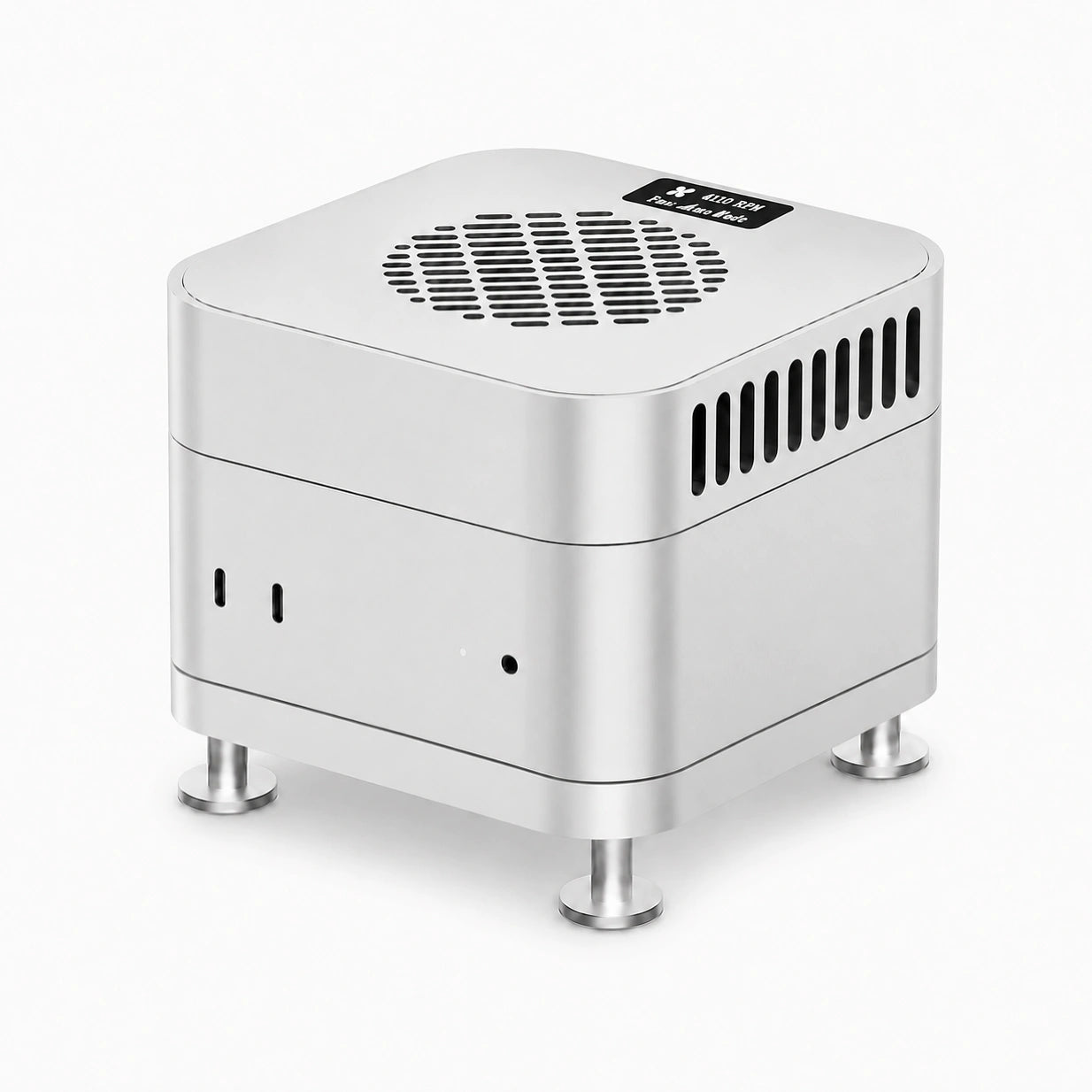
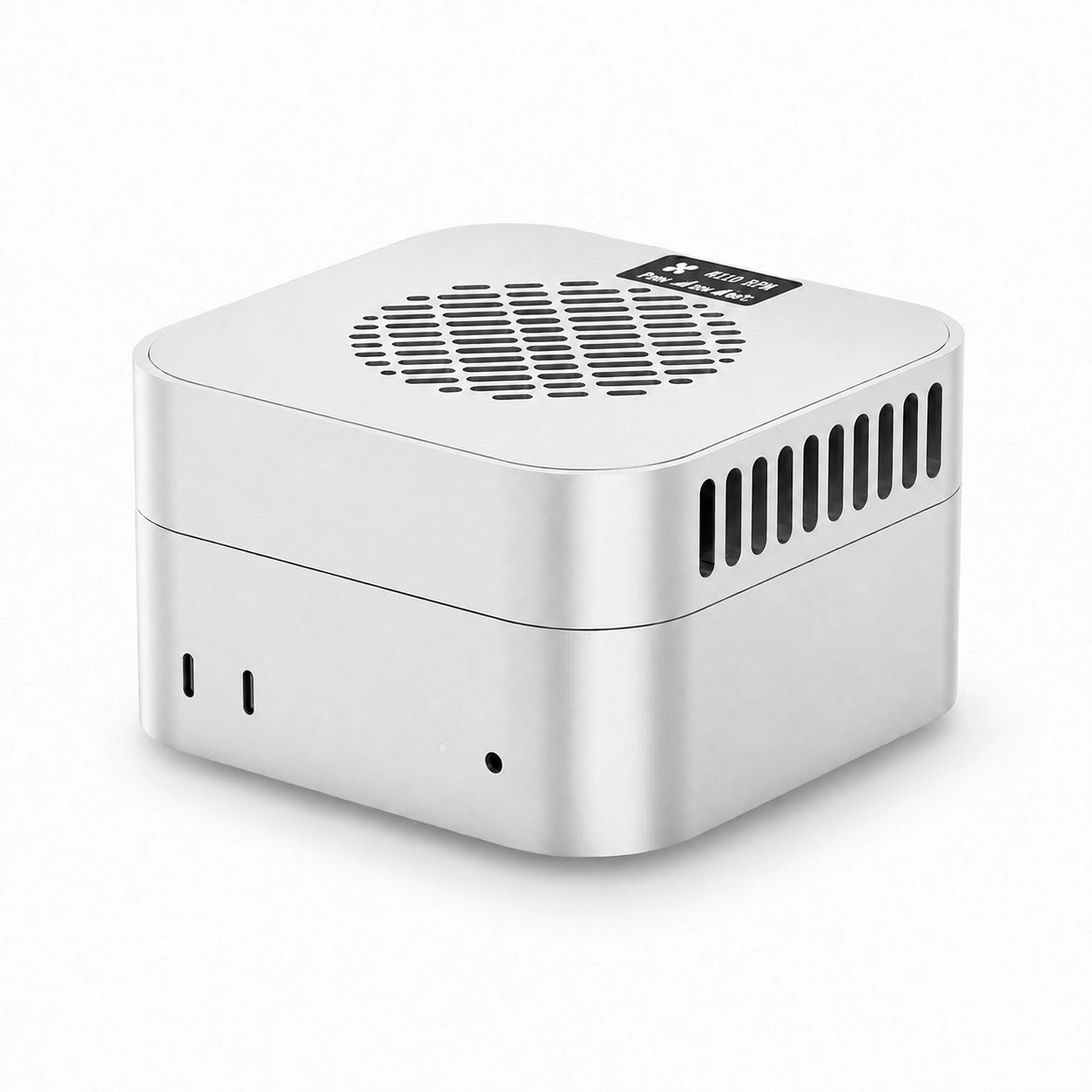
ZEERA MacFrost Pro is a 30W thermoelectric active cooler and CNC aluminum stand designed for Mac mini M6, M5 Pro and M4. Instead of blowing additional air into the bottom vents, it uses a direct-contact cooling plate and an included thermal silicone pad to draw heat through the top of the Mac mini’s aluminum enclosure.
The system offers 7W, 20W and 30W cooling levels, Auto temperature control and a 0.96-inch OLED display. The separate aluminum stand raises the computer while preserving access to its native bottom airflow. It is intended for sustained performance work, not as a requirement for every Mac mini owner.
For a technical explanation of Mac mini temperatures, cooler types and noise levels, see our Mac mini overheating and cooling guide.
What About Other M5-Powered Macs?
The old expectation that every Mac would move through the same chip name at the same time did not match Apple’s final 2026 lineup. Mac mini now combines M6 and M5 Pro configurations, while Apple’s Mac Studio announcement introduced M5 Max and M5 Ultra models. Product families can therefore use different chip generations simultaneously.
That makes exact model names more important than broad phrases such as “M5 Mac.” When comparing performance, accessories or compatibility, check both the computer family and the chip tier rather than relying on the chip generation alone.

Original M5-era illustration retained from the earlier version of this article.
Enhance a Mac Studio Setup with MacForge Studio
Mac mini is the focus of this guide, but Mac Studio owners can also give their desktop a Mac Pro-inspired appearance with the ZEERA MacForge Studio CNC Aluminum Case. Its aluminum enclosure is designed to add a more substantial professional desktop presence while maintaining ventilation and access around the computer.
Check the product page for the latest model compatibility before ordering, particularly if you are buying a newly released Mac Studio configuration.


Final Answer: The M5 Mac mini Rumor Was Only Partly Right
The long-running M5 Mac mini rumor ended with a less predictable answer than expected. Apple did bring M5 Pro to Mac mini, but the base model skipped standard M5 and moved to M6. The result is a 2026 lineup that gives mainstream users the newest base chip while reserving M5 Pro, Thunderbolt 5 and higher memory capacity for professional workflows.
The compact chassis remains, so current-generation accessories can continue across Mac mini M4, M6 and M5 Pro when explicitly designed for the shared footprint. Choose MacForge Gen3 when appearance, organization, accessible ports and silent passive thermal support matter most. Choose MacFrost Pro when the priority is active cooling during long, demanding workloads.
Frequently Asked Questions
Is there a standard M5 Mac mini?
No. Apple’s 2026 Mac mini lineup uses the M6 chip in the standard model and M5 Pro in the higher-performance model.
When is the new Mac mini release date?
Apple announced Mac mini with M6 and M5 Pro on August 25, 2026. Preorders opened that day, with availability beginning September 22, 2026.
Did Apple skip the M5 Mac mini?
Apple skipped the standard M5 chip for Mac mini, but it did not skip the M5 generation entirely because the professional model uses M5 Pro.
Does the M6 Mac mini have Thunderbolt 5?
No. The M6 Mac mini has three rear Thunderbolt 4 ports. Thunderbolt 5 is available on the Mac mini with M5 Pro.
Is MacForge Gen3 compatible with M6 and M5 Pro Mac mini?
Yes. ZEERA MacForge Gen3 is designed for the current compact Mac mini footprint used by Mac mini M6, M5 Pro and M4.
Does every Mac mini need an active cooler?
No. The built-in cooling system is generally enough for normal use. An active cooler is most relevant for repeated, sustained workloads where additional thermal headroom may help maintain more consistent performance.
What is the difference between MacForge Gen3 and MacFrost Pro?
MacForge Gen3 is a Mac Pro-inspired aluminum enclosure focused on desktop design, organization, port access and passive thermal support. MacFrost Pro is a powered 30W thermoelectric cooler and stand focused on active heat removal during sustained workloads.
Related Mac mini Guides