Quick Answer
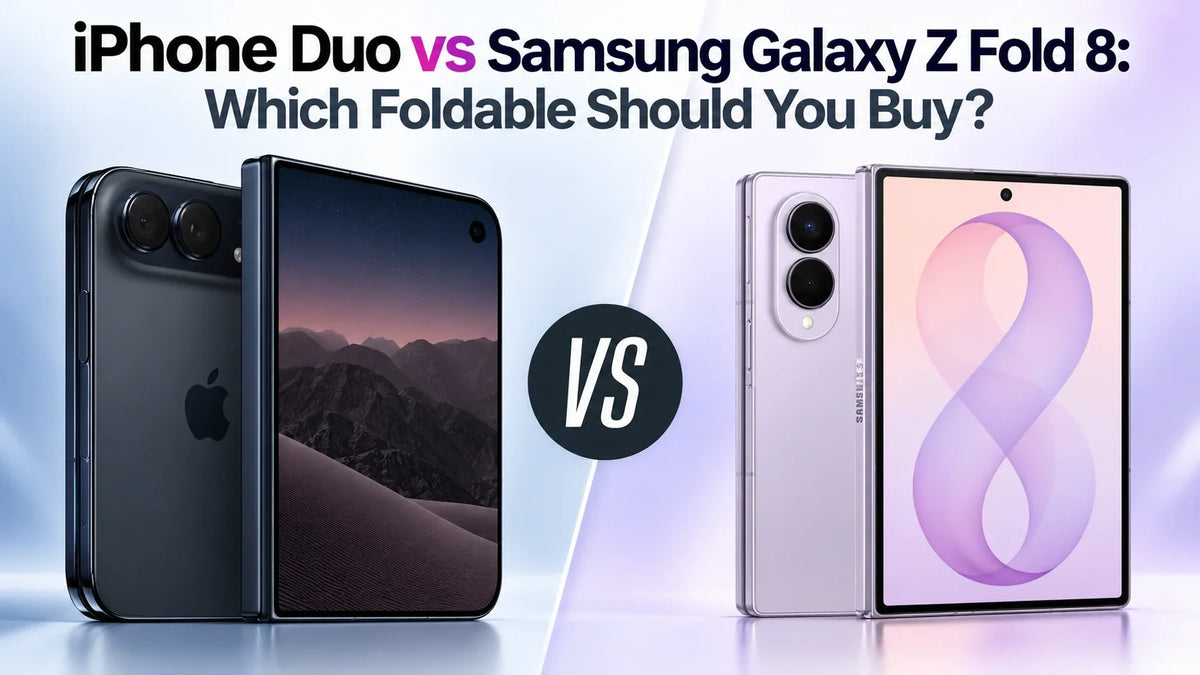
Choose iPhone Duo for its matte inner screen, flexible folding positions and Apple ecosystem.
Choose Galaxy Z Fold 8 for a lighter body, more adjustable multitasking and stronger value where discounted.
SuperSaf’s comparison favors Duo for battery life and overall video, while Samsung leads in ultrawide shots and the inner selfie camera.
The deciding question is how you will use the large screen: hands-free viewing and handwriting, or flexible app windows and desktop-style work.
iPhone Duo vs Galaxy Z Fold 8: what matters most?
Both are wide, passport-style foldables. Their biggest differences show up in your hand, on a desk and when two apps share the inner screen. This guide draws on SuperSaf’s head-to-head review, with published specifications checked against Apple and Samsung.
Duo’s extra weight buys a different folding experience; Samsung’s slimmer design makes everyday carrying easier. Neither approach wins every category.
Design and hinge: lighter carry or more useful folding positions?
Galaxy Z Fold 8: a substantial weight advantage
Samsung lists the Fold 8 at 201g; Apple lists Duo at 254g. That is a 53g difference before adding a case. SuperSaf’s own Samsung unit weighed about 205g, still noticeably lighter.
Samsung is also thinner: 4.5mm unfolded versus Duo’s 5.2mm. If you spend long periods holding a phone to read, that lower weight may matter more than an extra feature.
iPhone Duo: the hinge changes how you use it
In the demonstration, Duo holds intermediate angles for tabletop use, with content above and controls below. It also supports tent-style viewing and StandBy in supported positions.
The standard Fold 8 tends to spring open rather than remain at the same partial angle. Samsung explicitly says it does not support FlexMode. This comparison concerns Galaxy Z Fold 8, not Fold 8 Ultra.
Published dimensions and model features: Apple technical specifications and Samsung Galaxy Z Fold8.
Display: a less visible crease or richer-looking colors?
Duo’s matte finish disguises the fold
The two phones have 7.6-inch OLED inner screens with refresh rates up to 120Hz. Their surface finishes make them look different even before you compare brightness or resolution.
SuperSaf finds Duo’s nano-texture finish better at scattering reflections and making the crease less noticeable. The tradeoff is a softer-looking image, with less visual punch than Samsung’s glossy display.
Fold 8 favors contrast and color impact
Samsung’s anti-reflective coating reduces glare while retaining a glossier appearance. In the side-by-side comparison, colors look more vibrant and contrast appears stronger.
For reading near bright windows, Duo’s finish is appealing. For photos, games and movies, Samsung’s presentation may be more satisfying. A less visible crease does not mean the fold has physically disappeared.
Screen shape matters as much as diagonal size. For another useful reference, see how much 16:9 video iPhone Duo actually displays compared with Pro Max.
Battery and MagSafe: Duo’s advantage comes from daily use
SuperSaf reports roughly 10% better battery life on Duo while using both phones for similar daily tasks. This is his mixed-use observation, rather than a fixed runtime or a promise of 10% more life for every owner. Spending more time on the inner display changes the result.
Duo also has built-in MagSafe magnets. The Fold 8 needs a compatible magnetic case for that attachment and alignment experience. Apple’s U.S. specifications list up to 25W MagSafe and Qi2 charging for Duo; charging limits can differ by regional model and the charger used.
Multitasking: Samsung offers more control over your workspace
Duo: an approachable two-app workflow
Dragging an app to one side leaves the Home Screen available on the other, making it easy to choose your second app. That is a useful starting point for comparing products, taking notes beside a webpage or watching video while reading comments.
In the reviewed software, the split returns to an equal 50/50 layout when the divider is moved. Rotating the phone also maximizes the selected app rather than preserving the same split-screen arrangement.
Fold 8: resizable splits and three-app layouts
Samsung lets you resize app windows, keep a split arrangement through rotation and display three apps at once. SuperSaf also finds more third-party apps already optimized for the Fold 8 at the time of the review.
If one app needs more space than the other, Samsung’s flexibility is a meaningful advantage. Its Labs option can enable multi-window for additional apps; availability and behavior still depend on the app.
Both phones use a side fingerprint sensor. SuperSaf finds Samsung’s route to the Home Screen quicker; Duo’s Touch ID flow can involve an additional swipe or longer contact. He also prefers Duo’s left/right speaker separation when unfolded.
Duo’s A20 Pro and Samsung’s Snapdragon 8 Elite Gen 5 for Galaxy both deliver fast everyday operation in the review. The practical constraint is often app layout rather than chip speed. ZEERA’s iPhone Duo review hub collects more software and usability guides.
Cameras: choose by what you shoot
The review separates camera strengths instead of naming one winner for every shot. Its findings are particularly useful if you already know whether you shoot more people, landscapes or video calls.
Duo: portraits, low-light main-camera photos and video
SuperSaf prefers Duo’s portraits and main-camera results in low light. He also favors its overall video quality, especially dynamic range and low-light recording, along with its cinematic effects.
That makes Duo the more appealing choice from this comparison for family clips and portraits, even though Samsung offers a higher maximum video resolution.
Fold 8: ultrawide shots, zoom and inner-screen calls
Samsung produces better ultrawide results and better zoom in the review. It also offers 8K recording and more manual shooting options.
Its punch-hole inner camera is much clearer than Duo’s under-display camera. If you frequently join meetings with the phone unfolded, that difference can matter more than rear-camera specifications.
Neither phone has a dedicated rear telephoto lens. For a closer look at Duo’s hardware, see the camera teardown comparing its sensors with iPhone 17 and iPhone 18 Pro. If long-range photography is your priority, compare a conventional Pro or Ultra phone before committing to a foldable.
Apple Pencil or Samsung DeX: two different productivity benefits
Duo supports Apple Pencil (USB-C)
Apple identifies Apple Pencil (USB-C) as the supported Pencil for both displays. Install software that enables Pencil support before pairing it; compatibility is tied to the phone’s software as well as the Pencil model.
Do not substitute Apple Pencil Pro or an older Pencil model. Samsung confirms that the standard Galaxy Z Fold 8 does not support S Pen.
Fold 8 has the more direct desktop route
Samsung DeX lets the Fold 8 provide a desktop-style workspace on an external display. AirPlay on iPhone serves a different purpose and does not provide an equivalent DeX desktop.
For someone who wants one phone to connect to a monitor for desk work, this favors Samsung. For someone already working on a Mac and seeking a portable screen for notes and reading, Duo’s appeal is different.
Price and availability: the regional gap can decide the purchase
Apple’s announced U.S. starting price is $1,999, while Samsung lists the Fold 8 from $1,899.99 before trade-in. Compare equivalent storage configurations and the final checkout price, since promotions can change the difference substantially.
The video describes a much larger U.K. gap: approximately £1,999 for Duo against a temporary Fold 8 offer around £1,360. That is a snapshot from the recording, not a live offer. The same applies to its January delivery estimates for Duo: stock depends on storage, color and location.
Apple’s announced price and storage options are in its iPhone Duo launch announcement.
The buying decision
Duo makes sense when the matte screen, stable half-fold positions and staying within Apple’s ecosystem justify carrying a heavier phone.
Fold 8 makes sense when you value lighter hardware, adjustable app layouts and DeX, especially if the local price is substantially lower. Try your most-used apps on both screens before deciding; those layouts will affect your day more often than a benchmark score.
FAQ
Can I move my physical SIM straight into iPhone Duo?
No. Duo is eSIM-only worldwide. Confirm that your carrier can activate or transfer your plan to eSIM before switching, especially if you rely on physical travel SIMs.
Does an IP rating tell me which hinge is harder to break?
No. An IP rating concerns protection against specified dust and water exposure. It does not measure reverse-bending strength, drop resistance or long-term hinge wear. Those are separate durability questions.
Related reading