Quick Answer
WekiHome’s teardown puts iPhone Duo’s rear cameras much closer to iPhone 17 than iPhone 18 Pro.
The main camera has the same 1/1.59-inch sensor format and first-generation sensor-shift stabilization as iPhone 17, although its sensor model differs.
The 1/2.55-inch Sony IMX972 ultra wide is shared across Duo, iPhone 17 and iPhone 18 Pro.
Duo’s inner camera uses a square Sony IMX916 sensor, but the teardown chart lists only about 4.44MP actual image output.
The outer selfie camera outputs 12MP. The inner camera’s under-display optics add a further image-quality compromise.
Does iPhone Duo really use the same cameras as iPhone 17?
The WekiHome iPhone Duo teardown finally exposes the sensors beneath the lenses. Its central finding is clear: Duo’s rear-camera hardware is broadly iPhone 17-class, with the same main-sensor format, the same generation of stabilization and a matching ultra-wide sensor.
There is one detail worth getting right. The comparison labels Duo’s main sensor Sony IMX954 and iPhone 17’s IMX904. “Basically the same camera hardware” describes their size and configuration; it does not mean the complete main-camera modules are identical parts. Both sit below the larger main sensor in iPhone 18 Pro and Pro Max.
All iPhone Duo camera specifications from the teardown
All four camera sensors are identified as Sony components. The specification chart gives the following hardware details, including the distinction between the sensor’s native pixel count and the output used by the camera.

Main camera: Sony IMX954
51MP maximum native sensor pixels; 48MP maximum effective pixels; 1/1.59-inch optical format; ƒ/1.6 aperture; 26mm equivalent focal length; first-generation sensor-shift optical image stabilization.
Ultra wide: Sony IMX972
51MP maximum native sensor pixels; 48MP maximum effective pixels; 1/2.55-inch optical format; ƒ/2.2 aperture; 13mm equivalent focal length.
Outer front camera: Sony IMX915
24MP maximum native sensor pixels; 12MP actual output in the teardown chart; square CMOS sensor; ƒ/2.2 aperture; 23mm equivalent focal length.
Inner under-display camera: Sony IMX916
24MP maximum native sensor pixels; approximately 4.44MP actual output in the teardown chart; square CMOS sensor; ƒ/1.8 aperture; 22mm equivalent focal length.
The 51MP figure describes the rear sensors’ native pixel count; the effective imaging specification is 48MP. Likewise, the 24MP front-sensor figure does not mean Duo saves 24MP selfies. These are different stages of the imaging system. The fractional-inch figures are optical-format labels, rather than literal measurements of the chip’s width.
The main camera matches iPhone 17’s size, not the Pro sensor

| Phone | Main sensor | Optical format |
|---|---|---|
| iPhone 18 Pro / Pro Max | Sony IMX905 | 1/1.3-inch |
| iPhone Duo | Sony IMX954 | 1/1.59-inch |
| iPhone 17 | Sony IMX904 | 1/1.59-inch |
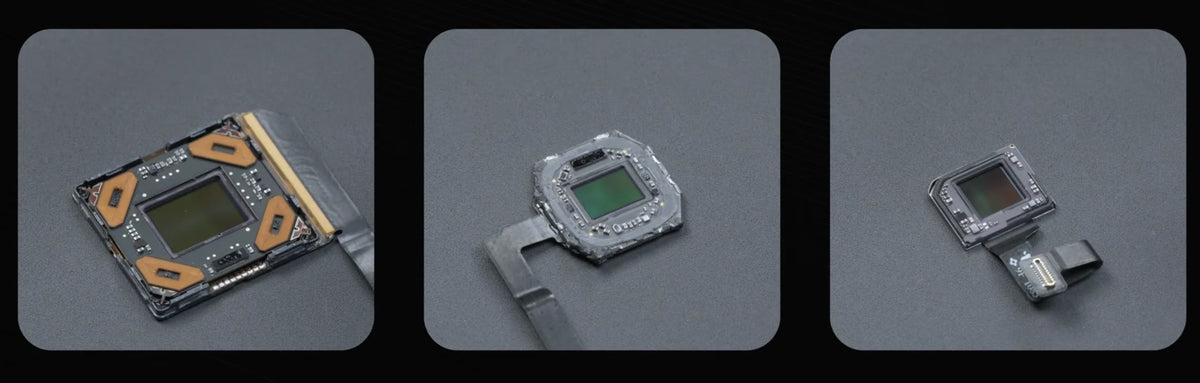
The exposed sensor comparison shows the difference directly: the Pro sensor is visibly larger, while Duo and iPhone 17 occupy the same size class. Duo also retains the first-generation sensor-shift stabilization arrangement identified in iPhone 17. A 48MP label therefore does not put all three main cameras on equal hardware footing.
A larger sensor can offer more light-collection potential, but the complete result also depends on the lens, exposure and image processing. This teardown explains the hardware hierarchy; it is not a controlled low-light photo comparison. Duo’s IMX954 designation also gives no basis for assuming that it has exactly the same readout or processing behavior as IMX904.
The ultra wide shares the same Sony IMX972 across all three

The ultra-wide finding is more straightforward. WekiHome identifies the same 1/2.55-inch Sony IMX972 in iPhone Duo, iPhone 17 and iPhone 18 Pro / Pro Max. Duo combines it with a 13mm-equivalent ƒ/2.2 lens and 48MP effective resolution.
This is where Duo’s camera hardware overlaps with both the standard and Pro models. It also shows why the comparison needs to be made camera by camera: the Pro has a larger main sensor, but its ultra-wide sensor is not larger in this teardown.
Why the inner camera produces weaker selfies despite a similar sensor size

The front-camera comparison labels iPhone 18 Pro and iPhone 17 with Sony IMX914, while Duo’s inner camera uses IMX916. All are square CMOS sensors, and WekiHome reports the same light-sensitive area. Duo’s outer IMX915 also has the same reported sensor area.
The difference becomes clear at the output stage. Duo’s chart lists 12MP for the outer camera and approximately 4.44MP for the inner camera, despite both sensors having up to 24MP native pixels. For reference, Apple lists iPhone 17’s front camera at 18MP. Sharing a square sensor format and similar area does not preserve the same usable selfie resolution.
The screen sits in the inner camera’s optical path
Light must pass through the display region before reaching the inner camera. That makes its optics fundamentally different from the outer front camera. WekiHome describes the inner camera’s image quality as mainly adequate for video calls, rather than the strongest choice for selfies.
The reviewer also compares Duo’s under-display camera region with the RedMagic 12 Pro+. Under the microscope, Duo has larger openings and a more open light-transmitting region, but lower local display-pixel density. This pixel density refers to the screen above the camera, separate from the camera sensor’s megapixels.
Larger openings help light get through, while the lower display density makes that area a greater compromise for the screen’s appearance. WekiHome suggests the arrangement may also contribute to the large color patches seen in Duo selfies. That proposed link is an explanation from the review, rather than an isolated cause proven by the microscope images.
The design is balancing three things at once: light transmission, display uniformity and camera image quality. The larger square sensor cannot, by itself, remove the effects of photographing through the display. For the screen construction behind that trade-off, see our iPhone Duo display materials and OLED teardown.
How Apple fits the outer camera into a 3.29mm module

WekiHome measures the outer front-camera assembly at only 3.29mm thick, including the protruding lens. The inner front-camera assembly reaches 6.15mm at its thickest point, using space available beneath the rear camera bump.
The outer camera saves height through its substrate construction. Instead of placing the CMOS sensor on top of the substrate as in the other front-camera examples, the substrate has a hollowed center. The sensor sits down inside that opening, with gold wire bonding around its edges.
This recessed arrangement explains how Apple achieves a much thinner module while retaining the reported sensor area. Module thickness, sensor area and final output resolution are separate specifications: the thinner outer camera still delivers the higher-resolution output of Duo’s two front cameras.
Camera mounts, flash and recording hardware: the rest of the transcript
The teardown also covers the parts around the sensors. These details explain how the cameras are mounted, protected and integrated into the foldable chassis.
Rear camera housing and removal
The back uses Ceramic Shield glass. WekiHome describes the camera-bump construction as similar to iPhone Air, with a one-piece cold-sculpted design and precision milling inside to create more space. Translucent molded material around the perimeter reinforces the area and helps retain the central metal protection plate. Thick dust-sealing foam surrounds the two rear cameras.
Shared metal cage and antenna routing
After disconnecting both batteries and removing the covers, the reviewer lifts an antenna running between the rear cameras, removes two camera-retaining screws and disconnects the camera interfaces. Both rear cameras sit in one metal cage; the inner front camera is removed during the same stage. This is why the assembled camera units and the number of individual lenses can look different in a teardown photo.
Front-camera alignment and thermal coverage
The outer screen’s concealed metal bracket reinforces the front-camera area. Positioning structures prevent lens movement, and foam provides dust protection. The inner front camera also has positioning structures and surrounding sealing foam. A thermal film covers the corresponding rear-camera and mainboard area.
Smaller flash and built-in ambient-light sensing
Duo’s flash incorporates rear ambient-light sensing. Its outer dimensions and internal LED unit are smaller than those of iPhone 18 Pro. The LED is not divided into the same segmented design, and the reviewer links this to the missing adjustable concentrated flashlight beam. The separate rear microphone sits beneath a metal cover nearby.
That beam adjustment concerns the flashlight’s spread. We examine the component comparison separately in why iPhone Duo cannot adjust its flashlight beam like iPhone 18 Pro.
Four microphones and the Camera Control cover
WekiHome counts four microphones in the phone, with smaller units than the Pro series, and describes them as below the Pro’s studio-quality microphone configuration. The Camera Control button retains a sapphire cover. These are additional recording and control differences beyond the image sensors.
Around the front assemblies, the outer ambient-light sensor also supports proximity sensing and sits near a laser emitter. The inner ambient-light/color-temperature sensor lacks proximity sensing; a second inner ambient-light sensor sits on the sub-board. Together with the rear flash’s sensing function, the teardown counts four ambient-light sensing locations.
What this means for photos, video calls and upgrading
For everyday rear-camera photography, the teardown gives a practical reference point: expect an iPhone 17-sized main sensor and the familiar IMX972 ultra wide, packaged for a foldable. The hardware does not provide the larger main sensor of iPhone 18 Pro, and the two rear lenses contain no dedicated telephoto camera.
Software and capture capabilities still differ. Apple’s Duo specifications list main-camera 4K Dolby Vision recording up to 120 fps, compared with up to 60 fps on iPhone 17. Its 2× optical-quality setting uses the main camera rather than an extra telephoto module. The outer front camera supports 4K video up to 60 fps, while the under-display inner camera records 1080p at 30 or 60 fps.
For a quick call on the large unfolded screen, the inner camera offers convenience. For a more detailed selfie, use the outer camera or the rear cameras with the outer screen as a viewfinder. Anyone choosing between Duo and a Pro specifically for photography should weigh these differences alongside the value of the folding display.
FAQ
Does 1080p video mean the inner camera records 4.44MP frames?
No. A standard 1920 × 1080 video frame contains about 2.07 million pixels. The teardown chart’s approximately 4.44MP image-output figure and Apple’s 1080p video specification describe different outputs.
Watch the original camera teardown
Sources: WekiHome’s teardown, the supplied Chinese transcript and camera specification/comparison images for sensor identification, measurements and construction; Apple’s linked technical specifications for published camera and video features.
Related Articles
- Why iPhone Duo cannot adjust its flashlight beam
- iPhone Duo display teardown: Samsung M16 OLED and materials
- Why iPhone Duo’s MagSafe ring and center magnet are different
- Inside iPhone Duo’s two steel-cased batteries
- iPhone Duo overheating during FaceTime: early review findings
- iPhone Duo review hub: specifications, problems and tests