ZEERA Research Desk · October 19, 2026 · Official-document analysis
Quick Answer
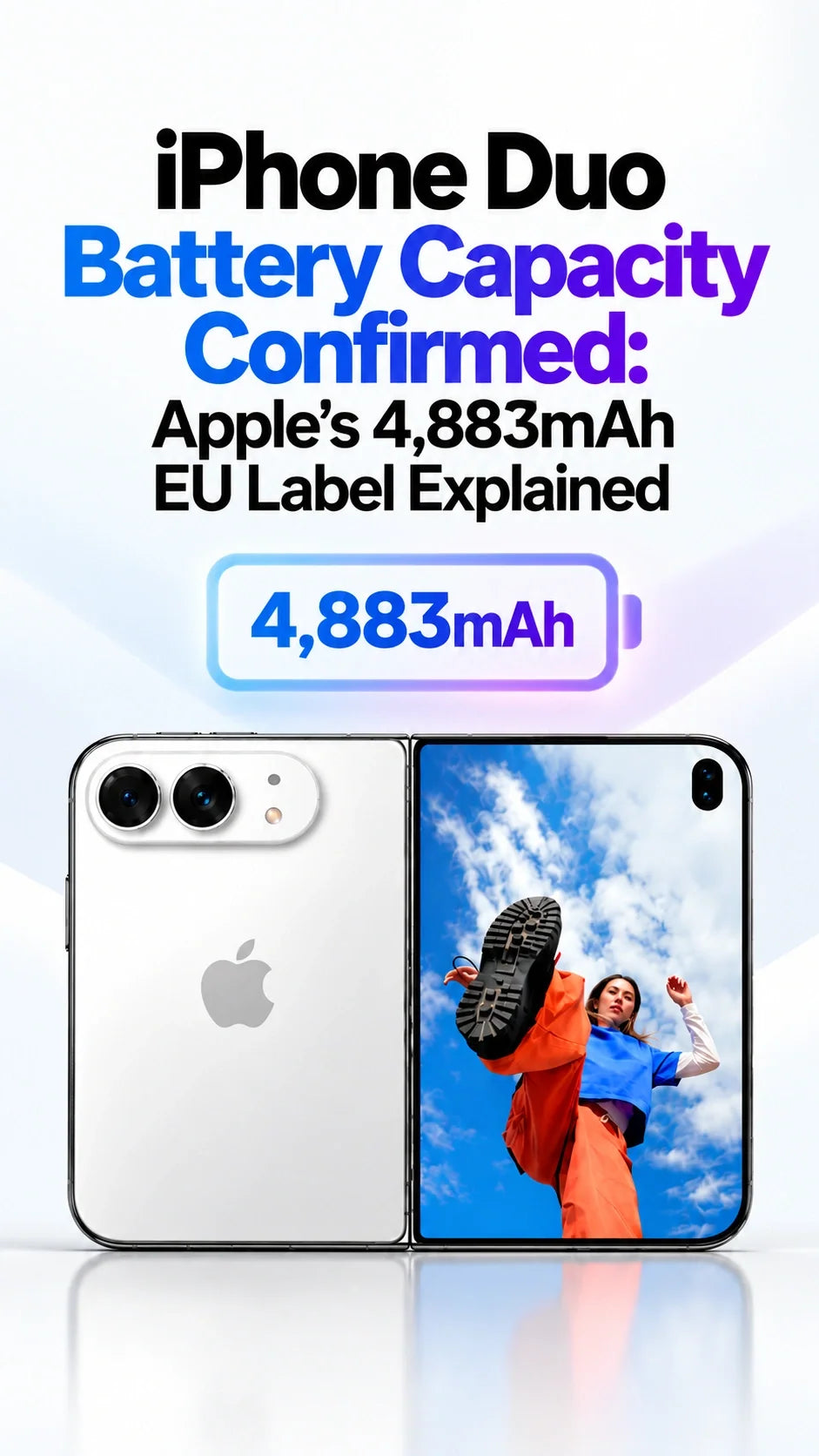
Apple has confirmed the iPhone Duo’s rated battery capacity at 4,883mAh in its EU Product Information Sheet for model A3720.
The same document lists 51 hours 30 minutes of EU-standard battery endurance and at least 1,000 charge cycles.
It also gives the Duo Class A energy efficiency, Class B drop reliability and Class C repairability (2.65/5).
51.5 hours is not a claim of 51.5 hours of screen-on time, and the 1,000-cycle figure concerns long-term battery health, not time between charges.
Primary source: Apple’s official A3720 EU Product Information Sheet (Version 1, PDF).
Where does the 4,883mAh figure come from?
It comes directly from item 10, “Rated battery capacity,” in a two-page regulatory sheet published on Apple’s own website. The document identifies the manufacturer as Apple and the model as A3720; Apple’s iPhone Duo technical specifications also identify A3720 as an iPhone Duo model.
That makes 4,883mAh a manufacturer-declared regulatory rating, not a leaked parts listing, a third-party teardown measurement or an estimated capacity inferred from battery-life claims. The sheet does not provide a separate rated mAh figure for each battery cell.
Every important number on Apple’s EU battery label
Rated battery capacity
4,883mAh
The combined rated capacity stated for the A3720 model; not a separate per-cell breakdown.
EU-standard endurance
51h 30m
Duration in a prescribed, repeatable usage test; not continuous display-on time.
Cycle endurance
≥1,000 cycles
A long-term battery-capacity measure under the applicable EU test method.
Energy efficiency
Class A
Highest letter grade on the EU A–G energy-efficiency scale.
Repeated-drop reliability
Class B
At least 140 falls in the unextended state and 35 in the fully extended state under standardized testing.
Repairability
Class C · 2.65/5
An EU scoring system for disassembly, parts, information and related repair requirements.
Other declared details: IP68 at 6m, a Mohs 5 screen scratch-resistance figure, USB-C with a listed 5W required charger output, no protective cover included, and a minimum five-year period of specified OS updates under the EU document’s timing rule. All values above are from Apple’s product sheet.
Important charging clarification: the label’s 5W entry is a required charger output, not the Duo’s maximum charging speed. Apple separately advertises up to 50% charge in around 20 minutes with a 60W-capable USB-C adapter, or around 30 minutes with a compatible MagSafe Charger and a 35W-or-higher power adapter, under its stated test conditions.
Does 51 hours 30 minutes mean the iPhone Duo lasts two full days?
No—not necessarily. The EU endurance number is the result of a defined test designed for comparable energy labels. The European Commission explains that the figure comes from a standardized scenario representing typical usage, not 51 hours of nonstop video, gaming or screen-on activity.
For example, the EU test specifies operating conditions including screen brightness and a prescribed sequence of tasks. A real user may spend long periods on the larger inner display, run navigation over cellular data, shoot video, or play demanding games. Those workloads can produce very different results.
EU energy-label test
51h 30m
Standardized usage scenario. Best suited to comparing devices tested under the same EU procedure.
Apple typical-use claim
Up to 24h
Apple’s own stated typical-use estimate, using a different method.
Apple video test · outer
Up to 44h
Video playback on the smaller outer display, using Apple’s test conditions.
Apple video test · inner
Up to 31h
Video playback on the 7.6-inch folding display, using Apple’s test conditions.
These figures cannot be added, averaged or treated as the same kind of test. The EU rating answers “How does the device perform under a common lab procedure?” Apple's playback claims answer a different question. Neither replaces independent real-world testing after release.
What does “at least 1,000 battery cycles” actually guarantee?
It describes cycle endurance, not how many days you can use the phone before recharging. In the EU labeling system, battery-cycle endurance is measured against the point where usable capacity declines to 80% of its rated new capacity. Apple’s “≥1,000” entry indicates the battery meets that declared endurance threshold in the standard test.
A full cycle is equivalent to cumulative charge/discharge throughput totaling 100% of capacity; it does not require draining the phone from 100% to 0% in a single session. For example, using 50% of the battery twice can add up to approximately one cycle. Temperature, charging patterns and workload still affect real-world aging.
What 1,000 cycles does not mean
It does not mean the battery must fail after its 1,000th cycle, will always retain exactly 80% capacity in your own conditions, or can only be charged 1,000 times. It is a measured threshold under default charging behavior, not an expiration date.
Class A is also an efficiency rating, not a promise of the longest possible runtime. A phone with a larger battery can last longer per charge while belonging to a different efficiency class. The EU rating and battery size answer related but separate questions.
How durable is the iPhone Duo? What Class B really measures
Apple’s document states at least 140 repeated falls without defect for the regular unextended test and 35 falls in the fully extended state. Under EU foldable-phone classification, this corresponds to Class B, not the highest Class A grade.
The EU uses a prescribed drop procedure; this is not a guarantee that any given iPhone Duo will survive 140 household drops, nor a reason to perform your own repeated-drop test. Impact angle, floor material and the condition of the hinge or display may differ substantially outside the lab.
Water and dust resistance
IP68 · 6m
Apple’s declared controlled-test ingress-protection rating; it does not mean the phone is waterproof in all conditions.
Screen scratch rating
Mohs 5
A regulatory screen-resistance figure; do not assume it proves identical scratch behavior on both screen surfaces.
The sheet also marks “shipped with protective cover: no.” If you want external protection, decide separately how much hinge coverage, outer-screen coverage and pocket bulk matter. ZEERA’s iPhone Duo case protection guide explains those trade-offs without treating a case as a guarantee against damage.
Why does Apple give the iPhone Duo a C repairability grade?
Its overall EU repairability index is 2.65 out of 5. The label also gives component scores that make the distinction clearer: 5.00/5 for spare parts, 5.00/5 for repair information, 2.24/5 for fasteners and just 1.12/5 for tools. A high availability score does not necessarily mean a simple repair process.
Apple also lists the battery as “user-replaceable: no.” This label uses a particular EU definition of replacement by an ordinary user with basic tools. It does not mean a worn battery is permanently sealed in or that Apple provides no battery-repair route.
In fact, page two of the same document explicitly refers to Apple’s Self Service Repair program, through which eligible individuals can access parts, tools and manuals for repairs including battery replacement. Check actual iPhone Duo repair-part and service availability in your region rather than assuming a universal do-it-yourself option.
Two other lines buyers often misread
Five years of specified OS updates: the sheet’s footnote says the minimum period is measured from the end of the product’s placement on the market, not automatically from its launch date. The document is not a promise of every future major iOS feature.
12-month supplier guarantee: this is the minimum guarantee declared on the sheet; it does not override any separate mandatory consumer rights that may apply locally.
What this official filing settles—and what still needs testing
Settled: A3720 has a declared 4,883mAh battery; the EU sheet records 51h 30m endurance, at least 1,000 cycles, Class A efficiency, Class B fall reliability and Class C repairability. These are now sourceable manufacturer-declared data, not speculative iPhone Duo battery numbers.
Not settled: how long a particular owner will last between charges when moving between the 5.4-inch outer and 7.6-inch inner screens; how quickly battery capacity changes under heavy heat and charging; and how specific cases or wireless accessories affect real usage. Those require controlled physical testing, not extrapolation from mAh.
If you're comparing protective accessories while waiting for independent testing, use the iPhone Duo case resource hub to find a guide that matches your actual use—not an unsupported battery-life promise.
FAQ: iPhone Duo’s official 4,883mAh battery rating
Is 4,883mAh the official iPhone Duo battery capacity?
Yes. Apple’s Version 1 EU Product Information Sheet for model A3720 declares 4,883mAh as its rated battery capacity. It is a regulatory declaration, not a teardown measurement.
Does the iPhone Duo use two batteries?
Yes. Apple’s published technical specifications describe dual built-in rechargeable lithium-ion batteries. The EU sheet gives the model’s combined rated capacity but does not specify the individual cell ratings.
Does Apple confirm the rumored 2,962mAh and 1,921mAh cell split?
No. Those individual cell values have been reported separately, but Apple’s A3720 EU sheet does not list them. The directly verifiable manufacturer-declared number is the total rated 4,883mAh.
Why does the EU label say 51.5 hours while Apple says 24 hours?
They come from different test methods. The EU figure is standardized device endurance; Apple’s 24-hour figure is its separate typical-use claim. They should not be interpreted as equivalent screen-on results.
Does 1,000 cycles mean the battery lasts only 1,000 days?
No. Cycle endurance measures cumulative battery usage until a specified capacity-retention threshold in lab testing. A cycle does not equal a calendar day, and 1,000 cycles is not an automatic failure date.
Can the iPhone Duo battery be replaced?
The EU document marks it “not user-replaceable” under the regulation’s definition, but it links to Apple Self Service Repair and acknowledges battery replacements. Actual service and parts availability may vary by region.
Is the iPhone Duo drop-proof because it received Class B?
No. Class B is based on repeatable laboratory drop tests, not a promise of survival in every real-world accident. It does not remove the risk of hinge, frame or display damage.
Official sources
- Apple — Product Information Sheet, model A3720, Version 1 (PDF). Primary source for rated capacity, endurance, reliability, repairability and supplier declarations.
- Apple — iPhone Duo Technical Specifications. Confirms model identifier, two built-in batteries, and the separate Apple usage and video figures.
- European Commission — Smartphones and Tablets Energy Label. Defines the meaning of endurance, cycle retention and class ratings.
- EU Delegated Regulation 2023/1669. Standardized testing and labeling methods.
Related iPhone Duo guides