Updated October 2, 2026
Quick Answer
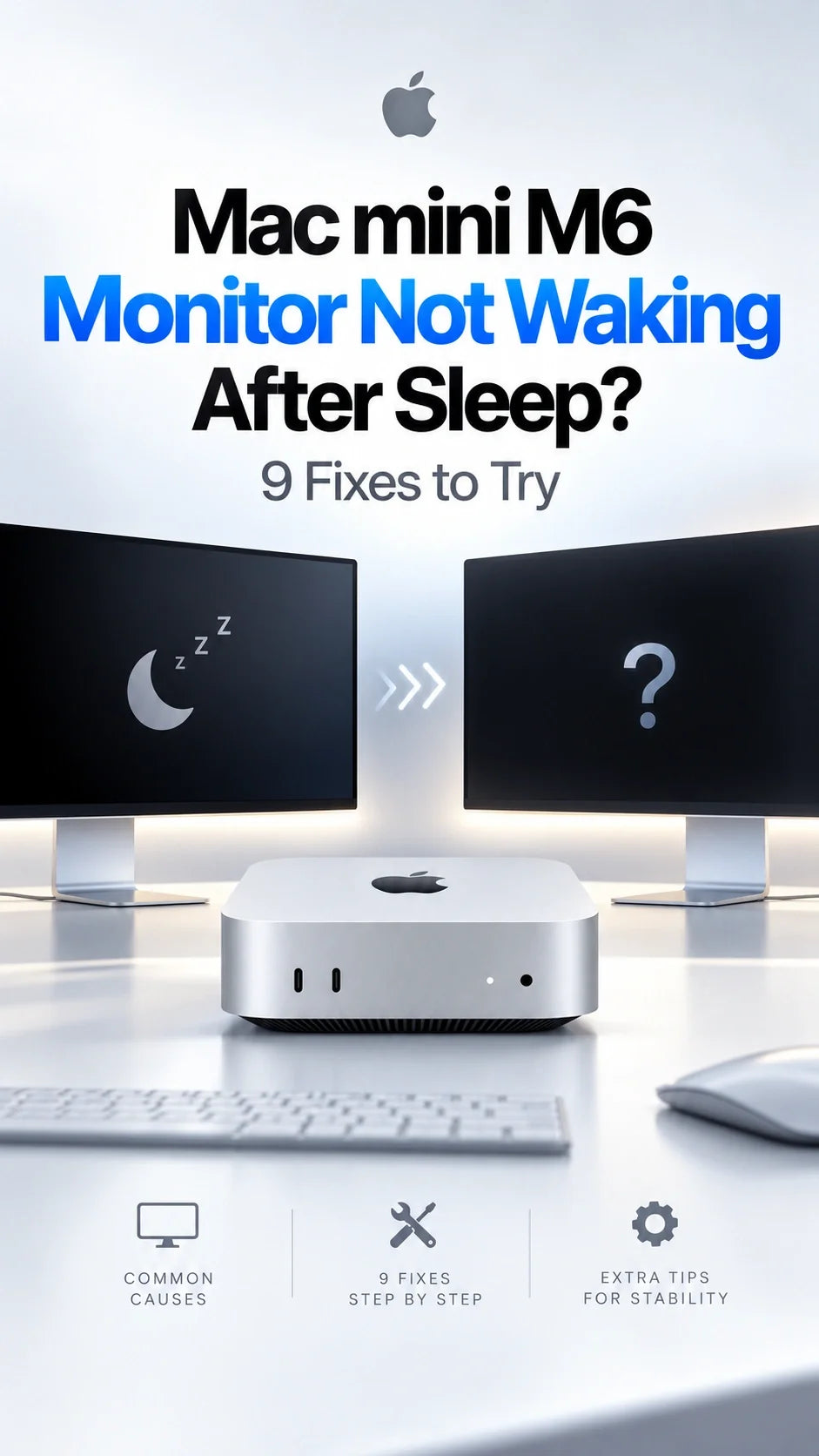
If your Mac mini M6 wakes but the monitor stays black, start by power-cycling the display and reconnecting it directly to the Mac.
Bypass the dock, KVM and adapter, then test another cable or output port.
If the picture returns at 60Hz with Adaptive Sync and HDR off, the likely problem is the signal path or display handshake—not a dead Mac mini.
Update macOS and the monitor or dock firmware before changing permanent sleep settings.
Do not begin with old Intel Mac SMC-reset instructions; the M6 is an Apple silicon Mac.
A black screen after sleep can look like a Mac mini M6 failure, but the symptom often begins somewhere between the Mac, cable, dock and display. Sleep and wake force that entire chain to negotiate the video signal again.
If one device resumes too slowly, the monitor may show No Signal, stay black, flicker, or appear only after you unplug the cable. High refresh rates, variable refresh rate, HDR, KVM switches and multi-monitor docks add more variables.
ZEERA’s troubleshooting assessment is simple: reduce the setup to one monitor and one direct cable, make it reliable, then add one feature or accessory back at a time. This identifies the failed link faster than changing several macOS settings at once.
First Check: Is the Mac Asleep or Only the Monitor Black?
Likely a display-path problem
The Mac reacts to the keyboard, audio continues, another screen works, or the monitor wakes only after reconnecting HDMI, USB-C or DisplayPort.
Possibly a system wake problem
No monitor works, input devices do not respond, network access disappears, and the Mac does not react until you force it off.
Start with the display fixes below if the Mac itself appears awake. If the entire computer repeatedly becomes unresponsive, skip to Fix 9 and consider Apple Support.
9 Fixes for a Mac mini M6 Monitor That Will Not Wake
Fix 1 · Fastest test
Wake the Mac, then power-cycle the monitor
Press a key or click the mouse, then briefly press the Mac mini power button once if needed. Do not hold it down, because a long press can force the Mac off.
- Turn the monitor off with its own power button.
- Disconnect the monitor from power and from the Mac.
- Reconnect power, turn the display on and choose the correct input.
- Reconnect the video cable to the Mac mini.
Apple includes disconnecting the display from both the Mac and its power source among its recommended steps for a dark external display.
Fix 2 · Isolate the chain
Connect one monitor directly to the Mac mini
Remove the dock, USB-C hub, KVM, capture device, extension cable and adapter. Connect one display directly to HDMI or use one direct USB-C-to-DisplayPort/Thunderbolt connection.
If direct connection wakes reliably, the Mac and monitor can communicate. Add the dock, KVM and other devices back one at a time. The first item that brings the failure back is the most useful lead.
Fix 3 · Monitor settings
Select the input manually and disable deep-sleep features
Open the monitor’s on-screen menu and manually select the port connected to the Mac. Temporarily turn off settings named Auto Input Switch, Deep Sleep, Eco Mode, Power Saving or HDMI-CEC. Names differ by manufacturer.
This is a test, not a requirement for every monitor. If manual input selection fixes wake, re-enable the convenience features one by one to find the conflicting option.
Fix 4 · Hardware path
Try another cable, output port and connection type
A cable can work after a cold boot but fail during the shorter wake handshake. Reseat both ends, then test a known-good cable that supports the resolution and refresh rate you actually use.
- Move the connection to another compatible Mac mini port.
- If possible, compare HDMI with direct USB-C-to-DisplayPort or Thunderbolt.
- Remove couplers and extensions.
- For a two- or three-monitor setup, test each display alone.
If only one cable, port or interface fails after sleep, you have narrowed the problem without replacing the monitor.
Fix 5 · macOS control
Use Detect Displays in System Settings
Open System Settings → Displays. Hold the Option key until the Detect Displays button appears, then click it.
Apple documents this hidden button for an external display that the Mac does not recognize. If the display immediately appears, the connection was present but the wake negotiation had not completed correctly.
Fix 6 · Bandwidth test
Set 60Hz and turn off Adaptive Sync or VRR
In System Settings → Displays, select the affected monitor and temporarily choose a fixed 60Hz refresh rate. Turn off Variable or Adaptive refresh rate. If the problem continues, test once with HDR off.
If wake becomes reliable, raise the refresh rate again one step at a time. A setup that works at 60Hz but fails at 120Hz, 144Hz, 165Hz or 240Hz points toward the high-bandwidth signal path, monitor input mode or cable.
This does not mean the M6 cannot drive a high-refresh display. Confirm that the complete setup fits the supported combinations in our Mac mini M6 monitor support guide.
Update Software Before Using a Permanent Workaround
Fix 7 · Firmware
Update macOS, the monitor and the dock
Go to System Settings → General → Software Update and install the latest compatible macOS update after making a backup.
Then check the monitor, Thunderbolt dock, USB-C hub or DisplayLink vendor for firmware and software updates. If you use Apple Studio Display, its firmware updates are delivered through macOS Software Update.
After updating, shut down the Mac mini and fully power-cycle the monitor and dock before testing sleep again.
Fix 8 · Temporary workaround
Prevent automatic system sleep when the display is off
Open System Settings → Energy and enable Prevent automatic sleeping when the display is off. Let the display turn off, but keep the Mac awake.
This can avoid the full system-sleep handshake that triggers some black-screen cases. It is useful when you need a stable workstation immediately, but it is not the ideal final fix because the Mac stays awake and uses more energy.
If this option solves the problem, continue testing the cable, dock, refresh-rate and firmware path rather than leaving the workaround unexplained.
Fix 9 · Software isolation
Start the M6 Mac mini in Safe Mode
- Shut down the Mac mini completely.
- Press and hold the power button until Loading startup options appears.
- Select the startup volume.
- Hold the Shift key and click Continue in Safe Mode.
If the monitor wakes normally in Safe Mode, review display utilities, DisplayLink software, login items, screen-control tools and recently installed drivers. Restart normally and disable one item at a time.
If the issue also happens in Safe Mode with one known-good monitor and a direct known-good cable, document the monitor model, port, resolution, refresh rate and macOS version, then contact Apple Support.
Should You Reset the SMC or NVRAM on a Mac mini M6?
Do not follow Intel Mac key combinations as your first fix.
The M6 Mac mini uses Apple silicon. Guides that tell you to restart while holding Option–Command–P–R were written for Intel Macs, and the traditional unplug-and-keyboard SMC reset procedure does not apply in the same way.
For an M6, prioritize a normal restart, a complete shutdown, software updates, Safe Mode and connection-path testing. This article intentionally does not present an Intel NVRAM or SMC reset as one of the nine fixes.
When the Pattern Tells You What Is Wrong
Direct cable works
Investigate the dock, KVM, adapter, extension or its firmware.
60Hz works
Check high-refresh bandwidth, VRR, HDR, the cable specification and monitor input mode.
Safe Mode works
Review display software, drivers, login items and third-party utilities.
Every simple setup fails
Test a second known-good display, then contact Apple if the Mac still cannot wake a direct connection.
Do not replace an expensive monitor just because it failed one wake test through a dock. Equally, do not assume the Mac mini is healthy if every direct, low-bandwidth, known-good display fails in normal mode and Safe Mode.
For a cleaner permanent workstation after the signal issue is solved, see our Mac mini M6 desk setup guide. Desk organization can simplify the cable path, but an enclosure or stand does not electrically repair a failed monitor handshake.
FAQ
Why does my Mac mini M6 wake but the monitor says No Signal?
The Mac may be awake while the cable, adapter, dock or monitor fails to renegotiate the video signal. Test one direct cable and one monitor first.
Is HDMI worse than USB-C or DisplayPort for wake?
Not automatically. Reliability depends on the complete path, including the cable, monitor input, resolution, refresh rate and any adapter. Compare direct HDMI with a direct USB-C-to-DisplayPort or Thunderbolt connection if both are available.
Why does the problem happen only at 144Hz or 165Hz?
A higher refresh rate uses more link bandwidth and can expose a weak cable, adapter, dock or monitor input setting. A stable 60Hz test is a useful diagnostic step, not proof that the Mac mini lacks high-refresh support.
Should I reset the SMC on a Mac mini M6?
No traditional Intel Mac SMC-reset sequence should be your starting point. The M6 is Apple silicon. Use a normal shutdown or restart, update macOS, test Safe Mode and isolate the display connection.
Is it safe to prevent the Mac mini from sleeping?
It is a reasonable temporary workaround, but the Mac stays awake and consumes more power. Continue troubleshooting so you can restore normal sleep behavior.
Do I need a new monitor?
Not until you test another cable, direct connection, fixed 60Hz, updated software and a second known-good display. Replace or service the monitor only after isolating it as the consistent failure point.
Related Mac mini Guides
Sources