Quick Answer
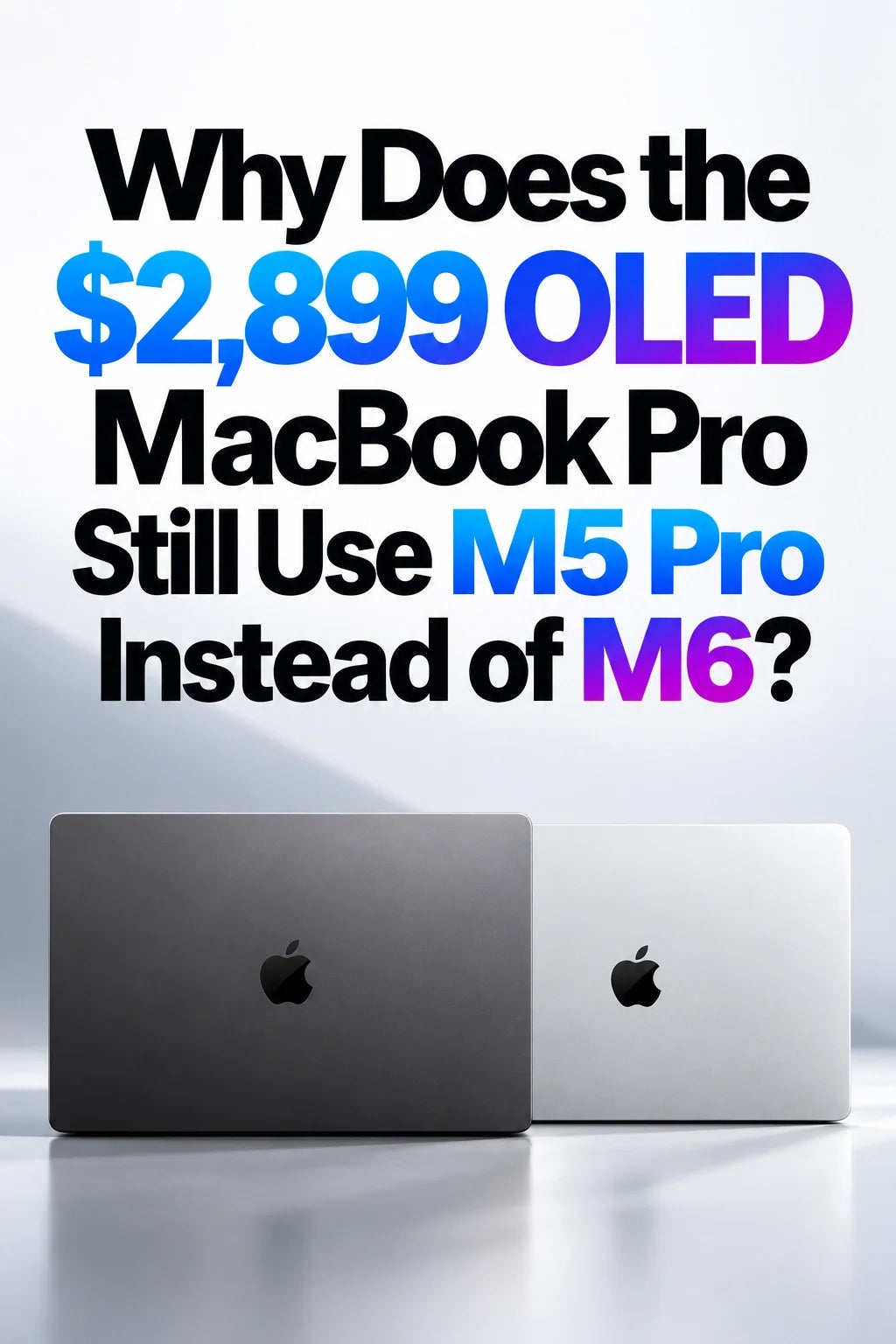
The $2,899 OLED MacBook Pro uses M5 Pro because Apple’s premium laptop combines a higher-tier processor with a new display and design. M6 is a newer chip generation, but the base M6 does not replace every capability of M5 Pro. The latter offers more CPU and GPU cores, greater memory capacity and higher memory bandwidth. Apple announced the M6 MacBook Pro on October 27, 2026, followed by the OLED model on October 28. ZEERA’s reading: Apple is selling two kinds of progress at different prices—newer silicon in the entry model, and a more capable platform with OLED in the premium model.
A newer chip in the cheaper MacBook?
Apple’s launch sequence creates an awkward first impression. Its M6 MacBook Pro announcement arrived on October 27; the redesigned OLED MacBook Pro followed one day later with M5 Pro and M5 Max. Those are U.S. announcement dates. Importantly, October 27 was M6’s arrival in MacBook Pro, not the chip’s debut: Apple had already announced M6 in Mac mini in August.
The apparent contradiction comes from treating the number after “M” as a complete performance ranking. Apple’s specifications show a more complicated picture. Generation tells you when a chip family arrived; Pro and Max identify a different level of hardware resources.
M6 vs M5 Pro: what the specifications reveal
For the full entry-model overview, see our M6 MacBook Pro launch guide. The relevant comparison here is the base M6 against the entry M5 Pro, rather than a fully upgraded Pro configuration.
| Specification | M6, mini-LED | M5 Pro, OLED |
|---|---|---|
| CPU / GPU | 12 / 12 cores | 15 / 16 cores |
| Starting memory | 16GB | 24GB |
| Memory bandwidth | 153GB/s with 16GB; 170GB/s with 24GB or 32GB | 307GB/s |
| Memory ceiling | 32GB | 48GB with this GPU; 64GB with the 20-core GPU option |
| Thunderbolt | Thunderbolt 4 | Thunderbolt 5 |
Specification sources: Apple’s Liquid Retina XDR models and PROLED XDR models.
That bandwidth distinction is particularly useful. M5 Pro provides roughly twice the bandwidth of the 16GB M6 configuration, and about 81% more than M6 configurations rated at 170GB/s. These are bandwidth comparisons, not promises of equivalent gains in application speed.
For a large project, the practical question is whether the computer can hold the working data and move it quickly enough. A newer CPU architecture cannot make a project fit into insufficient memory. Likewise, more GPU resources can matter when an application spreads substantial work across them.
M6 still has its own strengths
M6 introduces newer CPU technology and a Dual 16-core Neural Engine. Apple’s advertised gains over M5 refer to the base M5, not M5 Pro. Different tasks use different parts of the chip, so neither the generation number nor the core count settles every workload. An application-specific benchmark is the right way to judge a close performance decision.
The $900 gap is not an OLED-only surcharge
The headline comparison is $2,899 versus $1,999: a $900 gap, or about 45%. However, those starting prices also span different processor tiers and memory configurations.
| Model | Starting price | Position |
|---|---|---|
| M6, Liquid Retina XDR | $1,999 | Entry MacBook Pro |
| M5 Pro, Liquid Retina XDR | $2,499 | Higher processor tier |
| M5 Pro, PROLED XDR | $2,899 | Premium display and redesign |
The more useful display-and-design comparison is therefore the $400 step between the two M5 Pro starting models—about 16%. That is a comparison of product bundles, not a measurement of the OLED panel’s manufacturing cost. The standard M5 Pro price is also documented in MacRumors’ prelaunch pricing report.
The premium bundle includes a tandem OLED touchscreen, Dynamic Island and a lighter chassis. For a photographer or editor working away from a desk, the built-in screen is part of the production tool. For someone using an external monitor all day, the same upgrade has a different value. Our breakdown of the $400 touchscreen premium examines that decision in more detail.
Why this lineup makes commercial sense
ZEERA’s analysis: the product lineup supports a clear business interpretation, although it does not disclose Apple’s internal decision-making. Apple can refresh the processor story and the physical experience on separate schedules, while charging for the benefits each buyer values.
1. It creates several reasons to move up the range
A customer satisfied with everyday performance can enter through M6. A customer constrained by memory or graphics resources has a reason to consider Pro. A customer who wants that platform together with the new screen and lighter design has another reason to spend more.
This is price segmentation: different bundles let buyers choose how much they are willing to pay. Keeping the standard design available also preserves an option for customers who need Pro resources but place less value on touch and OLED.
2. The redesign can earn its own premium
A processor upgrade is often noticed when a task finishes sooner. A screen and weight change can be noticed whenever the laptop is opened or carried. Those benefits appeal to overlapping groups of customers, but they do not depend on the same buying motivation.
Reusing the processor tier lets Apple establish a separate price for the physical experience. That can raise revenue per buyer when customers choose the premium design. It does not establish how much profit Apple makes on the upgrade: component costs, assembly expenses and product mix are not provided in the launch materials.
3. Hardware development does not run on one clock
A redesigned laptop brings together a display, hinge, chassis, thermal system and software behavior. Keeping an existing chip platform is one way a manufacturer can limit the number of major changes it must validate at once. It also allows a product launch to proceed without tying it to another processor launch.
This is a plausible engineering and commercial explanation, rather than evidence of a chip shortage, a delayed M6 Pro or inventory clearance. The published specifications do not identify any of those as the cause.
ZEERA’s view: price the improvement you can use
As an Apple accessory brand, we look at hardware value through the problem a design solves. An enclosure, stand or cooling system earns its place by improving a particular setup. Its material, appearance and function can carry value even when the computer’s processor stays the same. The same way of assessing value helps explain this MacBook launch.
The OLED premium is most persuasive when the screen is central to the work. Its individually lit pixels can make bright details against dark backgrounds easier to distinguish without backlight blooming; Adobe RGB support adds another relevant capability for compatible photography and print workflows. Apple lists 2,000-nit peak HDR brightness, while sustained full-screen brightness is rated up to 1,000 nits. Those are different operating conditions.
For desk-based work, map the bottleneck first. If projects exceed available memory, prioritize memory capacity. If rendering occupies the day, examine benchmarks from the software you actually use. If visual review happens on an external display, assess that display before paying more for the laptop panel.
A fixed workstation may also make a desktop worth comparing. Apple’s Mac mini lineup already pairs M6 and M5 Pro at different prices, showing the same distinction between generation and processor tier. A monitor, input devices and the need to work away from the desk belong in the total-cost comparison. Our Mac mini versus MacBook buying guide covers those setup costs.
Who should consider the OLED model?
You create and review work on the road
The strongest candidate is someone who needs Pro-class resources and regularly relies on the built-in display: an editor reviewing footage on location, a photographer selecting images between shoots, or a designer presenting directly from the laptop. Compare the premium with how often those improvements help you deliver work.
You mainly need a capable everyday Mac
Start with M6 and configure enough memory for the applications you keep open together. The OLED model’s higher price needs a specific benefit to justify it. Having a larger budget alone does not mean its additional capabilities will improve your work.
You already own an M5 Pro or M5 Max MacBook Pro
Treat this as a display-and-design purchase. A new chassis with the same chip name is not, by itself, evidence of faster exports or builds. Keep the existing machine unless the new physical experience solves a problem worth the replacement cost.
Our buying rule: identify the job your current machine struggles with, then pay for the hardware that improves that job. Apple’s naming makes this launch look contradictory; its specifications make the choices easier to understand.
FAQ
When does the OLED MacBook Pro become available?
Preorders opened on October 28, 2026. Apple lists November 6, 2026, as the start of customer deliveries and store availability.
Does the touchscreen MacBook Pro run iPadOS?
No. It runs macOS 27. Touch adds another way to interact with the Mac alongside its keyboard and trackpad; it does not change the operating system to iPadOS.
Related Reading
- M6 MacBook Pro: official specifications, price and release date
- Is the touchscreen MacBook Pro worth the extra $400?
- The glowing Apple logo returns with PROLED XDR
- M6 MacBook Pro versus a discounted M5
- Mac mini versus MacBook Air and Pro: comparing the total setup
- Mac mini accessories: MacForge Gen3 and MacFrost Pro
Additional official context: Apple’s August 25 M6 and M5 Pro Mac mini announcement. Prices are U.S. starting prices before tax, checked for this October 29, 2026 analysis.
Guichang Chen · ZEERA WIRELESS · October 29, 2026
Reposting Notice: Please credit Guichang Chen · ZEERA WIRELESS when sharing or republishing this article.