Quick Answer
Apple has not announced a Mac Neo, and the widely shared $299 price, A19 Pro chip and 12GB memory configuration should be treated as an unconfirmed concept rather than a verified product leak. If Apple built it, an A19 Pro desktop could feel close to the M4 Mac mini in many short, everyday actions because their single-core performance is relatively close. The Mac mini should remain much faster in sustained multi-core work such as long video exports, code builds and 3D rendering. Storage, ports, display support, design and release date remain unknown.
Price Update — September 8, 2026
The popular “$300 cheaper than Mac mini” comparison uses the M4 Mac mini’s original $599 U.S. starting price. Apple now lists the new M6 Mac mini for preorder from $899, with availability beginning September 22. If a Mac Neo still launched at $299, the gap versus Apple’s current entry Mac mini would be $600—not $300.
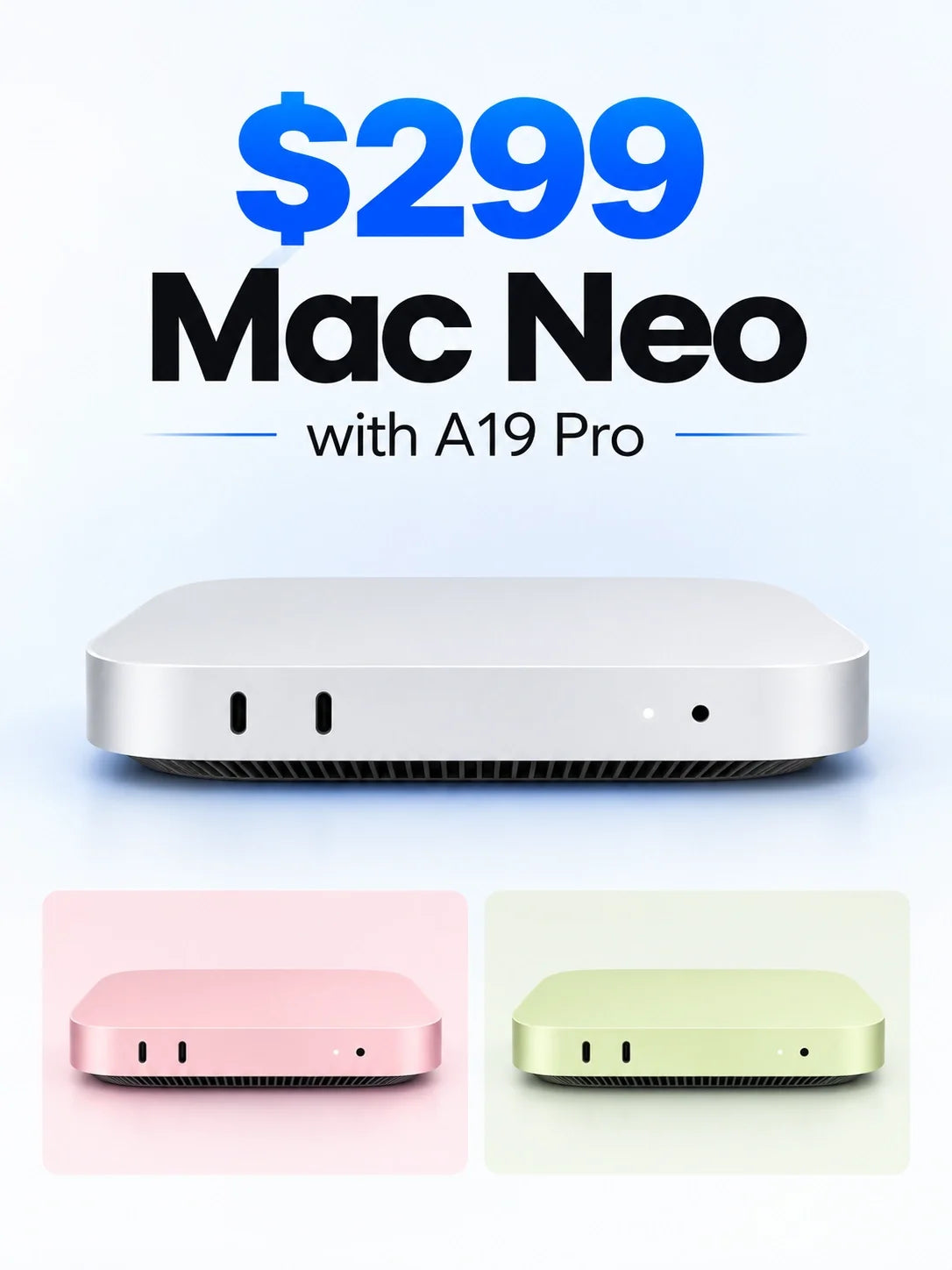
A $299 Mac Neo would be Apple’s cheapest desktop Mac by a wide margin. That possibility is easy to understand: take the A-series approach Apple has already used in MacBook Neo, remove the built-in display and battery, and create a compact entry-level Mac for web browsing, schoolwork, documents, streaming and basic home-office use.
However, the appealing price has traveled farther online than the evidence behind it. The most useful question is not simply “Is Apple making a $299 Mac?” It is: What would an A19 Pro desktop actually be good at, where would it fall behind a Mac mini, and which important specifications are still missing?
What Is the Rumored Mac Neo?
Mac Neo is the name being used online for a possible low-cost Apple desktop positioned below Mac mini. The frequently repeated configuration combines an A19 Pro chip, 12GB of unified memory and a speculative $299 starting price.
This idea follows Apple’s real MacBook Neo, which proved that macOS can run on an iPhone-class A-series processor. Apple’s current MacBook Neo uses the A18 Pro, 8GB of unified memory and 256GB or 512GB of SSD storage. That makes an A-series desktop technically plausible, but it does not confirm that Apple plans to sell one.
| Mac Neo claim | Status | What it means |
|---|---|---|
| Mac Neo product name | Unconfirmed | Apple has not announced a desktop with this name. |
| $299 starting price | Speculative | A compelling target price, but not an Apple price or a verified supply-chain leak. |
| A19 Pro chip | Speculative | Plausible because Apple already ships an A-series Mac, but not confirmed for a desktop. |
| 12GB unified memory | Speculative | Consistent with A19 Pro devices, but no Mac Neo configuration has been verified. |
| Storage, ports and displays | Unknown | These details would determine whether the machine is genuinely useful as a desktop. |
| Release date | Unknown | There is no confirmed launch window or preorder date. |
Would Mac Neo Really Cost $299?
The Mac Neo $299 price is the headline that makes the rumor attractive, but it is also the least substantiated part. Apple has not announced the product, price or a new desktop tier below Mac mini.
The original comparison was simple: a $299 Mac Neo would cost exactly $300 less than the M4 Mac mini’s $599 launch price. That would place a complete macOS computer close to the price of some Chromebooks, small Windows PCs and higher-end streaming boxes.
That baseline has since changed. Apple’s U.S. store currently lists the M6 Mac mini from $899. The old $599 figure remains useful for understanding how the Mac Neo discussion started, but it should not be described as the current Apple Store price.
A real $299 Apple desktop would also need compromises. Apple could limit memory configurations, SSD capacity, external display support, high-speed I/O, Ethernet options or the number of ports. Until those specifications are known, the headline price alone cannot tell us the true cost of a usable setup.
Mac Neo Rumored Specs
The current Mac Neo discussion centers on three numbers: $299, A19 Pro and 12GB. Everything else is open.
| Specification | Rumored Mac Neo | Why buyers should care |
|---|---|---|
| Processor | A19 Pro | Could deliver fast everyday response with fewer CPU cores than an M-series Mac mini. |
| Memory | 12GB unified memory | Potentially enough for common tasks, but limited for large creative projects, virtual machines and local AI models. |
| Starting price | $299 | Would create a new budget Mac desktop category if accurate. |
| Storage | Not reported | A 128GB and a 256GB base model would offer very different long-term value. |
| Ports | Not reported | USB speed, Thunderbolt, HDMI and Ethernet could define the difference from Mac mini. |
| External displays | Not reported | Display count and maximum resolution are essential desktop specifications. |
| Design | Not reported | It could resemble a smaller Mac mini, an Apple TV-sized box or something entirely new. |
How Fast Could an A19 Pro Mac Neo Be?
An A19 Pro Mac should not automatically be described as “phone performance.” Apple’s A19 Pro is a modern six-core processor, and its strongest CPU cores are fast enough to compete closely with desktop-class Apple silicon in short single-threaded tests.
Public Geekbench 6 averages currently place the iPhone 17 Pro’s A19 Pro at about 3,152 in single-core and 8,755 in multi-core. The 2024 M4 Mac mini averages roughly 3,279 in single-core and 15,354 in multi-core.
| Geekbench 6 CPU | A19 Pro in iPhone 17 Pro | M4 Mac mini | Practical reading |
|---|---|---|---|
| Single-core | About 3,152 | About 3,279 | A19 Pro is about 4% lower—close enough that many short actions may feel similarly responsive. |
| Multi-core | About 8,755 | About 15,354 | A19 Pro delivers about 57% of the M4 score, leaving the M4 roughly 75% faster in this benchmark. |
Important Benchmark Context
These are averages from shipping iPhone 17 Pro and M4 Mac mini devices—not Mac Neo test results. A desktop enclosure, different cooling, macOS behavior, power limits and the exact A19 Pro configuration could change performance. Benchmarks also do not measure every real application equally.
Why Single-Core Performance Matters for Everyday Use
Web research, document editing and video playback are usually bursty workloads. The processor works quickly when you open a page, switch tabs, apply an edit, launch an app or begin playback, then often returns to a lower level of activity.
In those moments, strong single-core performance has a visible effect on responsiveness. That is why a possible A19 Pro Mac Neo could feel quick when:
- Opening Safari tabs and web apps
- Writing in Google Docs, Microsoft Word or Notes
- Managing email, calendars and messages
- Streaming YouTube, Apple TV+ or Netflix
- Making light edits to photos
- Running school and office applications
- Using a remote desktop or cloud-based work platform
Single-core performance does not make two computers equal. It only explains why a lower-cost machine can feel fast during short interactions even when its total computing capacity is much lower.
Why Mac mini Could Pull Ahead in Long Multi-Core Work
The balance changes when a task keeps many CPU cores busy for minutes or hours. Long video exports, large code compilations, 3D rendering, scientific workloads and heavy batch processing can use more cores continuously.
The M4 Mac mini has more CPU cores than A19 Pro and a desktop thermal design built for sustained work. Its large multi-core benchmark advantage suggests that a long task could finish substantially sooner on Mac mini, even if both computers seem similarly responsive when opening the app.
This distinction answers a common question: How can two Macs feel close in normal use but finish the same export at very different times? Opening the project and navigating the interface depend heavily on short bursts of performance. Rendering the entire project is a continuous, parallel workload.
A desktop chassis might let A19 Pro maintain higher performance than it can in a phone, but cooling cannot create extra CPU cores. A Mac Neo could improve sustained behavior over an iPhone while still remaining well below an M-series Mac mini in multi-core throughput.
Is 12GB of RAM Enough for a Budget Mac?
12GB of unified memory could be enough for a low-cost Mac focused on browsing, documents, streaming, communication and light creative work. It would also be 50% more than the 8GB included in the first MacBook Neo.
But 12GB would define the product’s ceiling. Unified memory is shared by the CPU, GPU and system, and it cannot be upgraded later. Many browser tabs, large photo libraries, virtual machines, local AI models and complex creative apps can increase memory pressure quickly.
| Workload | How 12GB may fit |
|---|---|
| Browsing, email and documents | Likely a comfortable target for typical users. |
| Streaming and media playback | Likely sufficient, assuming the required display and codec support. |
| Light photo editing | Potentially suitable for smaller libraries and occasional edits. |
| 4K video editing | May work for short, simple projects but would offer limited headroom. |
| Large code projects or virtual machines | Mac mini with more memory would be the safer choice. |
| Local AI models | 12GB would sharply limit model size and multitasking capacity. |
Memory capacity also says nothing about SSD size. A 12GB Mac Neo with only 128GB of storage would be a very different purchase from one with a 256GB or 512GB SSD. Buyers should not treat the rumored RAM figure as a complete specification.
Storage and Ports May Matter More Than the Chip
For an affordable Mac desktop, the missing specifications could matter more than another benchmark. A small SSD can fill rapidly after macOS, applications, photos and offline files are added. External storage can help, but only if the device has enough fast ports.
Before deciding whether a Mac Neo is worth waiting for, buyers would need answers to these questions:
- Does the base model include 128GB, 256GB or more storage?
- Are its USB-C ports USB 2, USB 3, USB4 or Thunderbolt?
- Does it include HDMI and Ethernet?
- How many external displays can it support?
- Can it drive a 4K or 5K monitor at the desired refresh rate?
- Does it support fast external SSDs?
- Is Wi-Fi the only standard networking option?
A $299 computer that needs a dock, storage drive and Ethernet adapter may cost far more after setup. Mac mini’s higher price buys not only CPU performance but also a more complete desktop platform.
Mac Neo vs Mac mini: Who Would Each Mac Be For?
If Apple releases a budget Mac Neo, it would make more sense as a separate entry-level Mac than as a replacement for Mac mini.
| Buyer or task | Rumored Mac Neo | Mac mini |
|---|---|---|
| First Mac for basic home use | Could be an excellent low-cost entry point. | More expensive, with greater long-term headroom. |
| Student documents and browser work | Potentially enough if storage and ports are practical. | Better for heavier courses, coding and creative applications. |
| Living-room or family computer | A strong possible use case for a small, quiet desktop. | Better when multiple peripherals and displays are required. |
| Long video exports and rendering | Likely much slower under sustained multi-core load. | The clear choice for repeat professional workloads. |
| Local AI, virtual machines and large builds | 12GB would be restrictive. | Higher memory options and M-series performance are better suited. |
| Multi-display desk setup | Unknown until Apple reveals display support. | The safer purchase when connectivity is essential. |
Could Mac mini Supply Constraints Make Mac Neo More Likely?
Mac mini and Mac Studio availability became a major story in 2026, with high demand for compact Apple silicon systems and broader memory constraints affecting configurations and delivery times.
One theory suggests that an A-series Mac could use a more mature production path and reduce direct competition with higher-end M-series chips and their associated memory configurations. That is a reasonable manufacturing hypothesis, especially after Apple shipped an A18 Pro MacBook Neo.
It is still only a hypothesis. Apple has not said that it plans to use A19 Pro in a desktop to solve Mac mini supply, and current shortages do not confirm a new product strategy. Apple has separately announced that future Mac mini production will begin at a new facility in Houston, but that announcement does not mention Mac Neo.
Should You Wait for Mac Neo or Buy a Mac mini?
Do not postpone necessary work for a product Apple has not announced. If you need a Mac now for professional applications, large projects, multiple displays or sustained performance, buy based on the confirmed Mac mini lineup and the configuration you can obtain.
Waiting may make sense if your current computer still works and your needs are limited to browsing, documents, video playback and light apps. In that case, a $299 Apple desktop would be unusually attractive—but only if the final storage, ports and display support meet your needs.
The decision can be reduced to one question: Are you buying for fast everyday interactions or for the time it takes to complete long, demanding jobs? A possible Mac Neo could be optimized for the first. Mac mini is designed to handle both.
What Would Make a $299 Mac Neo Worth Buying?
The A19 Pro name alone would not determine value. A genuinely useful Apple desktop under $300 would need a balanced base configuration.
- At least 256GB of storage for practical everyday use
- 12GB of unified memory without an expensive required upgrade
- At least one fast USB-C port for external storage
- Reliable support for a modern 4K display
- A clear path to Ethernet through a built-in port or affordable adapter
- Quiet cooling that can sustain performance during longer tasks
- Several years of macOS and security updates
If Apple reaches $299 by cutting storage too deeply or limiting connectivity, the Mac mini may remain the better long-term value. If the base configuration is balanced, Mac Neo could become one of the easiest ways to enter the Mac ecosystem.
Bottom Line
The rumored Mac Neo is compelling because the core idea is believable: Apple has already demonstrated an A-series Mac with MacBook Neo, and A19 Pro offers strong single-core performance for everyday computing.
But the complete “$299 Mac Neo with A19 Pro and 12GB RAM” package is not confirmed. Public benchmark data suggests it could feel responsive in short tasks while falling far behind an M-series Mac mini in sustained multi-core work. The unanswered questions—storage, ports, displays, cooling and release date—matter just as much as the chip.
For now, treat Mac Neo as an interesting low-cost Mac concept, not a product to preorder or a reason to assume the Mac mini is being replaced.
Mac Neo FAQ
Is Apple Mac Neo real?
Apple has not announced a Mac Neo desktop. The name and proposed configuration are currently an unconfirmed media concept, not a verified Apple product.
How much will Mac Neo cost?
$299 is the widely discussed target price, but Apple has not confirmed a price or even the product. Treat it as speculation.
Will Mac Neo use the A19 Pro chip?
A19 Pro is the chip most often proposed for Mac Neo. It is plausible because Apple already uses an A-series chip in MacBook Neo, but no A19 Pro desktop has been announced.
Would Mac Neo have 12GB of RAM?
The rumored configuration includes 12GB of unified memory. Apple has not confirmed the amount, whether it would be fixed or whether other memory options would be available.
Would Mac Neo be as fast as Mac mini?
It could feel close to an M4 Mac mini in some short, single-core-heavy actions. Mac mini should remain considerably faster in sustained multi-core workloads because its M-series chip has more CPU cores and a desktop-oriented performance envelope.
Is 12GB enough for macOS?
12GB should be workable for browsing, documents, streaming and light creative tasks. It offers less headroom for virtual machines, large video projects, heavy multitasking and local AI models.
When will Mac Neo be released?
There is no confirmed Mac Neo release date, announcement event or preorder schedule.
Should I wait for Mac Neo instead of buying Mac mini?
Wait only if your current computer is adequate and your needs are light. If you need a Mac now or depend on sustained performance, larger memory options and known connectivity, choose from Apple’s confirmed Mac mini lineup.
Sources and Fact-Check Notes
- Apple: current Mac mini pricing and availability
- Apple: M4 Mac mini launch price
- Apple Support: MacBook Neo technical specifications
- Apple: A19 Pro in iPhone 17 Pro
- Geekbench: iOS benchmark averages
- Geekbench: 2024 M4 Mac mini benchmark averages
- AppleInsider: the Mac Neo concept and proposed positioning
- Apple: future Mac mini production in Houston
Last fact-checked September 8, 2026. Rumor details can change before any official announcement.