Quick Answer
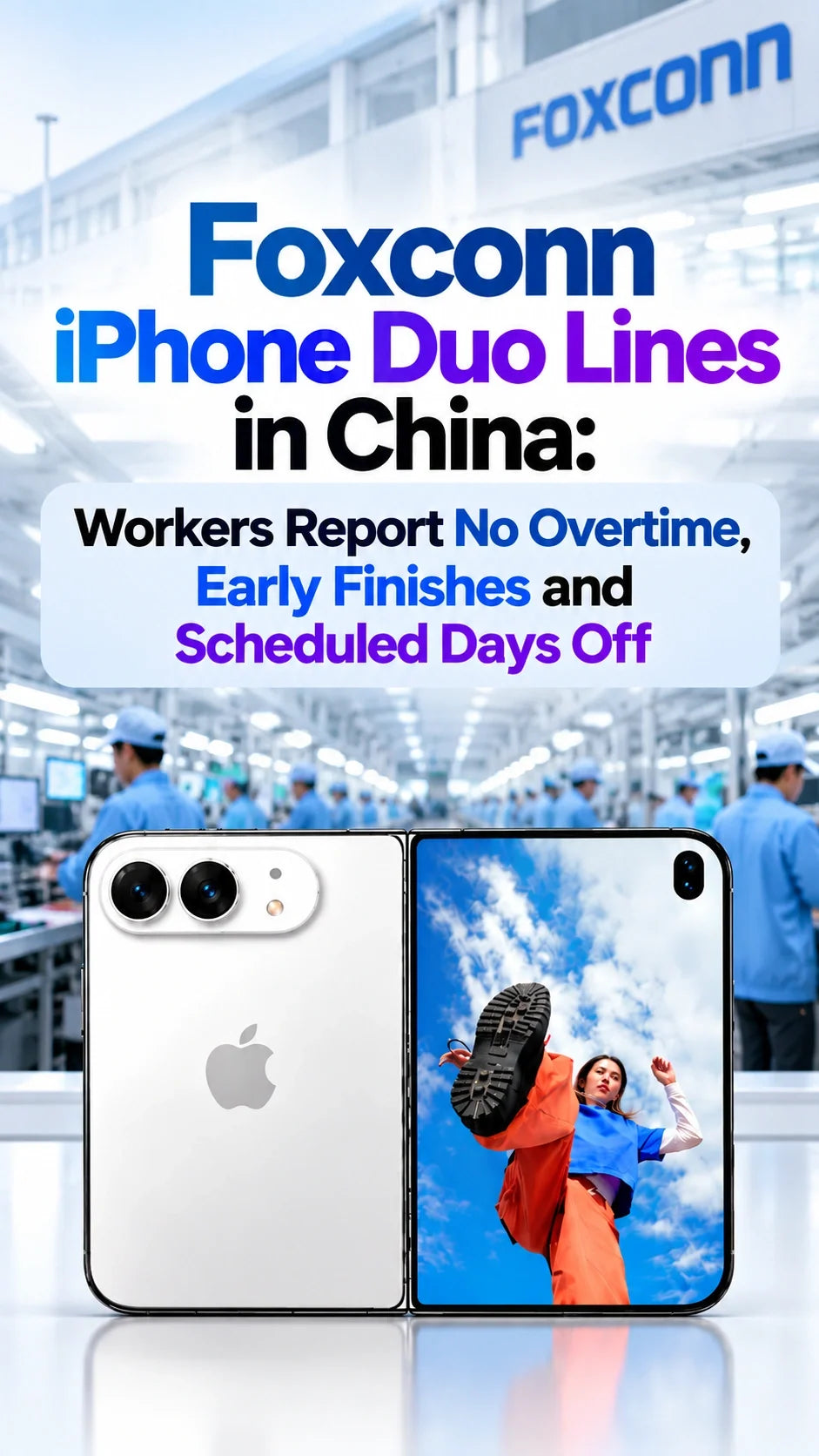
Frontline-worker reports relayed to ZEERA describe some Foxconn iPhone Duo production roles in China working without overtime, finishing early or being assigned days off.
The accounts point to interrupted component supply and an inner-screen assembly bottleneck; these claims have not been independently verified.
A separate claim puts Amphenol-related hinge yield at around 40%, with no confirmed measurement period or production scope.
Suggestions that some work may be moving to Luxshare remain unconfirmed. Shorter shifts alone cannot establish an order transfer or weaker demand.
As of October 19, 2026: preorders have opened; Apple's scheduled first release date is October 23.
What are Foxconn iPhone Duo workers reporting?
The information provided to ZEERA concerns some production roles, rather than a verified shutdown across Foxconn's iPhone Duo operations. The reported changes include no overtime, an earlier end to the working day and scheduled days off. The accounts also describe shortages of incoming parts and difficulty increasing output at the inner-screen assembly stage.
ZEERA has not independently authenticated production logs, staffing schedules or supplier quality records behind these accounts. They should be read as an early factory-floor signal whose coverage is unknown, rather than a measurement of Foxconn's total output or Apple's worldwide orders.
Why can parts shortages lead to shorter shifts?
A phone assembly line needs the right combination of usable components at the right time. More staff hours cannot complete a phone that is waiting for a required display, hinge or other part. In this context, a reported material shortage can mean missing finished components or subassemblies, rather than a shortage of raw metal or glass.
Missing parts can leave downstream work idle
If an upstream delivery is interrupted, later assembly or inspection stations may have less work available. Ending a shift early can match staffing to what can actually be processed. That is a possible explanation for the worker accounts, not a verified description of Foxconn's scheduling decisions.
A slow station can constrain an otherwise ready line
Even with sufficient components, one difficult assembly step can hold up later stages. Extra overtime elsewhere may create more unfinished units instead of more phones ready to ship. The precise location of a bottleneck matters more than the number of people available to work.
ZEERA's analysis: shorter shifts and a long customer waiting list can coexist. A factory may have strong order demand while being unable to convert it into finished output at the desired pace.
What could an inner-screen assembly bottleneck mean?
The worker account refers to inner-screen assembly, which is a different issue from a panel supplier failing to deliver enough screens. A usable incoming panel still has to become part of a functioning phone.
In a foldable design, the screen, support layers, hinge movement and chassis must work together. Apple's official iPhone Duo description details a hinge with more than 100 components, screen layers that can slide relative to one another and a titanium backing plate. These design details explain why integration is demanding; they do not identify the current cause of a production delay.
Panel supply and screen installation are separate constraints
A shortage of incoming panels limits how many assemblies can start. An installation or inspection problem limits how many can move successfully through the next step. Either could slow production, and both could occur together.
ZEERA has no verified process data identifying whether alignment, bonding, support flatness, functional testing or another operation is responsible for the reported inner-screen bottleneck. Naming one of those as the confirmed fault would go beyond the available information.
A September 21 republication of Jiemian News's reporting described equipment and process adjustments during the production ramp, alongside earlier panel and hinge-component supply setbacks. It supports the broader context of a difficult ramp, but does not independently verify ZEERA's newer worker reports.
Is the reported 40% hinge yield an Amphenol figure?
The frontline information supplied to ZEERA identifies Amphenol as the relevant supplier and suggests a hinge yield of around 40%. That number is unverified. No supporting quality report, sample size, date range, factory or inspection definition has been provided.
There is public background for Amphenol's involvement in the foldable iPhone hinge supply chain. In his October 12, 2025 industry survey, analyst Ming-Chi Kuo assigned approximately 35% of hinge orders to Amphenol and about 65% to a Foxconn–Shin Zu Shing joint venture. That historical survey does not establish today's supplier shares or validate the 40% claim.
Hinge yield is not finished-phone yield
A component yield, a hinge-module acceptance rate and a final assembly yield measure different stages. A first-pass failure may also be recoverable through rework. Without knowing the definition, a low percentage cannot be converted into a scrap rate.
Jiemian's earlier account put final assembly yield slightly above 60% as of September 17. It is an older, differently scoped figure. Multiplying 40% by 60%, or claiming that six out of ten retail phones are defective, would be unsupported.
The 40% allegation therefore remains a lead requiring corroboration. The supply-chain question is whether enough accepted hinge assemblies are reaching the relevant line; the figure alone cannot quantify the shipping impact.
Could Apple be shifting iPhone Duo production to Luxshare?
Another explanation circulating alongside the worker reports is that some production work may be moving to Luxshare Precision. ZEERA has not verified a current transfer of iPhone Duo final assembly from Foxconn to Luxshare, its volume or its timing.
Public discussion of Luxshare's participation is not consistent. A contribution carried by 36Kr describes entry into the Duo assembly supply chain, but does not document a recent transfer causing Foxconn shift changes. Meanwhile, Cailian Press's September 10 original reporting specifically described Luxshare developing hinge technology for a subsequent Apple foldable.
Kuo's 2025 survey also discussed Luxshare as a possible future hinge supplier after 2027. Neither future hinge development nor participation somewhere in the supply chain demonstrates that current finished-phone assembly orders have moved.
Three possibilities need different evidence
- Final assembly reallocation: would require evidence of Duo phone-building orders and output at another assembler.
- Component or module work: could involve a hinge or another subassembly without changing the final assembler.
- Future qualification or development: can prepare a supplier for later products without reducing today's Foxconn allocation.
Conditional analysis: if final assembly work has been reallocated, it could contribute to less work at particular Foxconn stations. But if both assemblers depend on the same constrained components, moving an assembly order would not automatically create more usable screens or hinges. Reallocation and parts shortages could also coexist.
For now, the Luxshare explanation is a hypothesis to investigate. A shorter shift is evidence about a local work schedule, not evidence identifying which company has received an order.
Do shorter shifts contradict Apple's reported production increase?
Not necessarily. Securities Times reported on October 10 that Apple had increased Duo production orders by 30%, with the total still below 10 million units. An order increase is a plan for supply; it is not a count of finished phones leaving the factory each day.
For the commercial meaning of that earlier report, see our iPhone Duo production increase and availability analysis. Here, the new question is how parts and assembly capacity could prevent planned orders from becoming consistent output.
An expansion can include uneven station workloads
Jiemian's October 12 report from Apple's COO visit to Foxconn described new manufacturing processes and Sabih Khan's comments about expanding production while maintaining quality standards. Expansion across a program does not require every station or every shift to operate at maximum hours each day. That is a manufacturing interpretation, not confirmation of the anonymous accounts.
The same Securities Times report described lower orders for iPhone 18 Pro and higher orders for Pro Max, leaving the combined Pro-series total unchanged. It cannot support a blanket claim that all traditional Pro orders have fallen.
What does this mean for iPhone Duo delivery dates?
Apple's published launch schedule places preorders on October 16 and first availability on October 23. As of this article's October 19 date, the first release day is still ahead.
The Verge reported on October 16 that the configurations it checked on Apple's website showed delivery in late January 2027. That snapshot describes estimates for orders available then. It does not establish that every earlier customer had an October delivery promise pushed back.
Check the promise attached to your own order
- Keep the delivery window shown on your confirmation and compare it with later status changes.
- Distinguish a later estimate for a new order from a delay to an existing order.
- Ask a retailer to distinguish allocated stock from a reservation awaiting allocation.
- Use your local market's estimates; a global production target cannot determine a US, UK or German delivery date.
Our Duo shipping and pickup guide covers purchasing options separately. A factory rumor is not a reliable basis for cancelling a confirmed order or paying a resale premium.
What would show that the production situation is improving?
The useful signals are accepted component deliveries, output through the constrained assembly step and more predictable replenishment. A return to overtime might accompany an improvement, but overtime alone cannot show how many complete phones pass inspection.
Evidence to watch
- Factory evidence: dated, consistently defined output or acceptance data, rather than an isolated shift anecdote.
- Supplier evidence: confirmation of the relevant component, process and period behind any yield claim.
- Luxshare evidence: a credible report identifying current Duo final assembly work, rather than general iPhone or future hinge involvement.
- Customer evidence: steadier retail replenishment and shorter delivery estimates across comparable configurations.
ZEERA's assessment is that the worker accounts are consistent with a supply or assembly constraint, but cannot establish its size or duration. The Luxshare possibility remains open. Neither explanation can be settled from work schedules alone.
If you are preparing accessories while waiting, compare fit, hinge coverage and installation requirements in our iPhone Duo case resource hub. A protective case addresses everyday handling; it does not resolve an internal manufacturing issue.
More from ZEERA: the following accessory is for compatible Mac mini models.
Frequently asked questions
Does scheduled time off mean Foxconn has stopped making iPhone Duo?
No shutdown has been established by these accounts. They describe some roles working shorter schedules; they do not identify the status of every line, shift or factory.
Does a low manufacturing yield mean my delivered phone is defective?
A production yield measures acceptance at a defined manufacturing step. It does not by itself measure the defect rate of devices sold to customers. The anonymous hinge figure cannot predict the condition of an individual phone.
Would moving assembly to Luxshare immediately solve a shortage?
Only conditionally. Another qualified assembler could help if final assembly capacity is the limiting factor. If accepted components are scarce, additional assembly capacity alone cannot remove that constraint. No current Duo transfer has been independently verified by ZEERA.
Is there a confirmed date when Duo supply will normalize?
The sources reviewed do not establish one. An earlier estimate for reaching mature manufacturing yields is not a promise about retail stock, and cannot determine when a particular customer's order will arrive.
Sources and reporting scope
Prepared October 19, 2026. The shift changes, current parts shortages, inner-screen assembly bottleneck and approximately 40% Amphenol-related hinge-yield claim originate from frontline information relayed to ZEERA. No independently authenticated factory records accompany those claims. The suggested current Luxshare transfer is also unverified. No public confirmation from Apple, Foxconn, Amphenol or Luxshare was located for these specific allegations. General manufacturing explanations in this article are ZEERA's conditional analysis.
- Apple: iPhone Duo announcement, design and launch schedule.
- Jiemian News, republished by Eastmoney on September 21: production-ramp reporting based on September 17 information.
- Ming-Chi Kuo, October 12, 2025: foldable iPhone hinge supplier survey.
- Cailian Press, September 10, 2026: component suppliers and Luxshare's next-generation hinge development.
- 36Kr-carried contribution: differing claims about supply-chain participation; not proof of a current order transfer.
- Securities Times, October 10: reported production-order changes.
- Jiemian News, October 12: COO factory visit and manufacturing processes.
- The Verge, October 16: delivery estimates observed when preorders opened.
Related articles
- iPhone Duo Preorder: Will a Reported 30% Production Boost Make It Easier to Buy?
- iPhone Duo Shortage: Why Resale Premiums Could Last Months
- iPhone Duo Sold Out? Shipping Delays and Pickup Options
- Is iPhone Duo Worth $2,000? Five Big Compromises
- iPhone Duo Case Hub: Materials, Protection and Fit Guides
- Do All iPhone Duo Cases Need Adhesive? Read This Before Buying
- iPhone Duo Case Materials: Aramid Fiber vs PC vs Vegan Leather