Quick Answer
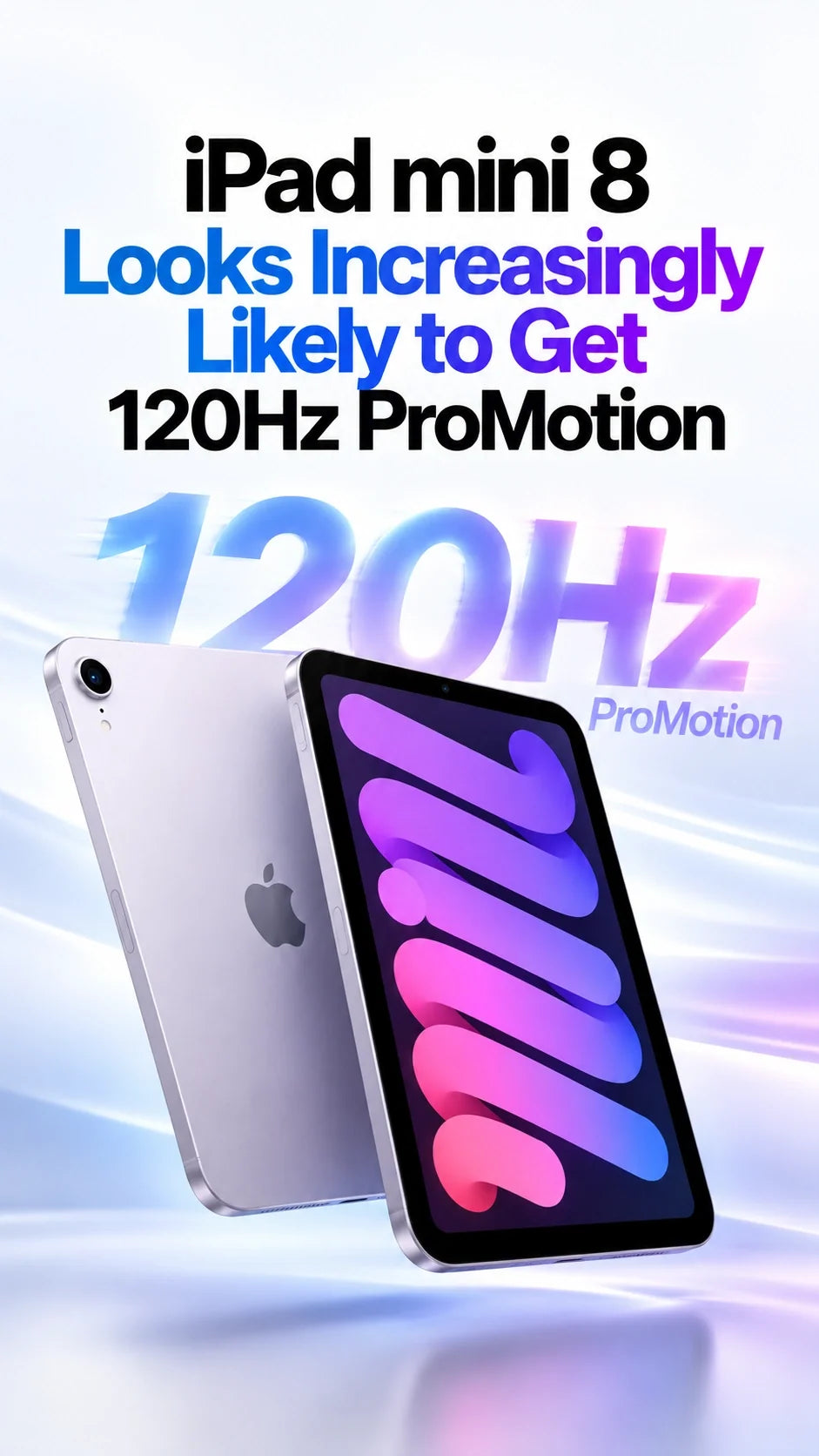
The iPad mini 8 has a stronger case for 120Hz ProMotion than the earlier 60Hz-only rumors suggested.
According to MacRumors’ October 15 report, Mark Gurman says Apple tested both refresh-rate options.
That makes ProMotion a reported development option, but the production choice remains unknown.
Our view: there is more reason for optimism, without enough evidence to call 120Hz the likely final specification.
If smoother scrolling is essential to you, wait for Apple’s official display specifications.
Why Does iPad mini 8 ProMotion Look More Plausible Now?
The meaningful change is the evidence behind the idea. In its October 15 report, MacRumors attributes the testing information to Bloomberg’s Mark Gurman and his Power On podcast. His account leaves the selected display unresolved.
Our interpretation is that 120Hz now deserves more consideration. Reports of a tested option strengthen its credibility compared with a wish list, while leaving its chances of reaching customers uncertain.
Written October 20, 2026. This article analyzes pre-release reporting; ZEERA has not tested an iPad mini 8. Promotional modules feature accessories for their stated iPhone or Mac models.
What Does the New Report Establish—and What Is Still Missing?
Stronger evidence: the faster display was reportedly evaluated during development.
Missing evidence: a verified specification for the model Apple will sell.
The key distinction: a prototype can demonstrate that a design was explored without revealing whether it passed the final cost, power and production decisions.
“Increasingly likely” should therefore be read as cautious editorial optimism relative to the earlier rumor picture. There is no defensible percentage to attach to it, and the available information does not establish that 120Hz is more probable than 60Hz.
It also does not establish that Apple is still deciding. A reporter’s uncertainty about the chosen configuration is different from uncertainty inside Apple’s production plan.
Why the 60Hz OLED Rumor Still Matters
There is a specific competing claim. In a report dated October 9, MacRumors covered yeux1122’s renewed assertion that production would use a 60Hz LTPS OLED panel. The publication described the tipster’s record as mixed.
That claim and the testing report can coexist: a company can evaluate a faster screen and ultimately manufacture a slower one. The later report does not, by itself, overturn the earlier production allegation.
How to weigh the conflict: the 60Hz report claims knowledge of production; the 120Hz report describes development testing without identifying the winner. Neither gives readers an official specification.
For the separate question of whether an OLED upgrade would still matter at the lower refresh rate, see our iPad mini 8 at 60Hz display analysis.
OLED, 120Hz and ProMotion Describe Different Things
OLED: the display technology, with self-emitting pixels that can produce deep blacks. The word does not specify a refresh rate.
120Hz: the display can update up to 120 times per second. That describes its maximum update frequency, rather than a promise that every app renders at that speed.
ProMotion: Apple’s adaptive display system, which varies refresh behavior with content and system conditions. A fixed 120Hz panel and an adaptive ProMotion implementation are not interchangeable descriptions.
Apple’s developer documentation for ProMotion explains that the system controls the actual refresh rate. App requests do not force the screen to operate at a particular rate. Until Apple specifies the next mini’s implementation, its minimum refresh rate and supported operating modes remain unknown.
Our assessment is that the OLED rumor, chip expectations and display-testing report should be evaluated separately. A faster processor does not prove a faster screen, and a higher rumored price does not identify the panel Apple selected.
Where Would 120Hz Make the Biggest Everyday Difference?
Scrolling and moving between apps
At 60Hz, one refresh interval is about 16.7 milliseconds; at 120Hz, it is about 8.3 milliseconds. When the app supplies frames at the higher rate, smaller steps between updates can make motion appear more fluid.
Handwriting and drawing
More frequent display updates can help the visible stroke track movement more closely. Actual pen-to-screen latency also depends on input sampling, processing and the app, so a doubled refresh ceiling is not proof of halved Pencil latency.
Games that support higher frame rates
A 120Hz display creates room for higher-frame-rate output. Whether a particular game uses it depends on software support, graphics settings and sustained device performance.
These are potential benefits of the display feature, rather than performance results for the unreleased mini. Apple’s variable refresh rate presentation explains the underlying timing and adaptive behavior.
Would ProMotion Turn the iPad mini 8 Into a Small iPad Pro?
It could remove one important reason a buyer prefers the Pro’s screen. It would not establish equivalence in brightness, panel construction, external display support, ports or the rest of the tablet.
For a compact reading and note-taking device, the more useful question is whether the final screen fixes the limitation you notice today. A feature checklist alone cannot tell you whether the smaller tablet fits your work.
Apple’s current iPad mini specifications list an 8.3-inch Liquid Retina LCD and Apple Pencil Pro support. Existing Pencil support should not be confused with ProMotion, and compatibility with a future mini still needs checking.
Our iPhone Duo versus iPad mini 8 guide looks at the different question of choosing between a folding phone and a dedicated small tablet.
Should You Wait If 120Hz Is Your Main Reason to Upgrade?
If 60Hz is your current frustration: wait for the final specification before ordering. OLED alone does not answer your motion-smoothness concern.
If you mainly read stationary pages: judge text rendering, brightness, reflections and comfort alongside refresh rate. The upgrade’s value depends on how you use the screen.
If you draw or play games: look for tests in your actual apps. Confirm compatible Pencil models, supported frame rates, heat and battery behavior.
Price should be evaluated once the configuration is known. Our analysis of the rumored iPad mini 8 price premium explains the budgeting question separately; an estimated price is not evidence of ProMotion.
What Would Actually Confirm iPad mini 8 ProMotion?
The decisive evidence would be Apple’s product announcement and a technical specification naming ProMotion and its refresh-rate range. Credible testing of shipping hardware would then show how it behaves in real apps.
Watch for clear wording about the maximum rate and adaptive operation. A generic OLED label, an accessory listing or a video of a smooth animation cannot establish those details.
ZEERA’s assessment: there is now a concrete reason to keep hoping for 120Hz. Treat it as a feature worth waiting to verify, rather than a specification on which to base a purchase today.
Frequently Asked Questions
Can a software update turn a 60Hz iPad into a 120Hz model?
A software update cannot supply missing display hardware capability. Do not buy a confirmed 60Hz model on the assumption that a later update will unlock 120Hz.
Would a 120Hz mini run every game at 120fps?
No. The screen’s maximum refresh rate and the game’s rendered frame rate are different limits. Both the game and device must support the intended output.
Does OLED guarantee more comfortable reading?
No. Comfort varies with brightness, reflections, text size, dimming behavior and personal sensitivity. Try the finished display if screen comfort is a purchase priority.
Would ProMotion necessarily reduce battery life?
There is no reliable mini 8 battery conclusion yet. Higher refresh rates and adaptive operation affect power differently, while brightness, workload and battery capacity also matter. Wait for comparable tests of shipping devices.
Related Articles
- iPad mini 8 at 60Hz? What OLED Would Improve Over mini 7
- iPad mini 8 Near $799? Understanding the Possible Price Premium
- iPad mini 8 vs iPad mini 7: Should You Wait?
- iPhone Duo vs iPad mini 8: Can It Replace an iPad?
- OLED MacBook Pro and iPad mini: Buy Now or Wait?
- Can You Use an iPad as a CarPlay Screen? What CarCast Shows
Sources
- MacRumors, October 15: Gurman’s report of 60Hz and 120Hz testing
- MacRumors, October 9: the competing 60Hz production claim
- Apple Developer: supporting ProMotion displays
- Apple Developer: optimizing for variable refresh rate displays
- Apple: current iPad mini technical specifications
By Guichang Chen · ZEERA WIRELESS. Please credit the author and link to the original article when sharing excerpts.