Quick Answer
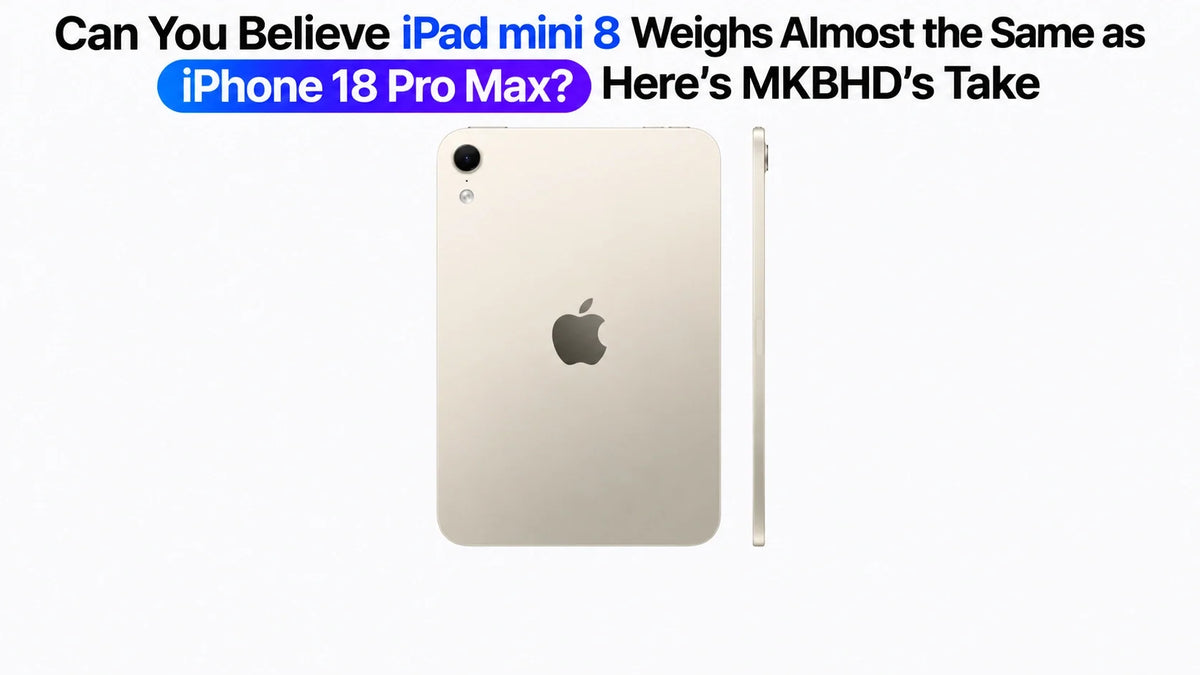
The iPad mini 8 Wi-Fi model weighs 255g—only 6g more than the 249g iPhone 18 Pro Max. That makes MKBHD’s comparison surprisingly literal: Apple’s 8.5-inch tablet carries almost the same weight as its largest conventional iPhone.
In his review, Marques Brownlee praises the thin design, OLED screen and reading experience. His enthusiasm comes with two clear objections, though: the display remains 60Hz, and storage-linked upgrades make the most appealing configurations considerably more expensive.
What did MKBHD say about the iPad mini 8’s weight?
Marques Brownlee captures the redesign with a wonderfully simple comparison: the new mini feels like an iPhone 18 Pro Max spread across a much larger surface. In his review, OLED iPad Mini is The Most Apple Product They've Ever Appled, he says it weighs “almost the exact same weight as an iPhone 18 Pro Max.”
The point is how little effort it takes to bring a proper tablet along. He describes wanting to carry it everywhere, with reading articles and watching videos among its strongest everyday uses.
How close are the actual weights?
| Device | Weight | Compared with Pro Max |
|---|---|---|
| iPhone 18 Pro Max | 249g | Baseline |
| iPad mini 8 Wi-Fi | 255g | 6g heavier |
| iPad mini 8 Wi-Fi + Cellular | 263g | 14g heavier |
Device-only figures from Apple’s iPad mini specifications and iPhone 18 Pro Max specifications.
The Wi-Fi mini is approximately 2.4% heavier than the Pro Max. Its 5.4mm body also spreads that weight across a much wider device. Similar mass does not mean identical handling: hand span, grip position and a fitted case all affect comfort.
For existing mini owners, the comparison with the previous generation may matter even more. The Wi-Fi iPad mini 7 weighed 293g, so this redesign removes 38g. Our iPad mini 8 vs iPad mini 7 comparison covers the other physical changes.
Why the lighter OLED mini makes sense for reading
More room for the page
An 8.5-inch tablet gives articles, books and documents a larger canvas than a phone. Brownlee’s enthusiasm centers on that combination: a useful reading surface in a device light enough to bring along casually.
Nano-texture suits his reading habits
His review unit has nano-texture glass, and he likes its handling of reflections and the way fingers move across the surface. The finish stops before the bezels, leaving a different texture around the edge where you hold the tablet.
That does not make nano-texture essential for everyone. If glare is your main concern, our nano-texture vs standard glass guide explains the configuration cost and practical trade-offs.
Why MKBHD still objects to the 60Hz screen and pricing
The review’s central tension is that Brownlee clearly enjoys the hardware while questioning the choices around it. Three details explain why.
OLED does not bring ProMotion
The mini still runs at 60Hz. Brownlee says he consistently notices the difference because the other displays he uses have higher refresh rates. For him personally, this is a dealbreaker. If you already use a ProMotion iPhone, try scrolling on the mini before deciding whether the larger screen outweighs that change in motion.
The appealing display option starts at $899
The US Wi-Fi model starts at $699 with 128GB and standard glass. Nano-texture requires at least 256GB, then adds another $100. That makes the cheapest nano-texture configuration $899 before tax—a $200 increase over the entry model.
Storage also changes the chip configuration
Apple lists a 5-core CPU and 16-core Neural Engine for 128GB and 256GB models. The 512GB version gets a 6-core CPU and Dual 16-core Neural Engine. Brownlee questions the upgrade ladder while also acknowledging that ordinary browsing and reading hardly demand the top configuration.
Configuration details: Apple technical specifications and Apple US Store. Prices are US purchase prices before tax.
A small tablet with plenty of performance headroom
Brownlee also investigates whether the extremely thin body compromises sustained performance. In his extended benchmark run, he reports that the mini remains more consistent and throttles less than the iPhone 18 Pro after 20 loops. That comparison concerns the smaller Pro phone, rather than the Pro Max used for the weight comparison.
His battery-life impression is less dramatic: endurance is broadly unchanged. The redesign’s attraction is a better screen and lighter body backed by substantial processing headroom, rather than a major increase in time between charges.
He also likes the idea of pairing a compact phone setup with a cellular mini. For readers considering that arrangement, the useful question is whether you want a separate reading and viewing device enough to carry two screens. A mini and an iPhone together still add to your total carry weight, even when each is individually light.
FAQ
Does a cellular iPad mini replace an iPhone?
Cellular connectivity gives the iPad mobile data. It does not turn it into a conventional iPhone with the same native carrier calling experience. Think of it as an independently connected tablet when planning a phone-and-mini setup.
Can I reuse an iPad mini 7 case?
Do not assume a fitted case will transfer. The mini 8 is thinner and narrower, with changes to its camera and audio layout. Choose a case explicitly designed for the iPad mini with A20 Pro.
Related Reading