Quick Answer
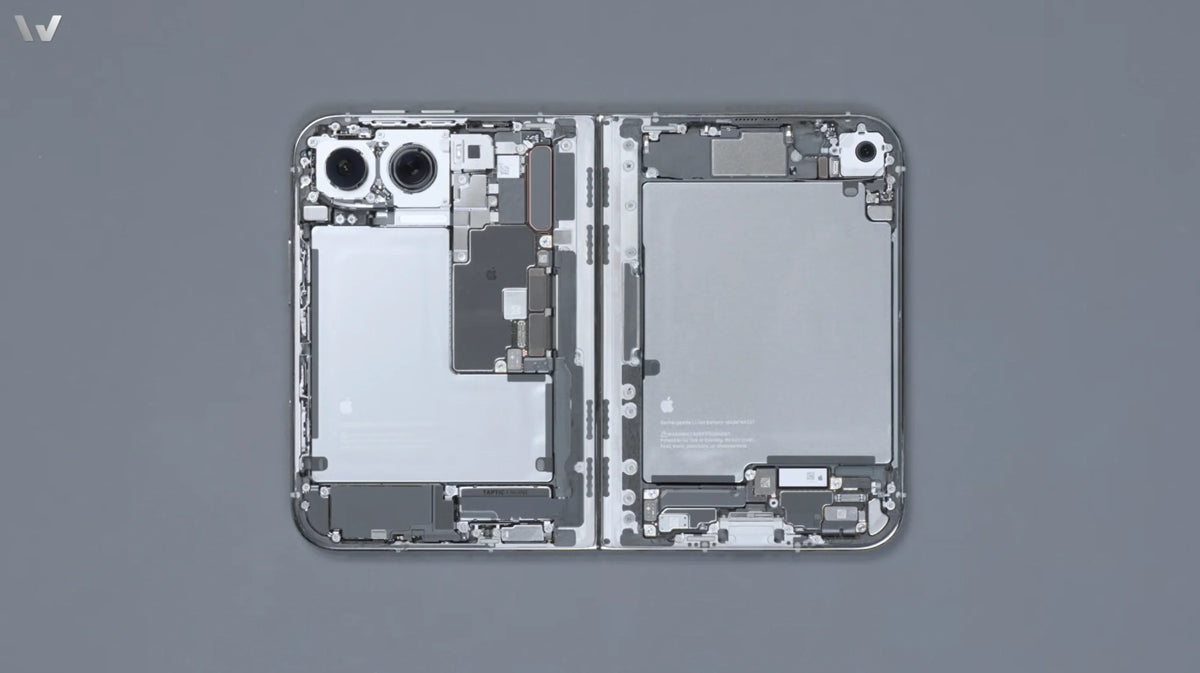
iPhone Duo contains two steel-cased lithium-ion batteries, one in each half of the phone.
WekiHome reports 1,921mAh and 2,962mAh, adding up to 4,883mAh.
Both use shaped, stacked cells with one connector per battery; measured thickness is 3.02mm and 2.96mm.
The reviewer calculates approximately 789Wh/L and 809Wh/L using rated capacity and packaged dimensions.
Apple lists up to 44 hours of outer-screen video playback, 31 hours on the inner screen and a wired half-charge in around 20 minutes with the specified adapter.
Why does iPhone Duo have two steel-cased batteries?
The WekiHome iPhone Duo teardown shows a separate steel-cased battery in each half of the foldable chassis. They have different capacities and shapes, using the space available around the hinge, circuit boards, cameras and other components.
This arrangement distributes battery volume across the two rigid halves while the hinge occupies the center. The cells themselves remain in the rigid sections as the phone folds. The unequal sizes make practical use of unequal internal space; they do not imply one battery belongs exclusively to the outer screen and the other to the inner screen.
iPhone Duo battery specifications: the two packs compared
These are WekiHome’s reported teardown values and measurements. Apple’s U.S. technical specifications confirm the dual built-in rechargeable lithium-ion design and provide the endurance and charging ratings discussed below.
| Teardown detail | Smaller battery | Larger battery |
|---|---|---|
| Rated capacity | 1,921mAh | 2,962mAh |
| Share of the stated total | ≈39.3% | ≈60.7% |
| Measured thickness | 3.02mm | 2.96mm |
| Calculated energy density | ≈789Wh/L | ≈809Wh/L |
| External housing | Steel case | Steel case |
| Cell construction | Shaped, stacked cell | Shaped, stacked cell |
| Cell / connector arrangement | One cell, one connector | One cell, one connector |
| Retention | Electrically releasable adhesive | Electrically releasable adhesive |
The capacity calculation is straightforward: 1,921 + 2,962 = 4,883mAh. The percentages above are calculated from those two stated capacities. The larger battery holds roughly 61% of the total even though it is slightly thinner, showing why thickness alone says little about capacity without the footprint.
Two batteries do not automatically mean double charging speed
A connector for each battery establishes the physical arrangement, not the complete electrical topology or charging strategy. The transcript does not establish series versus parallel wiring or how charging current is divided. Charging performance needs to be read from Apple’s specifications and charging tests.
Who makes the iPhone Duo batteries and cells?
WekiHome identifies the battery manufacturer as Changshu Huapu (常熟华普) and the cell supplier as Zhuhai CosMX (珠海冠宇). Those are different roles: the battery assembly and the electrochemical cell inside it should not be treated as the same supplier identification.
The reviewer describes both as shaped, stacked cells. A stacked construction arranges electrode layers in a stack, while a shaped outline accommodates the available chassis space. Neither the steel casing nor the stacked layout identifies the exact electrode formulation, so these observations do not establish a silicon-carbon or solid-state chemistry.
What does the steel battery casing contribute?
WekiHome highlights how closely the battery housings fit the surrounding components, with little visibly unused space around their edges. A rigid metal shell provides a defined mechanical envelope that can help designers package a cell tightly within a thin chassis. The teardown supports that packaging observation; it does not quantify a percentage capacity gain over a pouch design.
Apple’s iPhone Duo Product Environmental Report also names the battery enclosure among components using 80% recycled steel. It reports 100% recycled cobalt and 95% recycled lithium in the battery. These material-sourcing figures describe the relevant materials, rather than saying the entire battery is 95% or 100% recycled.
Housing material and battery chemistry are separate
“Steel-cased” describes the enclosure. The energy still comes from a rechargeable lithium-ion cell. A rigid shell does not make the battery immune to damage or eliminate the need for charge management and temperature control.
For a foldable, the engineering challenge is not simply finding room for a large cell. It is fitting two protected energy stores into thin halves alongside a hinge, two displays and the electronics, while retaining usable capacity.
789Wh/L versus 809Wh/L: how to read the energy density
WekiHome calculates volumetric energy density from the packaged dimensions, using rated—the reviewer describes it as minimum—capacity values. The smaller battery comes out at approximately 789Wh/L and the larger at approximately 809Wh/L.
Wh/L measures stored energy per liter of volume. It is different from mAh, which measures electric charge, and from Wh/kg, which measures energy per unit mass. A meaningful cross-phone comparison needs the same capacity basis and the same volume definition: packaged battery versus packaged battery, rather than a bare cell on one side and a complete pack on the other.
Why the rated-versus-typical distinction matters
Typical capacity can be higher than the guaranteed rated figure. WekiHome suggests that using typical values would put both batteries in the roughly 800Wh/L class, but the transcript does not supply those typical capacities. The reproducible figures to retain here are the reported 789Wh/L and 809Wh/L calculations.
The approximately 20Wh/L gap is about 2.5% relative to the smaller battery’s reported value. That describes a packaging-level energy-density difference, not a 2.5% charging-speed or lifespan advantage. The supplied transcript does not state nominal cell voltages or watt-hour ratings, so converting the combined mAh into an exact Wh total would require an additional verified value.
Battery life: Apple’s ratings and measured performance
Apple publishes separate playback ratings for the two displays. These are “up to” results for the specified tasks, so they should not be read as continuous mixed-app screen-on time.
| Apple U.S. endurance rating | Outer display | Inner display |
|---|---|---|
| Video playback | Up to 44 hours | Up to 31 hours |
| Streamed video playback | Up to 37 hours | Up to 26 hours |
Apple also lists up to 24 hours of typical use. The display-specific playback figures make the practical point: the same battery system produces different runtime depending on how the phone is used. Brightness, illuminated screen area, network activity and workload all matter alongside capacity.
In the Mediastorm review summarized in our Duo versus Pro battery test, Duo retained 61% after two hours of recording, compared with 59% for iPhone 18 Pro Max and 45% for iPhone 18 Pro. After a separate three-hour video-playback test, Duo retained 84%, behind Pro Max at 93% and Pro at 87%.
Those results show why the 4,883mAh number does not predict every ranking. Recording, decoding video and illuminating the display impose different loads. The steel enclosure helps describe how the energy storage fits inside; it does not, by itself, explain the full runtime result.
Charging: a 60W adapter does not mean a 60W battery input
| Apple U.S. charging specification | Requirement / rating |
|---|---|
| Wired fast charge | Up to 50% in around 20 minutes; 60W-capable or higher adapter and USB-C cable |
| MagSafe fast charge | Up to 50% in around 30 minutes; MagSafe Charger and 35W or higher adapter |
| MagSafe wireless charging | Up to 25W |
| Qi2 wireless charging | Up to 25W |
The adapter rating describes the specified power source. It is not a promise that the phone sends 60W continuously into its cells. In the Mediastorm review covered by our iPhone Duo wired-versus-wireless charging analysis, the measured wired peak was 36–37W and a full 0–100% charge took 88 minutes.
A half-charge benchmark and a full-charge test answer different questions. Power changes over the charging curve, and readings at the adapter include conversion losses and power used by the phone. The 25W wireless figures above refer to Apple’s U.S. specification; the charging guide explains the regional and charger-version differences.
Electrically releasable adhesive changes battery removal
WekiHome finds two small metal tabs on each battery and identifies electrically releasable adhesive beneath the packs. In the demonstration, electrical activation releases the bond so the battery can be removed. This separates the retention system from the cell’s steel enclosure: one holds the battery to the chassis, while the other encloses the cell.
The removal sequence is useful evidence of the repair design, but it does not establish cycle endurance, capacity retention after years of use or an owner-replaceable battery system. Those need separate service information or aging measurements.
Watch the original WekiHome teardown
Sources: WekiHome’s teardown and supplied Chinese transcript for battery construction, supplier identification and measurements; Apple’s U.S. technical specifications and environmental report for published ratings and materials. The separate recording, playback and full-charge tests are from Mediastorm’s review.
FAQ
Does folding the phone switch from one battery to the other?
The teardown does not show a battery dedicated to each screen or a fold-triggered battery handoff. Treat the two packs as parts of the phone’s overall power system rather than independent user-selectable batteries.
Does the larger battery wear out faster?
Capacity and the reported energy density do not establish which pack ages faster. That would require data on each pack’s temperature, charging behavior and capacity retention over time.
Related Articles
- iPhone Duo’s 4,883mAh EU energy label explained
- iPhone Duo vs Pro Max and Pro: recording and playback battery tests
- iPhone Duo wired and MagSafe charging speed
- iPhone Duo MagSafe battery-pack questions and compatibility
- Does the inner display drain more battery?
- iPhone Duo review hub: specifications and test results