Quick Answer
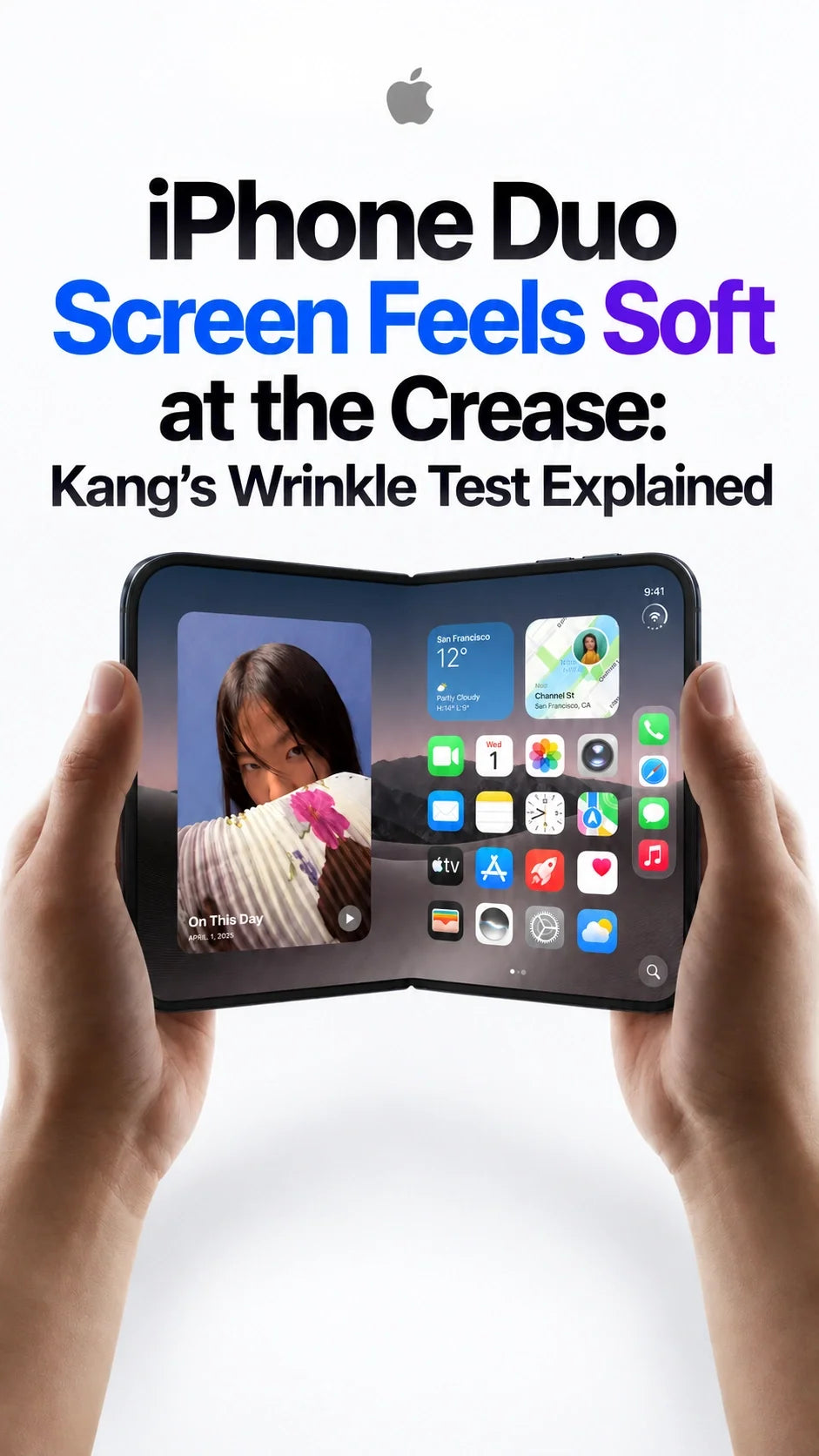
Kang reportedly found that the iPhone Duo’s inner screen feels soft over the hinge and can wrinkle when pressed with a finger.
The claim covers multiple units, but does not establish how common the behavior is or whether it causes lasting damage.
ZEERA supply-chain contacts suggest localized compliance may provide cushioning and room for thermal stress relief. That explanation remains unverified.
A variable-thickness glass design is a possible explanation, not a confirmed cause. The replaceable cover layer also makes surface wear a separate service question.
ZEERA’s view: prioritize persistent marks, image or touch faults, and abnormal closure gaps over a pressure demonstration alone.
What Did Kang Report About the iPhone Duo’s Soft Crease?
A hands-on video attributed to Weibo user Kang has raised a new question about the iPhone Duo’s folding display. In the account shared by Ice Universe on X, the strip around the crease feels unusually soft and develops visible wrinkles under finger pressure.
Kang reportedly encountered similar behavior on multiple units. That makes it worth examining, but the available account does not provide a controlled sample, measured pressing force or long-term follow-up.
The Evidence at a Glance
Reported observation: localized softness and pressure-induced wrinkling around the folding strip.
Source chain: Kang’s hands-on account, relayed by Ice Universe. ZEERA has not independently measured the pressure or verified the unit count.
Unknown: which layers move, whether marks persist, and how the behavior changes after extended use.
Scope: this report concerns the area above the hinge. It does not establish that the entire inner display behaves the same way.
Ice Universe shares Kang’s reported iPhone Duo crease-area pressure test and asks whether variable-thickness glass could explain the behavior.
View the source post and video on X
Video credit: Kang, via Ice Universe. If the embedded post does not load, use the source link above. The demonstration is not a calibrated durability test.
This is a different question from whether the crease is visible in ordinary lighting. Our iPhone Duo vs Galaxy Z Fold8 crease comparison addresses appearance; this report concerns how the folding region responds to pressure. It would be premature to call the behavior unprecedented across all foldable phones.
Could Variable-Thickness UTG Explain the Wrinkles?
It is a plausible hypothesis, but a finger-press video cannot identify the glass structure beneath the surface.
Apple’s folding-display patent US11862664B2 describes glass with a locally thinned folding region, a polymer-filled recess and transitions to thicker surrounding sections. The document explains that gradual transitions can help avoid stress concentrations. It establishes an engineering approach Apple explored, rather than the exact construction of a shipping iPhone Duo.
Three Parts of the Explanation Need to Stay Separate
Glass geometry: a thinner folding strip can be designed to bend more readily than thicker sections away from the fold.
Surface behavior: visible wrinkles do not reveal whether deformation comes from the cover, adhesive, underlying support or their interaction.
Durability: neither a patent nor this demonstration establishes how many years the assembly will remain free of permanent marks.
In its iPhone Duo announcement, Apple describes a custom polymer cover with a nano-texture finish, a scratch-resistant coating, glass above and below the folding panel, and adhesives that let layers move to relieve bending stress. Those details support treating the display as a moving multilayer assembly. They do not confirm that variable-thickness UTG causes Kang’s reported result.
ZEERA Supply-Chain View: Cushioning and Thermal Stress Relief
ZEERA’s supply-chain contacts offer a less alarming interpretation: the localized softness could be a useful allowance within the structure. Their assessment is that some movement may cushion the folding region and give the assembly room to accommodate stress as temperatures change.
Potential Benefit: Local Cushioning
A region that yields slightly may accommodate displacement instead of transferring all of it into a rigid boundary. This is the contacts’ proposed explanation; ZEERA has not performed an impact test showing that the Duo’s soft strip reduces damage.
Potential Benefit: Room for Expansion and Contraction
The contacts also suggest that movement could help accommodate differential expansion and contraction in warmer or colder conditions. No temperature-cycle measurements supplied with this report establish that benefit, and the theory does not extend Apple’s permitted operating conditions.
The important distinction is between a possible design purpose and a demonstrated result. Apple’s published explanation concerns stress relief during folding; the temperature-related benefit is ZEERA’s supply-chain interpretation.
Will the Soft Hinge Area Affect Everyday Use?
ZEERA’s contacts say the behavior is concentrated above the hinge, so they expect limited impact on ordinary use. That is a preliminary assessment. A localized effect still needs to be evaluated during normal scrolling, typing and viewing.
The More Useful Questions
- Does the area look uniform when nobody is pressing it?
- Do normal swipes and taps work consistently across the center?
- Does an indentation remain after pressure has stopped?
- Does the behavior change with ordinary use over time?
A pressure demonstration alone does not answer those questions. A temporary change that recovers fully would have different implications from a permanent dent, lifting surface or developing touch fault. The available account is not enough to establish which outcome owners should expect over years.
Buyers comparing Duo with a conventional iPhone should consider whether they are comfortable with a flexible inner surface. The iPhone 18 Pro series accessories below are for those models; they do not fit the Duo’s folding display.
The Real Durability Question Is the Polymer Cover and Its Bond
The tradeoff identified by ZEERA’s supply-chain contacts is the life of the surface cover and its bonded interfaces. If the surface resists indentation poorly, or the bond deteriorates, localized movement could become a visible wear issue. That is a potential failure mode to investigate, not evidence that it is already occurring.
The contacts believe Apple has addressed the tendency to retain marks. Their confidence is encouraging, but it is not a published endurance result.
Apple says its custom cover polymer has up to 40 percent higher stiffness than other materials used in the industry. Stiffness, surface hardness and resistance to permanent indentation describe different properties. The stiffness claim alone cannot establish how the cover will respond to repeated concentrated pressure.
What Would Provide Stronger Evidence?
Measurements of indentation and recovery under known loads, repeated folding, temperature cycling, and inspection for lifting or permanent optical changes would be more informative than a single pressing clip. ZEERA has not conducted these tests for this article.
Replacement provides a separate maintenance path. Apple’s U.S. AppleCare fee schedule lists cover layer-only damage separately from inner-display damage, including a $19 fee for the former under applicable coverage. Eligibility and the repair classification depend on Apple’s assessment.
A new cover cannot be assumed to repair damaged glass, the OLED panel or a hinge fault. For the service distinction, see our iPhone Duo replaceable cover layer guide. Replaceable also does not mean owners should peel the factory layer off themselves.
Why Uneven Closure Gaps Deserve More Attention
ZEERA’s judgment is that an abnormal, uneven gap when the phone closes deserves more immediate attention than localized softness revealed by deliberate pressing. The former may be a direct fit or alignment concern; the latter still needs to be connected to an actual functional problem.
Check the Pattern, Not Just the Presence of a Gap
A foldable may have intentional clearance. A visible gap by itself does not prove a defect.
More useful observations include unexpected left-to-right asymmetry, one corner sitting higher, interference from a case, or a change in normal closing behavior. Have Apple inspect persistent irregularities rather than squeezing the phone shut or attempting to realign it.
This is an inspection priority, not a claim that uneven closure gaps are widespread. The reported soft strip neither proves poor quality control nor rules out a separate assembly issue on an individual device.
Should You Worry or Try the Pressure Test Yourself?
ZEERA’s assessment: this may turn out to be a minor characteristic of the folding structure. The report does not yet justify describing the screen as defective, and it does not establish long-term durability either.
There is little practical value in repeatedly recreating the demonstration. Use ordinary touch input, inspect the display under normal lighting and keep the factory surface intact. An extra inner film is not a proven remedy for softness; our iPhone Duo inner-screen protector guide explains the separate compatibility question.
If a mark persists, the cover lifts, an image fault appears or touch becomes unreliable, record what happens during normal use and arrange an inspection. A case can protect specified exterior areas, but it cannot change the mechanical response of the inner display.
Frequently Asked Questions
Does the video show the glass itself wrinkling?
It does not identify the moving layer. The visible surface response cannot establish whether the glass, cover, adhesive or support structure is responsible.
Does “multiple units” mean every iPhone Duo behaves this way?
No. Kang’s reported observation does not include a representative sample or a verified prevalence rate.
Will replacing the cover fix a permanent dent?
That depends on where the damage is. Apple must distinguish a cover-only issue from damage deeper in the display assembly before recommending service.
Does pressure-induced wrinkling qualify for a free replacement?
The report does not establish that. Service eligibility depends on the diagnosis, applicable coverage and local terms.
For readers who also use a Mac mini, the following accessory is designed for Mac mini cooling. It does not address the iPhone Duo’s display behavior.
Related Articles
- iPhone Duo Crease: Still There, Just Harder to See
- iPhone Duo vs Galaxy Z Fold8 Crease Comparison
- iPhone Duo Replaceable Cover Layer Guide
- Should You Add an Inner-Screen Protector?
- Common iPhone Duo Problems and Fixes
- Does iPhone Duo Need Hinge Protection?
- iPhone Duo Inner-Screen and Hinge Repair Considerations
Sources and Reporting Notes
- Ice Universe’s X post and source video: relays Kang’s observation; the original Weibo post was not independently authenticated for this article.
- Apple Newsroom: iPhone Duo: published cover materials and folding-stack description.
- Apple patent US11862664B2: locally thinned folding glass; patent disclosure does not establish implementation in this model.
- AppleCare U.S. fees and deductibles: cover-only and inner-display damage are separate service categories.
- ZEERA supply-chain commentary supplied for this report: proposed cushioning, thermal stress accommodation, limited everyday impact and surface-layer durability assessment. These explanations have not been independently validated by ZEERA testing.
Reporting date: October 21, 2026. Written by Guichang Chen · ZEERA WIRELESS. Please credit the author and ZEERA when citing our original supply-chain commentary.