Quick Answer
Buying an M6 Mac mini as your main computer? Skip 256GB and choose at least 512GB.
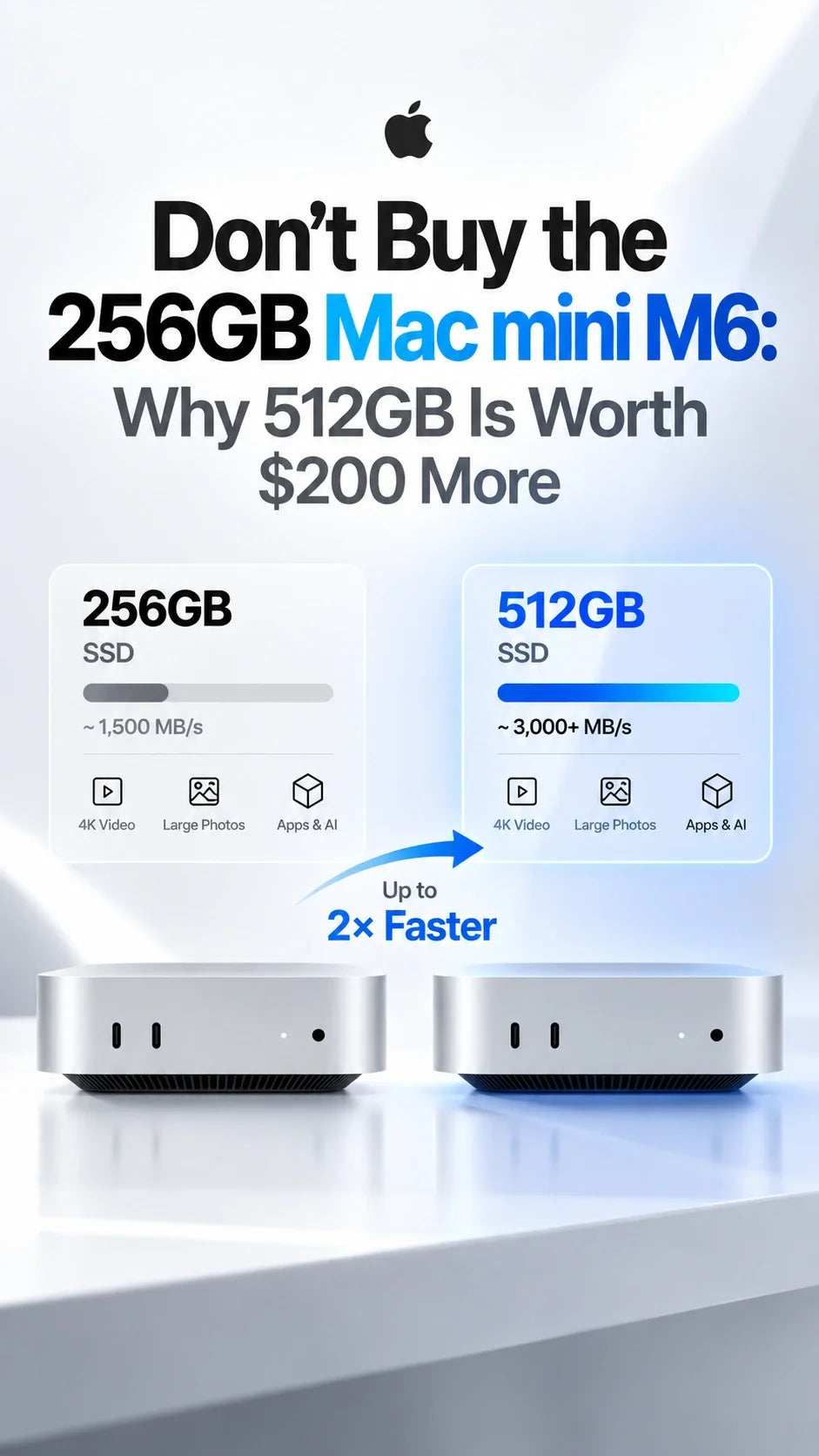
Published SSD tests show approximately twice the sequential read speed and more than twice the write speed, alongside double the capacity.
The everyday benefit is more room for apps and active work, with faster storage-heavy tasks and fewer cleanup interruptions.
The $200 upgrade works out to about $3.33 a month over five years, before any resale benefit.
512GB is ZEERA’s recommended starting point for long-term ownership; 256GB suits a tightly controlled budget or a secondary Mac.
Mac mini buying guide · Updated October 2, 2026
The cheapest Mac mini M6 is not the configuration we would choose for a main desktop. When a computer will serve you for several years, saving $200 at checkout can mean accepting a smaller, slower internal SSD for the entire time you own it.
How Much Slower Is the Mac mini M6 256GB SSD?
256GB vs 512GB: the purchase at a glance
256GB: $899 starting U.S. price with 16GB unified memory; the lowest upfront cost.
512GB: $1,099 with the same 16GB memory, using the $200 U.S. storage upgrade; our recommended minimum for a primary desktop.
What changes: SSD capacity and measured storage throughput. The storage upgrade does not add CPU cores or unified memory.
Prices are before applicable sales tax. Retail discounts, education pricing and regional upgrade costs can change the gap; compare otherwise identical configurations.
The measured gap is close to two-to-one. AAPL Ch. directly tested the 256GB M6 Mac mini using Blackmagic Disk Speed Test with a 1GB workload. The 512GB results below come from published Tom’s Hardware testing, as compiled by AAPL Ch.
Blackmagic Disk Speed Test · Third-party results
M6 · 256GB SSD
3,000.2 MB/sSequential write
3,216.8 MB/sSequential read
M6 · 512GB SSD
6,577.4 MB/sSequential write
6,371.5 MB/sSequential read
What the numbers mean: the 512GB result was about 119% faster in sequential writes and 98% faster in sequential reads. Different drive fill levels, file sizes and test conditions can change exact results.
These are results from different publications, not a controlled ZEERA comparison. The ratios are approximately 1.98× for reads and 2.19× for writes. They describe sequential SSD throughput, not a twofold increase in overall Mac performance.
This is not ZEERA lab testing. It is a synthesis of published third-party results. Independent review units with 512GB storage also landed in the same general range: 9to5Mac reported roughly 6,000–6,400MB/s writes and 6,000–6,300MB/s reads.
Why Is the 256GB SSD Slower?
The tested 256GB configuration uses a single NAND package, while higher-capacity configurations can access more NAND in parallel. Think of the 512GB SSD as having more lanes available for data: the total capacity is larger, but the parallel layout is what produces the higher sequential throughput.
This does not mean the M6 chip itself is slower in the 256GB model. CPU, GPU and Neural Engine performance are separate from SSD throughput. A processor benchmark should be broadly similar when memory configuration, cooling and test conditions are equal.
Important context: 3,000MB/s is still fast. The 256GB M6 result is not a “slow computer” result; it is slow relative to the unusually fast 512GB M6 SSD.
Will You Notice the Difference in Everyday Use?
Yes, the difference can become meaningful in a real working day—but it depends on what you do. Repeatedly moving large files, managing active projects or running short of internal space makes the upgrade more useful than a browser-only session would suggest.
After reviewing published SSD tests and owner discussions, ZEERA’s assessment is that 512GB makes more sense for a primary Mac because it combines higher storage throughput with more working room. This is an editorial assessment, not a claim that ZEERA timed every everyday task.
Usually little difference
- Safari, email and office apps
- Streaming and video calls
- Launching small applications
- Light coding and photo edits
- Files already held in memory
More likely to matter
- Copying very large files
- Video caches and scratch media
- Large Xcode or Docker workloads
- Memory pressure that triggers swap
- Loading large local AI models
The daily improvement is also fewer interruptions
Consider downloading a large update while keeping a photo library, a development toolchain and current projects on the Mac. With 512GB, you have another 256GB of nominal internal capacity before you need to decide what to move or delete.
That extra room can matter even when you cannot perceive a speed difference in Safari. Finishing a task without reorganizing storage is part of the ownership experience.
Sequential benchmarks measure ideal large-file throughput. They do not predict every click. Small-file performance, latency, application design, available unified memory and CPU/GPU work can matter more than maximum sequential speed.
For local AI, storage speed mainly affects model loading and moving model files. Once a model fits in unified memory, inference speed depends much more on the chip and memory subsystem. If the system runs short of memory and begins swapping heavily, the faster SSD becomes more valuable—but buying enough unified memory is the better first defense. See our Mac mini M6 local AI memory guide.
Should You Pay $200 More for 512GB?
For a main Mac that you plan to keep for three to five years, we would pay the extra $200. You use the upgraded storage throughout ownership, rather than receiving only an extra place to archive files.
For most buyers using the M6 Mac mini as a primary desktop, yes. The upgrade gives you twice the capacity, roughly twice the measured sequential read speed, more than twice the measured write speed and more room before storage management becomes a weekly concern.
Buy 256GB
Best for browser-first work, a secondary Mac, a home server with separate data storage, or a strict budget.
Buy 512GB
Best for a main desktop, normal app growth, creative work, development and fewer storage compromises.
Buy 1TB+
Best when large active projects must remain internal and external storage would interrupt the workflow.
Apple lists 256GB and 512GB configurations in the official Mac mini technical specifications. At current U.S. pricing, the 16GB/256GB M6 starts at $899 and 512GB adds $200, bringing the configuration to $1,099. Check the live Apple Store before purchasing because regional pricing can differ.
What Does the $200 Upgrade Cost Over Three to Five Years?
The checkout difference is real. Spread across a normal ownership period, however, it is much less intimidating. These figures divide the one-time $200 premium by the months of use; they are not financing payments.
Three years: about $5.56 per month
$200 ÷ 36 months = $5.56 per month, or about $66.67 per year.
Four years: about $4.17 per month
$200 ÷ 48 months = $4.17 per month, or $50 per year.
Five years: about $3.33 per month
$200 ÷ 60 months = $3.33 per month, or $40 per year—roughly 11 cents a day.
For a desktop used most days, that is a modest long-term premium for more internal space and higher measured SSD throughput. If the upgrade is affordable today, we would rather pay it once than repeatedly work around a capacity limit.
A lower monthly equivalent does not change the amount due at purchase. If $200 breaks your budget, the 256GB model remains capable of light work.
Is 256GB Plus an External SSD a Better Value?
External storage offers excellent value for bulk capacity, but our preferred main-desktop setup is 512GB internal storage plus an external SSD when needed. The M6 Mac mini includes three rear Thunderbolt 4 ports rated up to 40Gb/s, suitable for fast USB4 or Thunderbolt NVMe storage.
An external SSD does not automatically expand the Mac’s internal startup volume. In a normal internal-boot setup, macOS and swap remain on the startup disk; many apps also place support files and caches there by default. You can move compatible libraries and projects, but that requires choosing locations and keeping the drive connected.
256GB + external SSD works when…
You are comfortable managing locations, most large files are media or archives, and the computer stays on one desk.
512GB internal is better when…
You want a simple main Mac, keep active projects local, use large apps, or do not want storage decisions to shape daily work.
For most owners, the balanced setup is 512GB internally for macOS, apps and active work, then an external SSD for completed projects, media libraries and backups. Mac mini’s fixed desktop role makes this hybrid arrangement particularly practical.
Will a 512GB Mac mini Be a Better Choice When You Sell It?
We would expect 512GB to be easier to recommend to a future buyer. Double the internal capacity gives them more room for their own apps and files, and lets you offer a more practical standalone configuration.
This is a buying judgment, not a verified M6 resale-price forecast. The model has only recently reached buyers, so there is no multi-year used-market evidence showing how much of the $200 premium you will recover.
Think in terms of net ownership cost
If a future buyer pays more for the 512GB version, that premium reduces your net upgrade cost. Treat any resale recovery as a bonus; the main reason to buy 512GB is using the extra space and storage performance yourself.
Condition, unified memory, warranty status and the market at the time will also affect a used Mac’s value. Apple Trade In and a private sale may value configuration upgrades differently.
Choose Memory Before Excess Storage
For everyday use, 16GB/512GB is our starting recommendation. For heavier multitasking, coding or creative work, consider 24GB/512GB if the additional memory fits your budget.
If your budget forces a choice between more unified memory and a very large internal SSD, memory is often harder to work around. Storage can be expanded externally; unified memory cannot.
- 16GB / 512GB: the best everyday configuration for most buyers.
- 24GB / 512GB: the stronger value for development, heavier multitasking, moderate local AI and creative work.
- 32GB / 512GB: better when memory-heavy work is central and large archives can live externally.
- 16GB / 1TB: sensible only when local capacity matters more than memory-heavy workloads.
Storage speed is only one part of the purchase. Our M6 vs M5 vs M4 performance comparison explains the processor gains, while the M6 vs M4 upgrade guide is the better place to decide whether the new generation is worth buying at all.
Final Verdict
Our recommendation: don’t buy the 256GB Mac mini M6 as your main desktop if the 512GB upgrade is comfortably within reach. Choose 512GB as the practical minimum; choose more if your active files already require it.
You get double the capacity, approximately twice the published sequential read speed and more than twice the published write speed. The extra space also gives your apps, projects and updates more room to grow.
Over five years, the $200 difference averages about $3.33 a month before any resale recovery. For a computer you rely on regularly, we consider that a worthwhile premium.
Choose enough unified memory for your workload, start at 512GB, and add external storage for bulk files. That is the M6 Mac mini configuration strategy we would use for long-term ownership.
Mac mini M6 256GB vs 512GB FAQ
Is the M6 Mac mini 256GB SSD slow?
No. Around 3,000MB/s is fast for everyday computing. It is slow only in comparison with the 512GB M6 SSD, which tested near 6,400–6,600MB/s.
Does the 256GB SSD make the M6 chip slower?
No. CPU and GPU performance are not reduced simply because the SSD is smaller. Storage-heavy tasks and memory swapping can finish more slowly, but pure processor performance is separate.
Will 512GB make apps open twice as fast?
Usually not. Maximum sequential bandwidth is only one factor. Many launches depend on small-file access, latency, caching and the application itself.
Can I upgrade the internal SSD later?
Do not plan on it. Teardown reporting indicates that the M6 and M5 Pro Mac mini use onboard NAND rather than the M4 generation’s removable storage module. Treat the capacity selected at checkout as permanent.
Is a fast external SSD as good as 512GB internal storage?
It is excellent for projects, media and archives, but it does not add space to the internal system volume automatically. The 512GB internal SSD also has higher measured throughput than typical Thunderbolt 4 external storage.
Should I choose 24GB/256GB or 16GB/512GB?
Choose 24GB/256GB for memory-heavy work only if you accept external storage from day one. Choose 16GB/512GB for general use, lighter creative work and the simpler all-around experience.
Should I return a 256GB M6 Mac mini for 512GB?
If your real apps and files already leave too little free space, and you are still within the seller’s return window, an exchange is worth considering. Check its policy first. If your workload is light and there is ample space, a benchmark gap alone is not a reason to panic.
Is 512GB enough for several years of use?
It is a sensible starting point for general use with large archives stored externally. If your current active files already approach 512GB, choose 1TB or more instead. Capacity needs matter more than a universal “best” configuration.
Will I get the full $200 back when I sell the 512GB model?
Do not assume that. A better-equipped model may be more attractive, but future resale premiums are uncertain. Judge the upgrade primarily by the benefit during your ownership.
Sources and Testing Disclosure
- AAPL Ch.: M6 Mac mini 256GB and 512GB SSD benchmark comparison
- 9to5Mac: M6 Mac mini review and 512GB Blackmagic results
- Tom’s Guide: M6 Mac mini review and 512GB file-copy testing
- Apple: Mac mini technical specifications
ZEERA did not independently benchmark the two SSD capacities. Results are attributed to the original third-party publications and may vary with workload, software version, drive capacity used and test conditions.