Quick Answer
At equal memory capacity, the 64-core M5 Ultra is the more defensible value choice for a single-user local LLM setup unless your workload demonstrates a worthwhile gain from 80 cores.
Both GPU tiers have the same advertised 1.2TB/s memory bandwidth. The 80-core version adds compute resources, not a higher advertised bandwidth tier.
Long uncached prompts are a stronger reason to consider 80 cores than an assumption that every answer will stream faster.
We did not find a sufficiently controlled, same-memory 64-core versus 80-core test to assign a reliable percentage improvement.
The upgrade adds 25% more GPU cores; that is not a measured 25% improvement in local AI performance.
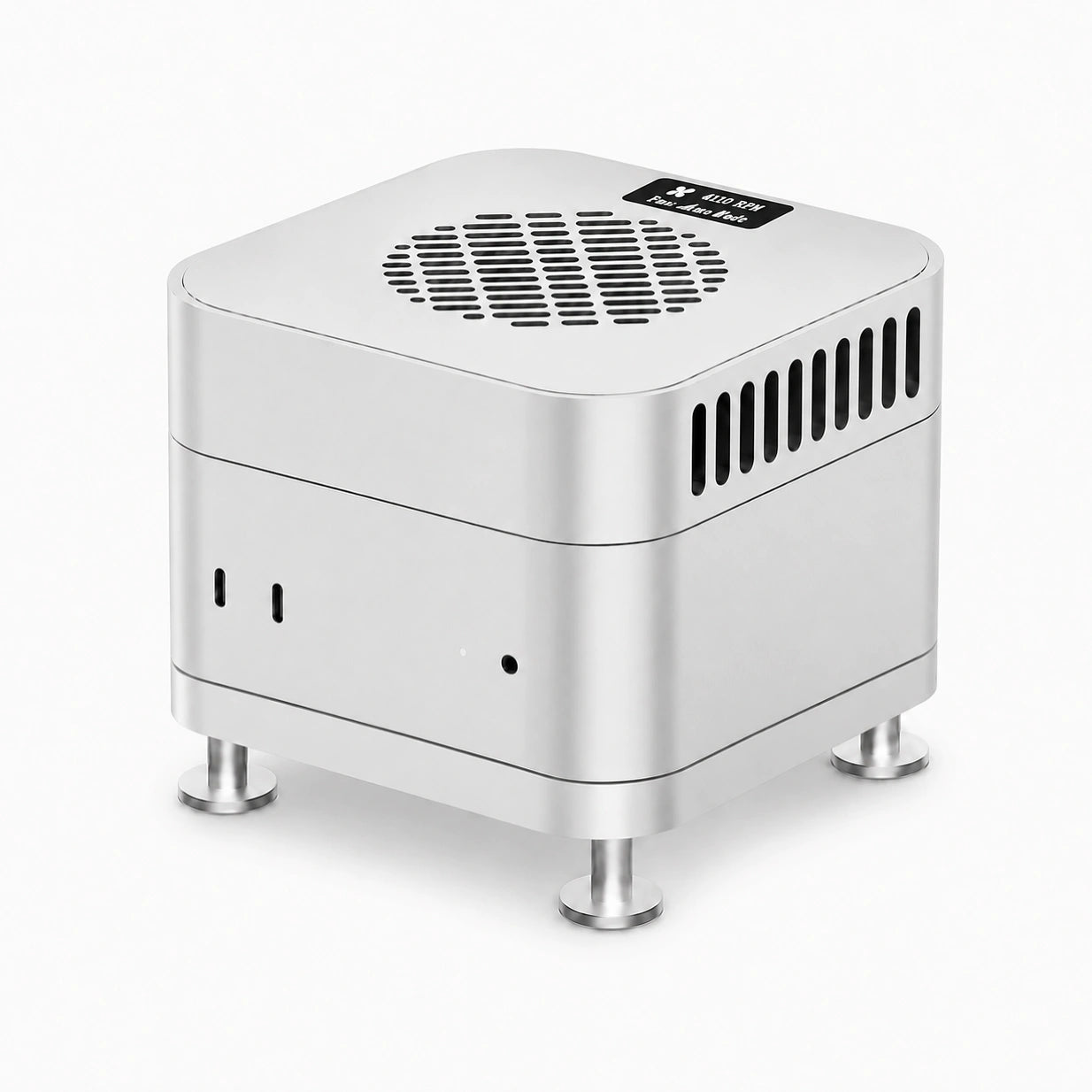
Accessory fit: MacFrost Pro and MacForge Gen3 modules below are for compatible Mac mini models, not Mac Studio.
Should You Pay for 80 GPU Cores at the Same Memory Capacity?
Pay for a demonstrated reduction in your waiting time or an increase in useful throughput. Without a matched benchmark, 80 cores are additional compute capacity whose value still depends on your model and workload.
This guide isolates the M5 Ultra tier decision. For the wider M5 Max versus Ultra choice and platform specifications, see our Mac Studio 2026: Price, Specs and Buying Guide.
Checked October 18, 2026. U.S. pricing context. This is source-based buying analysis, not a ZEERA hardware benchmark. Inferences and hypothetical calculations are labeled.
What Changes Between the 64-Core and 80-Core M5 Ultra?
| Item | 64-core tier | 80-core tier |
|---|---|---|
| GPU | 64 cores | 80 cores |
| CPU | 30 cores | 36 cores |
| Advertised memory bandwidth | 1.2TB/s | 1.2TB/s |
| Neural Engine | 32 cores | 32 cores |
| Memory for this comparison | Hold capacity equal | Hold capacity equal |
| SSD for this comparison | Hold capacity equal | Hold capacity equal |
Hardware specifications: Apple’s Mac Studio technical specifications. The CPU changes too, so a difference in an entire application cannot automatically be attributed to the 16 extra GPU cores.
Verify the exact memory configuration first
Do not assume every memory option is available with both chips. Apple explicitly ties the 512GB option to the 80-core tier. Verify your intended RAM and SSD combination in the configurator before treating two quotations as an equal-memory comparison.
Apple lists the M5 Ultra Mac Studio from $5,499 in the U.S.. That entry price is not the cost of a higher-memory configuration. Use the difference between two matched current Apple configurations rather than a forum’s price or delivery estimate.
Why Do Prompt Processing and Token Generation Scale Differently?
Prefill: processing the input
A long document or codebase has to be processed before the model can answer. Apple’s M5 GPU technical explanation describes this phase as substantial matrix work and explains the Neural Accelerators inside GPU cores.
Our inference: more GPU compute is most promising when uncached input processing is your bottleneck. Check the actual runtime and model path; core count alone does not establish the result.
Decode: generating the answer
NetworkChuck’s explanation of reading versus writing describes why single-stream dense-model generation can be limited by moving weights through memory. More arithmetic resources may then deliver less benefit than they do during prefill.
The shared advertised bandwidth therefore weakens the case for buying 80 cores solely for faster text streaming. It does not prove identical speed: model architecture, context, kernels and batching still matter.
Track three separate results: time to first token, generation tokens per second and total task time. First-token latency also includes application overhead; pure prompt-processing throughput is not the entire user experience.
What Do the Published Local AI Benchmarks Actually Prove?
They establish why the two phases need separate measurements. They do not establish the 64-to-80-core upgrade value.
A useful cross-generation example, not the requested tier comparison
In NetworkChuck’s published benchmark, Qwen3.8 27B at 4-bit with a nominal 32K prompt processed input at 388 versus 1,526 tokens/s on M3 Ultra versus M5 Ultra. Generation was 27.8 versus 42.6 tokens/s, while first-token latency was 83.6 versus 21.3 seconds.
The different gains illustrate the distinction between input processing and output generation. They cannot be transferred to 64 versus 80 GPU cores within M5 Ultra.
Hardware and test conditions
The test-machine record lists an 80-core GPU in both computers: M3 Ultra with 512GB and M5 Ultra with 256GB, both with 8TB storage. macOS versions differed: 26.5.1 and 27.0.
The language-model methodology names mlx-community/Qwen3.8-27B-4bit, MLX 0.32.2 and mlx-lm 0.31.3. Prompt caching and thinking were disabled; temperature was zero. Each benchmark cell discarded one warm-up, then measured five runs with 128-token outputs.
The published limitations and README also disclose a background process occupying one M3 CPU core during most tests. This was useful transparent testing, but it was not a same-memory, same-OS M5 Ultra GPU-tier experiment.
Apple’s own LM Studio chart is labeled as time-to-first-token performance and compares generations. It is not evidence that the 80-core M5 Ultra generates answers a particular percentage faster than the 64-core version.
Why 25% More GPU Cores Does Not Mean 25% Less Waiting
The arithmetic is simple: 80 ÷ 64 = 1.25. If a portion of a task became exactly 1.25 times as fast, that portion would take 80% of its previous time. Neither assumption is a measured M5 Ultra result.
Illustration A: generation dominates
Assume a task takes 20 seconds of prefill plus 80 seconds of generation. If only prefill becomes 1.25× as fast, total time becomes 16 + 80 = 96 seconds: a 4% time saving.
Illustration B: input processing dominates
Assume 80 seconds of prefill plus 20 seconds of generation. Under the same hypothetical improvement, total time becomes 64 + 20 = 84 seconds: a 16% time saving.
These examples hold generation and all other overhead constant. They are arithmetic illustrations, not forecasts, measured speedups or an upper bound. Your measured prefill share determines how valuable an actual prefill improvement would be.
Which Local AI Workloads Make 80 Cores More Compelling?
Long, changing documents and coding contexts
Consider 80 cores when you repeatedly wait for large new inputs and can verify lower first-token or completion latency on the model you use. Test repository analysis, document review or tool-driven work with representative prompts.
Several simultaneous requests
Test your real concurrency. More compute may become useful when serving multiple users or processing batches, but aggregate throughput is different from one user’s response latency. Record both; do not multiply a single-stream benchmark by the number of users.
Image, video or training work alongside LLMs
If these are part of your workload, benchmark the specific pipeline separately. An LLM decode result cannot price the value of extra GPU compute for diffusion or training. Keep model version, precision, output size and software fixed.
When 64 cores remain the sensible starting point
Favor the lower tier when your model and context fit comfortably, most of your wait is single-stream generation, or you have no verified task-level benefit to justify the premium. This is a conservative spending decision under incomplete evidence, not a claim that both chips perform identically.
Can Prompt Caching or More Memory Matter More Than Extra Cores?
MLX-LM documents prompt caching to reuse a shared prefix without recomputing it. If repeated system instructions or document context are already cached, the amount of new prefill work can be much smaller than the total conversation length suggests.
Measure cache misses and cache hits separately
Compare one fresh-context request and one repeated-prefix request on each machine. Do not treat a cached run as evidence of faster uncached input processing. Record reused tokens as well as new tokens.
Memory capacity determines what fits
Budget for weights, the conversation’s KV cache, runtime allocations and other apps. A model file fitting on disk does not establish that the complete workload fits in usable memory. MLX-LM warns that models large relative to available RAM can be slow.
At equal RAM, buying more GPU cores does not increase the memory budget. If model capacity is your real constraint, compare the memory configurations first. For a smaller-machine example of capacity planning, see our Mac mini M6 for Local AI: 16GB vs 24GB vs 32GB.
What Should a Trustworthy 64-Core vs 80-Core Test Include?
Before accepting an upgrade percentage, ask for this comparison record. The following is our proposed test protocol, not a claim that ZEERA has run it.
- Machines: equal RAM and SSD capacity, macOS version, memory settings and background workload; disclose both CPU tiers.
- Model: exact repository and revision, quantization, tokenizer and chat template. Do not compare MLX 4-bit to an unrelated GGUF quantization.
- Runtime: application, backend and build version, GPU offload, attention implementation and any speculative decoding.
- Requests: identical input tokens, output length, thinking mode and sampling settings. Include short, 4K, 16K and 32K inputs only where the model supports them.
- Cache and load: distinguish model-load time, uncached prefill and cached-prefix requests.
- Results: first-token latency, prefill throughput, generation throughput, end-to-end completion time, memory pressure and swap.
- Repetition: discard a documented warm-up, run multiple repetitions and publish individual results plus a consistent summary statistic. Test sustained operation and real concurrency separately.
llama-bench distinguishes prompt-processing, text-generation and combined tests. Its documentation says measurements exclude tokenization and sampling, so add an application-level timing test before equating microbenchmark throughput with how fast your assistant feels.
How Do You Decide Whether the Upgrade Pays for Itself?
Use the quoted upgrade cost and useful time saved. A shorter overnight batch does not automatically recover billable working time.
A hypothetical payback calculation
Suppose a matched configuration costs $1,200 more, and your own test shows 15 seconds saved on each of 80 daily tasks over 20 working days. That is 6.67 hours per month.
At $30 per useful hour, the time is worth $200 per month, giving a six-month simple payback. All inputs here are illustrative, including the premium and time saving; they are not an Apple quotation or a hardware benchmark.
If only one quarter of that time is useful, the same calculation becomes approximately 24 months. Add any cost of waiting for the higher tier using your actual delivery quotations. A forum’s postcode-specific wait is not a universal shipping date.
Our recommendation: preserve the memory capacity your workload needs. Start from 64 cores for value; choose 80 when measured latency, throughput or additional GPU workloads justify the matched premium. Do not pay solely for an assumed proportional increase in output tokens per second.
FAQ
Does the 80-core M5 Ultra give better AI answers?
With the same model, precision and inference settings, more GPU cores are not an upgrade to the model’s underlying capability. Evaluate answer quality separately from speed, and keep settings fixed when comparing machines.
Is the 32-core Neural Engine the same as the GPU Neural Accelerators?
No. Apple lists a separate 32-core Neural Engine on both M5 Ultra tiers. The GPU’s Neural Accelerators are different hardware inside GPU cores; the shared Neural Engine count does not establish equal GPU inference performance.
Can an external SSD substitute for enough unified memory?
An SSD is useful for storing model files, but storage capacity is not additional unified memory. Verify the full running workload’s memory pressure rather than assuming a large model library means every model will run comfortably.
Should I buy more RAM or the 80-core GPU?
First choose enough memory for your actual model, context and concurrency. Then assess compute value. If the memory you need requires a higher chip tier in the current configurator, the decision includes capacity rather than being a GPU-only upgrade.
Will a Mac mini cooler improve M5 Ultra Mac Studio performance?
The MacFrost Pro module here is for compatible Mac mini models. Do not infer Mac Studio fit or a measured Studio speed improvement from it. Accessory compatibility and GPU-tier performance are separate questions.
Sources and Benchmark Scope
Checked October 18, 2026. Official specifications are separated from third-party measurements and ZEERA’s buying analysis. No controlled, same-memory M5 Ultra 64-core versus 80-core benchmark was verified for this article.
- Apple: Mac Studio technical specifications
- Apple: current Mac Studio configurations
- Apple: M5 Max and M5 Ultra Mac Studio announcement and U.S. starting prices
- Apple: Mac Studio performance charts and comparison labels
- Apple Developer: M5 GPU Neural Accelerators and LLM inference phases
- NetworkChuck: original benchmark results and disclosures
- NetworkChuck: exact language models and test methodology
- NetworkChuck: hardware, memory and OS configurations
- NetworkChuck: benchmark limitations
- NetworkChuck: prompt-processing and generation explanation
- MLX-LM: prompt caching and large-model guidance
- llama.cpp: llama-bench documentation and measurement scope
Related Articles