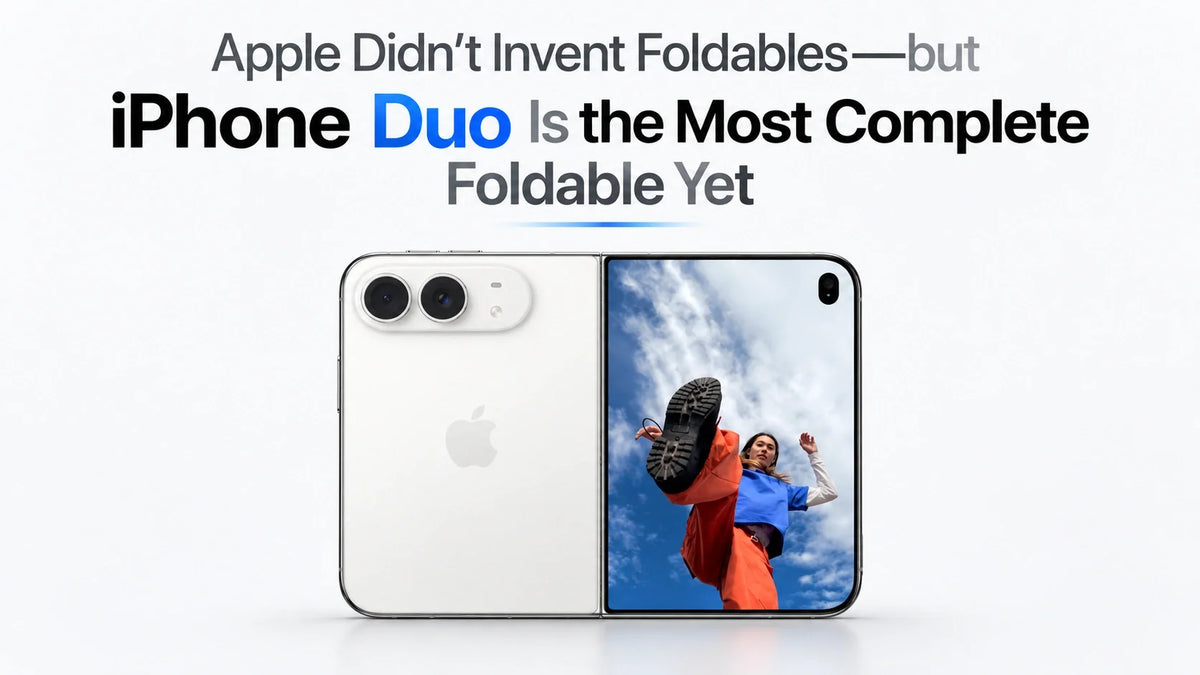
Apple did not invent the foldable phone, and much of the hardware knowledge behind iPhone Duo was developed by Samsung and other Android manufacturers over many years.
What Apple changed is the priority. Instead of treating folding as a hardware feature, Apple designed the screen proportions, iOS 27 interface, app state, controls, cameras and ecosystem around one question: How can two displays feel like one continuous device?
That integration is why Apple’s first foldable can feel more polished than products that have already reached their eighth generation—even though iPhone Duo is not ahead in every hardware category.
Foldable phones existed long before the iPhone Duo. Samsung brought the original Galaxy Fold to consumers in 2019, while Huawei, OPPO, Xiaomi, vivo, Honor, Motorola and Google have all helped improve the category.
These companies solved enormous engineering problems: flexible OLED panels, ultra-thin glass, complex hinges, split batteries, water resistance, lighter frames and large-screen multitasking.
Apple arrived late. It also reportedly relies on Samsung Display for one of the most important components inside its first foldable iPhone: the folding OLED panel.
So why does the iPhone Duo already look like one of the most refined foldable phones of 2026?
The answer is not that Apple secretly invented better folding hardware. The deeper answer is that Apple had the time, financial capacity and platform control to wait until it could design the entire experience as one system.
Apple Did Not Invent the Foldable Phone
The foldable industry should not be rewritten as an Apple invention story.
Samsung made foldable OLED phones commercially viable. Huawei pushed larger and thinner folding designs. OPPO improved compact proportions and crease control. Xiaomi experimented with wide, passport-style formats. vivo, Honor, Motorola and Google all contributed different approaches to cameras, hinges, batteries and software.
Even App Continuity is not new. Samsung has supported moving an app between the cover screen and main display for years, alongside Multi-Active Window and increasingly capable large-screen multitasking.
Apple entered a category that Android manufacturers had already spent years testing in public.
The fair conclusion: Android manufacturers built the road. Apple studied where that road became uncomfortable, then redesigned how the driver experiences the journey.
Why Did Apple Wait So Long to Release a Foldable iPhone?
Launching late allowed Apple to avoid some of the most expensive early mistakes.
Instead of teaching consumers why a folding screen should exist while display yields, hinge durability and app behavior were still evolving, Apple could observe which ideas survived multiple generations.
This is where Apple’s financial strength matters—but cash alone does not create a better product.
Financial resources can buy more prototype cycles, stricter component requirements and additional software development time. More importantly, Apple was not forced to release a new foldable every year just to defend an existing foldable-phone market share.
Samsung, Huawei, Xiaomi, OPPO and vivo must keep shipping new models while balancing component costs, retail prices and margins. Apple could wait until the category was mature enough to support the experience it wanted.
Money bought Apple time. Its integrated product structure determined how that time was used.
Apple entered after the hardest lessons
Years of industry development had already improved folding panels, hinge structures, adhesives, protective layers and manufacturing yields.
Fewer reasons to rush
Apple could delay entry until the hardware, iOS behavior and third-party app strategy were ready to launch together.
Hardware and software share one plan
Apple controls the processor design, operating system, interface frameworks, first-party apps and developer tools.
Developers have a clear target
Apple can give developers one primary foldable layout, a dedicated SDK and direct design guidance instead of many competing device shapes.
The fold is treated as input
Opening, closing, rotating and partially folding the device can change the interface deliberately instead of merely resizing it.
Apple accepted visible compromises
The Duo sacrifices weight, telephoto reach and some multitasking flexibility to protect Apple’s preferred overall experience.
Did Samsung Build the iPhone Duo Display?
Industry reports identify Samsung Display as the supplier of the iPhone Duo folding OLED panel. That would not be surprising: Samsung has more commercial foldable-display experience than any other major panel manufacturer.
However, supplying the OLED panel is not the same as designing the complete display system.
Apple specifies how the panel must work with its cover layers, adhesives, structural supports, hinge, touch system, display controller and software. Apple says the inner display uses high-strength glass above and below the folding panel, custom adhesives that let layers glide as the phone bends, and a titanium support plate underneath.
The nano-texture polymer cover reduces reflections and makes the crease less visually obvious. The hinge uses more than 100 components to control movement and support the center of the display.
Samsung’s manufacturing expertise is therefore part of the iPhone Duo story, not evidence against Apple’s contribution.
Apple’s advantage is not owning every component factory. It is defining how components, software and user behavior must work together.
Why Does iPhone Duo Screen Switching Feel More Seamless?
The most important iPhone Duo feature may not appear on a specification sheet.
It is the feeling that the outer and inner displays belong to the same interface.
Apple gave the 5.4-inch outer display and 7.6-inch inner display the same aspect ratio. This allows content to scale proportionally and helps preserve the visual relationship between closed and open states.
In iOS 27, the Dock, Dynamic Island, status information and major navigation controls move to the side. These elements act as stable visual anchors as the phone changes shape.
When the iPhone Duo opens, the interface does not simply abandon one screen and build an unrelated tablet layout. It gains space while trying to preserve the user’s position, focus and understanding of where everything belongs.
This is a small distinction with a large psychological effect.
If you are reading a post, composing a message or watching a video, you do not want the app to restart, lose its scroll position or suddenly rearrange every control. You want the device to remember what you were doing while giving you more room.
That is what good foldable phone app continuity should mean.
Important accuracy note: Android foldables do not always flash, restart or lose content when opened. Galaxy Z Fold models officially support App Continuity, and newer devices can transition smoothly in compatible apps.
However, behavior can still vary by model, setting and app. Samsung’s own support documentation acknowledges situations in which an app may refresh instead of transitioning correctly. Apple’s advantage is the consistency and priority given to this behavior across the complete iPhone Duo interface—not the invention of continuity itself.
For a closer look at how screen geometry affects this transition, read our analysis of iPhone Duo vs Xiaomi 18 Fold: Same Shape, Different UX.
What Does iOS 27 Do Differently on iPhone Duo?
Many foldable interfaces begin with a phone app and stretch it onto a tablet-sized screen.
Apple appears to have started from the transition itself.
iOS 27 treats the Duo as a device with multiple physical states rather than two unrelated screen sizes. Content can react while the hinge moves, reorient when the device turns and switch to the appropriate display when the phone is flipped over.
- Closed: essential controls move toward the side for easier one-handed reach.
- Open: the larger canvas supports two Home Screen pages, side-by-side apps and multiple windows from the same app.
- Partially folded: apps can place content on one half and controls on the other.
- Standing: the Duo can turn either screen into an expanded StandBy interface.
- Flipped: the system can move the experience to the display facing the user.
The animation is only the visible layer. The more important work happens underneath: maintaining the app session, preserving content state, selecting the correct layout and keeping navigation predictable.
This does not come from the A20 Pro chip alone. It comes from Apple designing the chip, iOS scheduling, UIKit and SwiftUI behavior, display control and first-party apps around the same product.
Why Does Apple’s App Ecosystem Matter So Much?
A foldable phone is only as good as the apps running on its larger screen.
This has been one of Android’s most persistent challenges. A manufacturer can optimize its own interface, but it cannot force every developer to design a special experience for every combination of display size, aspect ratio and hinge posture.
Android must support an enormous range of hardware. That flexibility is one of its strengths, but it also makes consistent foldable optimization harder.
Apple has a narrower target.
Before the iPhone Duo reaches customers, Apple is already providing dedicated developer guidance, updated APIs, iPhone Duo workshops and upcoming Xcode device support. Apple’s own apps are optimized first, while Netflix, Slack and Zoom have already demonstrated interfaces adapted to the folding design.
The difference is not simply that Apple developers are better. It is that they are given a more predictable hardware and software target—and strong commercial motivation to support it.
This ecosystem influence may become more valuable than any single hinge or OLED specification.
How Did Apple Turn the Hinge Into Part of the Interface?
On many early foldables, the hinge answered a mechanical question: Can this phone open and close reliably?
The iPhone Duo asks an additional question: What should the device do at every angle between open and closed?
That turns the hinge into an input method.
Set the Duo down partially folded and video controls can move to the lower half. Stand it like a small display and StandBy becomes available without requiring the phone to be charging. Use the rear cameras for a selfie and the outer screen becomes a live preview.
The same two displays can also support Duo Preview, shared FaceTime views and camera cues for the person being photographed.
These features are not all unprecedented individually. The difference is that Apple connects them to a consistent system-level model of posture, orientation and user intent.
Is iPhone Duo Actually Better Than Galaxy Z Fold8?
Not in every category.
The Galaxy Z Fold8 is significantly lighter at about 201 grams, compared with 254 grams for iPhone Duo. Samsung also offers a more mature and flexible multitasking system, including workflows beyond Apple’s current two-app Split View.
Several Android foldables provide stronger zoom cameras, thinner bodies or larger batteries. Apple’s first foldable has no dedicated telephoto camera and makes several compromises to fit its dual-display architecture.
That is why calling iPhone Duo the undisputed best foldable phone based only on launch demonstrations would be premature.
The Duo’s apparent lead is more specific:
- inner and outer displays designed around a shared visual relationship;
- system controls that remain spatially predictable;
- folding animations connected to actual layout behavior;
- consistent authentication through side-mounted Touch ID;
- first-party apps optimized before retail launch;
- a concentrated developer ecosystem with dedicated tools;
- hardware postures treated as meaningful software states.
Samsung may still be ahead in foldable engineering efficiency. Apple currently appears ahead in making the fold itself disappear from the user’s mental workload.
That distinction also explains controversial decisions such as replacing Face ID with side-button Touch ID. Read the real design reason iPhone Duo has no Face ID.
Why Doesn’t iPhone Duo Feel Like a First-Generation Product?
Because it is only Apple’s first generation.
For the foldable industry, iPhone Duo arrives after years of public research, commercial failures, manufacturing improvements and user feedback.
Apple benefits from Samsung’s display knowledge, supplier advances across Asia and the lessons created by every Galaxy Fold, Huawei Mate X, OPPO Find N, Xiaomi Fold and Google Pixel Fold generation.
But Apple also benefits from something its suppliers cannot sell as a component: control over the whole experience.
The screen ratio affects the interface. The interface affects the outer-screen shape. The hinge position affects the Dock. The authentication method works in both states. The cameras use the second display. The SDK teaches apps how to react. The accessories must protect the hinge without blocking those poses.
Each decision supports the next one.
It feels ahead because Apple decided what the complete experience should be, then made the parts behave like one product.
Will Apple Keep This Foldable Experience Lead?
Probably not automatically.
Samsung, Google, Xiaomi and other manufacturers can study Apple’s transitions, interface anchors and posture-aware features. Some ideas can be recreated through software updates without redesigning the hardware.
Apple also has weaknesses to solve. The Duo is heavy, expensive and limited to two-app Split View. Its inner camera is less capable than its outer camera, and the lack of a dedicated telephoto lens may disappoint buyers coming from an iPhone Pro Max.
Third-party app quality remains another unknown. Apple can provide tools and incentives, but it cannot guarantee that every app will behave perfectly on launch day.
iPhone Duo is scheduled to reach customers on October 23, 2026. Until long-term reviews test battery life, app continuity, hinge durability and daily comfort, “years ahead” should describe its design thinking—not an uncontested victory in every category.
Before ordering, see the 10 iPhone Duo limitations and trade-offs buyers should know.
Why Apple’s First Foldable Feels So Far Ahead
Apple did not beat Samsung, Huawei, Xiaomi, OPPO or vivo by arriving first. It arrived after those companies had already moved foldable hardware through years of difficult development.
Apple’s real achievement was recognizing that the remaining problem was no longer simply how to fold an OLED panel.
The harder question was how to preserve the user’s context while a phone changes shape.
That required more than a hinge, display or powerful processor. It required the outer display, inner display, operating system, apps, controls, cameras, authentication and accessories to be designed around the same behavior.
Android manufacturers proved that foldable phones could work.
With iPhone Duo, Apple is trying to make users stop noticing how much work the foldable phone is doing.
That is why its first generation already feels unusually mature.
iPhone Duo Experience FAQ
Did Apple invent the foldable phone?
No. Samsung, Huawei, OPPO, Xiaomi, vivo, Motorola, Honor and Google released foldable phones before Apple. Apple entered an already mature hardware category.
Why does iPhone Duo feel smoother than some Android foldables?
Apple designed the display ratios, iOS 27 layout, system controls and app behavior together. The goal is to preserve content, position and visual context as the phone opens or closes.
Does Galaxy Z Fold8 support app continuity?
Yes. Galaxy Z Fold8 supports App Continuity between its cover and main displays. Results can still depend on the app and display settings, so it is inaccurate to say every Android foldable always refreshes or shows a black screen.
Is the iPhone Duo folding display made by Samsung?
Supply-chain reports identify Samsung Display as the folding OLED supplier. Apple still specifies and integrates the complete display stack, hinge, protective layers, controllers and software experience.
Is iPhone Duo the best foldable phone in 2026?
It may offer one of the most coherent foldable software experiences, but it is not the hardware leader in every area. Galaxy Z Fold8 is lighter, while several Android foldables offer stronger multitasking, zoom cameras or larger batteries.
Will every iPhone app work perfectly on iPhone Duo?
No guarantee. Existing apps should resize, but specialized layouts and posture-aware features may require updates from developers. Apple is providing new APIs, Xcode support and dedicated developer guidance.
When will iPhone Duo be released?
Apple says iPhone Duo preorders begin October 16, 2026, with availability starting October 23 in the first group of countries and regions.
Sources and methodology: Confirmed product details are based on Apple’s official iPhone Duo product page, technical specifications, Newsroom announcement and developer resources. Galaxy App Continuity references are based on Samsung’s official documentation. Samsung Display supply information remains supply-chain reporting rather than a public Apple supplier confirmation. Comparisons of interface continuity and design priorities are ZEERA’s product-design analysis. Because iPhone Duo does not reach customers until October 23, long-term durability and third-party app behavior still require retail testing.