Quick Answer
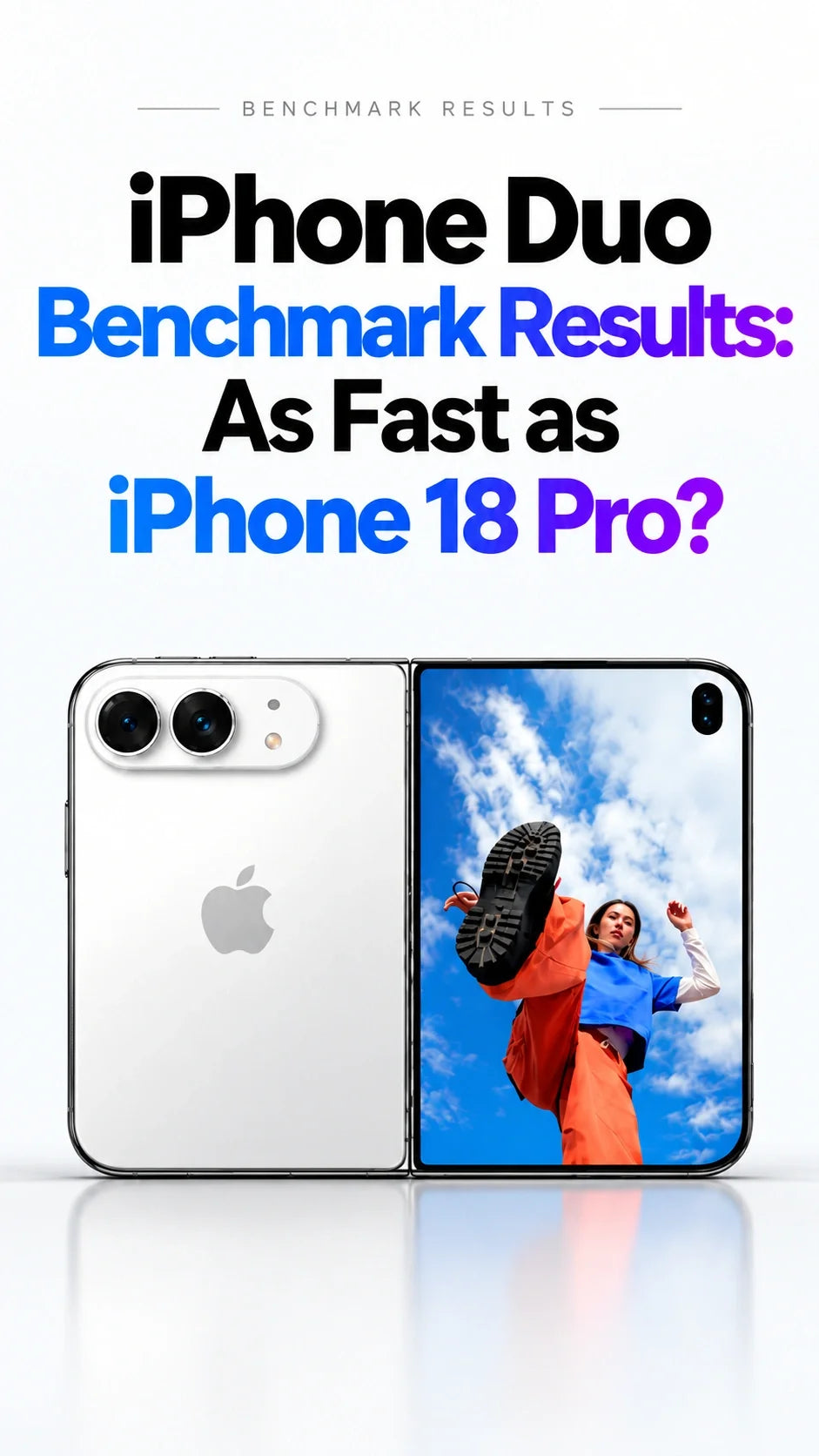
The first publicly reported iPhone Duo benchmark scored 3,986 single-core and 11,067 multi-core in Geekbench 7.
MacRumors identifies the listed iPhone19,4 as Duo and places its CPU results in the iPhone 18 Pro range.
The entry runs iOS 27.1 and reports 11.30GB of memory, consistent with 12GB RAM.
One CPU run cannot establish gaming speed, battery life, heat buildup or sustained performance.
Treat this as encouraging early CPU evidence; a controlled comparison still needs repeated tests.
What are the first iPhone Duo Geekbench scores?
The public Geekbench CPU entry records 3,986 single-core and 11,067 multi-core. It was uploaded on October 14, 2026, using Geekbench 7.1.0 for iOS AArch64. These are CPU scores from one submission, rather than an average across retail phones.
MacRumors reported the result ahead of launch. ZEERA has reviewed the published record; we have not independently benchmarked an iPhone Duo.
Is iPhone Duo as fast as iPhone 18 Pro?
This result is consistent with similar CPU performance, but it does not establish identical performance in every task. MacRumors says the scores sit alongside several iPhone 18 Pro and Pro Max results, even though they do not reach the highest Pro submissions.
That is plausible: Apple confirms that Duo uses the same A20 Pro chip as the iPhone 18 Pro models. Sharing a processor gives the comparison a sound starting point; the phone around that processor still matters.
What the result supports
The tested device can deliver CPU scores in the range reported for Apple’s current Pro iPhones. The foldable design has not produced an obvious short-run CPU deficit in this particular submission.
What a fair comparison still needs
Repeated Duo and Pro runs using the same benchmark version, comparable iOS builds and documented conditions. Comparing a single Duo submission with a leaderboard’s best Pro score would mix typical performance with a selected peak.
There is no controlled Pro baseline in this submission, so assigning an exact percentage lead or deficit would suggest more precision than the evidence provides.
What do we know about the test environment?
The listing documents hardware and software identifiers. It does not describe the room, the person running the test or the phone’s physical setup.
Published in the Geekbench record
- Model / Model ID: iPhone19,4, identified as Duo by MacRumors.
- Software: iOS 27.1.
- Benchmark: Geekbench 7.1.0 for iOS AArch64.
- CPU: six cores, arranged in two-core and four-core clusters.
- Base Frequency field: 4.93GHz.
- Reported memory: 11.30GB.
- Upload date: October 14, 2026.
Conditions not disclosed
Room temperature, battery level, charging status, case or external cooler use, background activity, and whether the phone was folded or unfolded. The visible operating-system field also does not identify the exact iOS build.
The listed frequency is a system-information field, not a log proving that the processor held 4.93GHz throughout the test. Similarly, the memory reading supports a 12GB configuration without measuring how many apps remain open. For that separate question, see our iPhone Duo 12GB RAM and multitasking guide.
What do the single-core and multi-core scores mean?
Single-core: work on one CPU core
This measures the suite’s CPU tasks using one core. It is useful context for lightly threaded work, but it is not a stopwatch for app launches, scrolling or touch response. Those experiences also involve software, storage, graphics and display behavior.
Multi-core: work that can use more cores
This measures the suite’s multi-core workloads. Primate Labs redesigned Geekbench 7 so tasks run multi-threaded when the applications they model do. The score is not a direct measure of how well two apps share the screen or how many apps stay in memory.
Primate Labs’ Geekbench 7 explanation describes changed workloads and larger data sets. Consequently, compare results within the same major benchmark version; a Geekbench 6 number is not an interchangeable baseline. For a close comparison, match the minor version too.
What this CPU benchmark cannot tell you
These limits follow from what was measured. They are reasons to request the right follow-up tests, rather than evidence that Duo performs badly.
Gaming and GPU performance
The submitted test is the CPU suite. It does not include a GPU score or a full game session. Even a CPU workload called Game Physics does not capture a game’s graphics settings, rendering resolution, frame pacing or GPU load.
Sustained speed and thermal throttling
One completed run does not establish how speed changes after a long game, repeated exports or successive benchmarks. A thermal test needs performance over time alongside temperatures. This result cannot prove that Duo throttles more or less than a Pro.
Battery life and power efficiency
A score reports completed computational work, without telling us the energy required for a day of use. Battery drain needs a controlled workload, a measured duration and a consistent display setup. Similar scores can coexist with different power consumption.
AI responsiveness and app retention
A general CPU result is not a dedicated Neural Engine test, Siri response-time test or background-app retention test. It cannot establish how quickly a particular AI model runs or whether an app reloads after switching away.
Apple describes Duo’s custom vapor chamber and advertises up to 35% better sustained performance than iPhone 17 Pro. That is a manufacturer claim against an older phone, not independent proof of parity with iPhone 18 Pro. The new CPU submission does not validate that sustained-performance claim.
Which follow-up tests would settle the performance question?
A useful independent review would compare shipping phones under repeatable conditions and disclose the setup. The following is a proposed test plan, not a ZEERA test result.
- Repeat the CPU test. Run several samples per phone, report the median and range, and show results before and after the devices warm up.
- Document the setup. Match software and benchmark versions where possible; record room temperature, battery level, charging state, cases, external coolers and background activity.
- Test real games. Use the same game version and graphics settings, document rendering resolution, and track frame rate, frame pacing and temperatures over a longer session.
- Separate Duo’s display modes. Test the outer and inner displays separately with brightness and settings documented. Report any changes rather than assuming one mode is more demanding.
- Measure energy and real tasks. Record battery drain during a fixed workload, time the same export, and test app switching separately from CPU throughput.
How much should this result change your expectations?
The useful new evidence is that a device identified as Duo has produced a Pro-range CPU result. It makes the shared-chip specification more concrete without resolving the longer workload questions.
If your concern is a slower processor simply because the phone folds, this submission is encouraging. If your decision depends on stable gaming performance, long exports or battery drain on the inner display, wait for tests that measure those tasks directly.
Keep the broader device decision separate: our iPhone Duo vs iPhone 18 Pro Max comparison covers the form-factor trade-offs. For ordering logistics, the Duo preorder guide covers Apple’s October 16 preorder and October 23 availability dates.
Frequently asked questions
Is this an official Apple benchmark?
No. It is a public Geekbench submission identified as iPhone Duo by MacRumors. Apple’s chip specifications are official; this submitted score is a separate piece of third-party evidence.
Who uploaded the iPhone19,4 result?
The visible record does not establish a verified tester identity or explain whether the device came from a reviewer, a development team or another source. Do not infer the uploader from the score.
Does an FPS figure in Game Physics mean actual gaming FPS?
No. It is throughput within a CPU benchmark workload, not the frame rate of a complete game rendered on Duo’s display. It cannot establish a playable graphics preset or sustained gaming smoothness.
Should my own Duo get exactly the same score?
No. Run-to-run variation and differences in software, temperature and background work can affect results. A small difference from one public entry is not enough to diagnose a faulty phone; compare repeated runs under similar conditions.
Sources and reporting notes
Checked October 15, 2026. Published specifications, reported device identification and ZEERA’s interpretation are distinguished throughout. No hands-on ZEERA performance testing is claimed.
- Geekbench Browser: iPhone19,4 CPU result — primary record for scores and listed test metadata.
- MacRumors: iPhone Duo’s A20 Pro Chip Benchmarked Ahead of Launch — device identification and context relative to Pro submissions.
- Apple: iPhone Duo launch announcement — official chip, cooling and availability information.
- Primate Labs: Geekbench 7 — benchmark workload and methodology changes.
Related reading
- iPhone Duo 12GB RAM: Multitasking and Siri AI Questions
- iPhone Duo vs iPhone 18 Pro Max: The Broader Comparison
- iPhone Duo Preorder: Time and Delivery Guide
- 12 ZEERA iPhone Duo Cases Compared
- Does MagSafe Charging Work with an iPhone Duo Ring Stand Case?
- Can You Add Extra Glass to a Case with a Built-In Screen Protector?