Evidence checked: October 18, 2026 · U.S. product information
Quick Answer
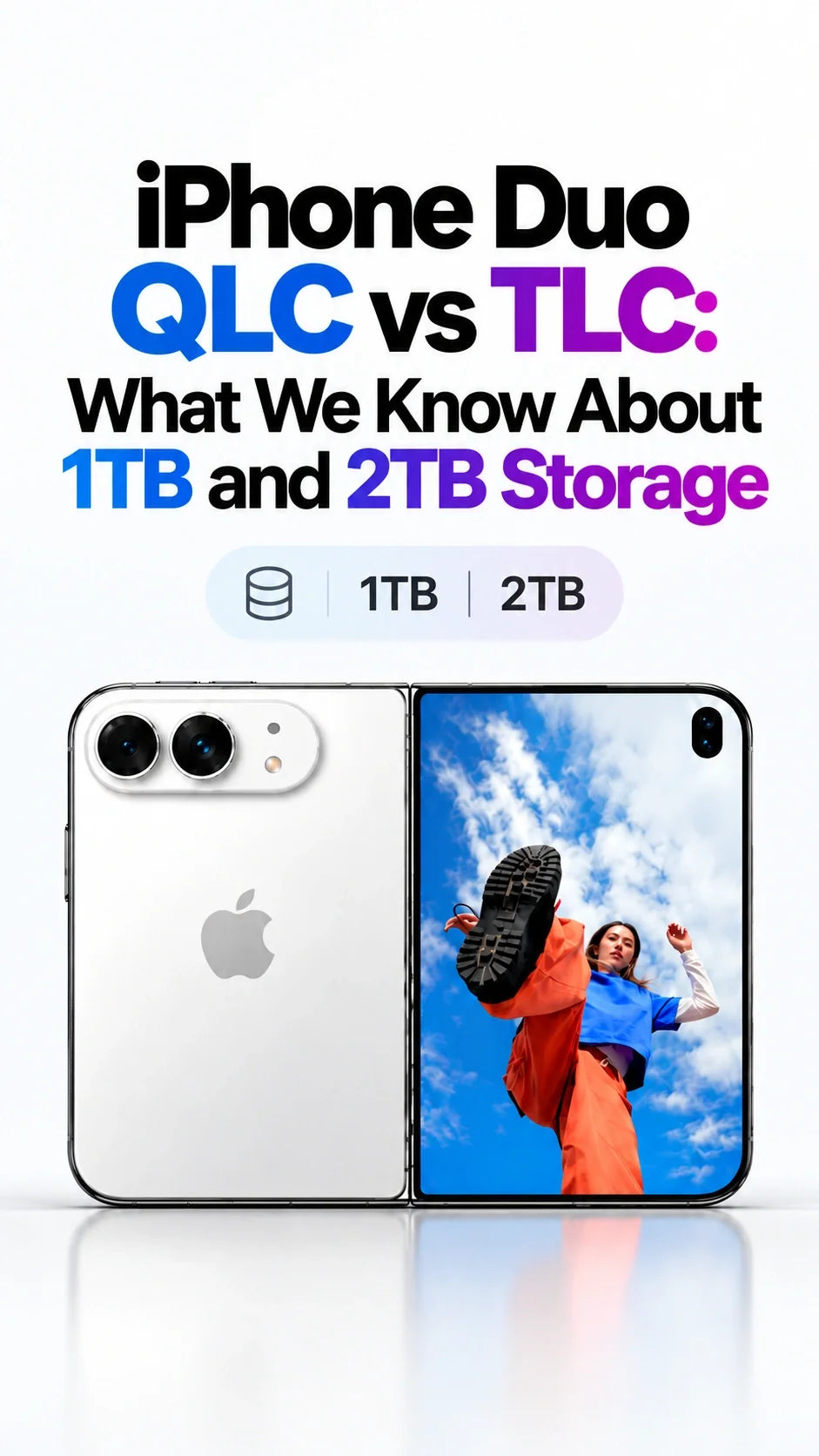
Apple confirms iPhone Duo comes in 256GB, 512GB, 1TB and 2TB capacities, but does not identify their NAND type.
The claim that 1TB and 2TB Duo models use QLC while smaller models use TLC remains unverified in the sources reviewed.
QLC can involve a sustained-write trade-off; that does not establish slower everyday performance on an untested Duo.
Tests of an iPhone 18 Pro cannot confirm the flash memory or speed of an iPhone Duo.
Choose enough capacity for your files. If sustained writing is critical, wait for capacity-specific Duo testing.
Does iPhone Duo use QLC or TLC NAND?
We cannot yet confirm either type for a particular Duo capacity. Apple’s technical specifications list four storage options without a TLC/QLC breakdown. A capacity label tells you how much storage is sold, not how many bits each flash cell stores.
This is a pre-release evidence check: Apple’s launch announcement places first availability on October 23, 2026. ZEERA has not dismantled or storage-benchmarked a Duo, and the sources reviewed do not establish a verified NAND map for retail Duo models.
What is confirmed about 1TB and 2TB storage?
The distinction below matters when deciding whether a higher-capacity order carries a proven performance compromise.
| Capacity | Apple listing | NAND evidence reviewed |
|---|---|---|
| 256GB | Confirmed | TLC not established |
| 512GB | Confirmed | TLC not established |
| 1TB | Confirmed | QLC not established |
| 2TB | Confirmed | QLC not established |
Buying a 512GB Duo does not currently guarantee TLC. Likewise, choosing 2TB does not prove you are receiving QLC. Neither conclusion follows from Apple’s capacity list.
Why are buyers connecting Duo to iPhone 18 Pro QLC tests?
The concern carries over from the high-capacity iPhone 18 Pro storage debate. HOMOLAB has published an iPhone 18 QLC storage test. Separately, the MacRumors Forums thread “1TB / 2 TB iPhone Duo” shows buyers asking whether the same concern applies to Duo. Its replies include predictions based on the Pro, rather than a documented Duo teardown.
A useful warning signal, with a clear evidence limit
Another model’s test can suggest what reviewers should investigate. It cannot identify the NAND package, cache behavior or sustained speed of a different phone.
Even a confirmed result for one 1TB Duo would need careful labeling: the tested unit, software and capacity. It would not automatically establish every 2TB unit’s configuration.
If you are choosing between the two phone families, our iPhone 18 Pro vs iPhone Duo comparison covers the broader purchase decision.
QLC vs TLC: what changes inside the storage?
Kingston’s NAND comparison defines TLC as three bits per cell and QLC as four. More bits per cell increase storage density, but the finished device’s controller, flash generation and workload also matter.
TLC: more write headroom in comparable designs
TLC generally favors demanding write workloads and cell endurance. That is a technology-level tendency, not proof that a particular 512GB Duo outperforms a 1TB Duo.
QLC: more capacity per cell
QLC supports higher density, with potential compromises in native write performance and endurance. Reading a stored movie is a different workload from repeatedly replacing a large video project.
KIOXIA’s QLC/TLC explanation highlights this distinction between read-centric and write-heavy use. Its discussion concerns SSD technology; it does not identify Apple’s Duo components.
Would QLC make a 1TB or 2TB Duo slower?
There is no verified Duo performance gap to quote here. The question worth testing is whether a long write slows after a fast cache fills, and whether that slowdown affects your actual task.
Why a short benchmark can miss the issue
Kingston explains pseudo-SLC caching as operating higher-density flash in a one-bit mode to accept incoming writes quickly. Data can subsequently move into denser storage.
This helps explain how strong burst performance can coexist with lower sustained write performance. It does not establish that Duo uses a particular cache design, size or exhaustion threshold.
Everyday use versus sustained writing
As a workload-based expectation, messaging, reading documents and playing already-downloaded media are less revealing tests of sustained writing than importing a large folder or repeatedly saving large projects.
That expectation still needs Duo testing. Avoid claims that every app will feel slower, or that nobody could notice a difference.
Also separate writing to the phone from copying files off it. The latter tests reading as well as the connection and destination. Apple lists USB 3 up to 10Gb/s for Duo; an interface ceiling is not a measured internal NAND write speed.
Does QLC mean a shorter iPhone Duo lifespan?
Lower cell endurance is a legitimate technical consideration, but it cannot be converted into a specific Duo failure date. Kingston notes that endurance varies with the flash manufacturing process; controller management and write amplification also affect the relationship between user writes and flash wear.
What we cannot calculate yet
The Apple specifications reviewed do not give a capacity-specific storage endurance rating. Without the exact flash configuration, endurance data and workload assumptions, claims such as “the Duo will last three years” or “TLC lasts exactly three times longer” are unsupported.
A mostly static offline library and a workflow that continually imports and deletes footage should not receive the same endurance prediction. Our practical advice is to keep an independent copy of important files whichever capacity you buy.
What testing would settle the 1TB and 2TB question?
A useful review needs component evidence and repeatable performance measurements. This is the checklist we would use to judge a future Duo storage report:
Evidence to look for
- Exact unit: Duo model, capacity, region and iOS build.
- NAND identification: readable package markings or a documented diagnostic identifier, interpreted against reliable component information.
- Long writes: a speed-over-time trace, file sizes and enough written data to expose caching effects.
- Storage occupancy: repeat runs with substantial free space and with the phone more heavily filled.
- Controlled conditions: temperature, charging, background activity, cable and source/destination performance.
- Separate capacities: actual 1TB and 2TB results, with additional units before broad claims about all production.
A CPU score is insufficient evidence for this question. Our iPhone Duo benchmark guide covers that separate type of performance evidence.
Should you avoid the 1TB or 2TB iPhone Duo?
The evidence reviewed does not justify avoiding either capacity solely because of QLC speculation. It also does not justify paying for 2TB on the assumption that a larger tier must be faster.
If your files comfortably fit in 512GB
Choose based on the space you need and your budget. Buying 512GB specifically to guarantee TLC goes beyond the available evidence.
If you genuinely need 1TB or 2TB
A large offline library is a concrete reason to buy more capacity. Do not choose a tier that cannot hold your working files just to avoid an unverified component claim.
If long imports or repeated large writes are central to your work
Wait for capacity-specific Duo tests before committing on performance grounds. Look for the actual task you need, its completion time and repeatability, rather than a single peak speed.
For the separate question of how much space to buy, see our iPhone Duo 256GB vs 512GB vs 1TB storage guide.
FAQ
Can the box or storage setting confirm TLC or QLC?
A capacity label alone cannot. A credible identification needs component-specific evidence; the Apple capacity listing reviewed does not supply it.
Does 2TB mean twice the speed of 1TB?
No. Twice the advertised capacity is not a promise of twice the throughput. A speed claim needs measurements from both configurations.
Can a benchmark app prove which NAND is inside?
A speed result by itself is insufficient. Different flash and cache designs can produce overlapping results. Look for documented hardware identification alongside testing.
Would iCloud turn QLC into TLC or replace local storage?
No. Cloud storage does not change the physical flash in the phone. Decide separately which files need to remain available locally.
Should I cancel my 1TB or 2TB preorder?
The sources reviewed do not establish a Duo-specific NAND defect or a measured storage penalty. If sustained writing determines whether the phone meets your needs, waiting for stronger evidence is reasonable.
Sources and evidence scope
This article separates official capacity information, general flash-memory principles and buyer discussion. It does not present another iPhone’s measurements as Duo results.
- Apple: iPhone Duo technical specifications — capacities and USB interface; no TLC/QLC breakdown.
- Apple: iPhone Duo announcement — launch timeline.
- HOMOLAB: iPhone 18 QLC storage test — original test publication, concerning another iPhone family; no numerical results are used here.
- MacRumors Forums: 1TB / 2 TB iPhone Duo — evidence of buyer questions and speculation.
- Kingston: enterprise versus client SSDs — NAND types, endurance and controller considerations.
- Kingston: NAND types and pseudo-SLC caching — general flash principles.
- KIOXIA: QLC vs TLC flash storage — workload trade-offs; not an identification of Apple components.
Related Articles
- Is 256GB Enough for iPhone Duo? 256GB vs 512GB vs 1TB
- iPhone Duo Benchmark Results: As Fast as iPhone 18 Pro?
- Buying iPhone Duo? Avoid This iOS 27.2 Beta Backup Problem
- Why Does My iPhone Duo Get Hot?
- iPhone 18 Pro vs iPhone Duo: Price, Size and Camera
- Is iPhone Duo Worth $2,000? Five Big Compromises
Reposting Notice: Please credit Guichang Chen · ZEERA WIRELESS when sharing or republishing this article.