Quick Answer
WekiHome identifies Samsung Display M16 LTPO OLED panels in both iPhone Duo screens.
The 5.4-inch outer display uses Ceramic Shield 2; the 7.6-inch folding display combines a nano-texture polymer surface with a multilayer glass-and-support structure.
The outer screen reaches about 1,100 nits under strong-light activation and 3,022 nits in a 10% test window.
The inner screen closely matches it at 1,090 and 3,029 nits, respectively.
The key distinction is illuminated area: a small peak-brightness window is different from a bright full-screen page.
Who makes the iPhone Duo screens?
In its iPhone Duo teardown, WekiHome identifies both panels as Samsung Display LTPO OLEDs using M16 emissive materials. The supplied outer-screen specification image lists the same supplier and material generation, alongside 460 ppi, 1–120Hz refresh and 480Hz PWM dimming.
Samsung Display supplies the OLED panels in the reviewed device; Apple integrates them into two different display assemblies. M16 describes the OLED emissive material generation. It does not describe the cover glass, the touch controller or the complete folding-screen stack.
iPhone Duo inner and outer display specifications
Apple’s technical specifications establish the sizes, resolutions and display features below. Supplier, M16, PWM and internal construction details come from WekiHome’s teardown.
| Specification | Outer display | Inner display |
|---|---|---|
| OLED supplier reported by WekiHome | Samsung Display | Samsung Display |
| Panel / emissive materials | LTPO OLED / M16 | LTPO OLED / M16 |
| Diagonal size | 5.4 inches | 7.6 inches |
| Resolution | 1398 × 2034 pixels | 1878 × 2670 pixels |
| Pixel density | 460 ppi | 430 ppi |
| Refresh | 1–120Hz reported; ProMotion | 1–120Hz reported; ProMotion |
| PWM reported by WekiHome | 480Hz | 480Hz |
| Outer surface | Ceramic Shield 2 | Nano-texture polymer cover layer |
| Structural detail | Metal-backed assembly | Dual UTG; 120 μm titanium-alloy support |
Both screens support Always-On display, HDR, True Tone and P3 wide color. The larger inner display has more total pixels, while the outer display packs them more densely. That distinction matters: the inner screen’s softer appearance cannot be explained simply by saying it has fewer pixels.
LTPO and M16 do different jobs
The OLED material emits the light. LTPO refers to the transistor backplane controlling the pixels and helps enable variable refresh rates. Lower refresh rates can reduce display-driving work for static content; up to 120Hz supports smoother scrolling. Neither term specifies the surface finish you touch.
Why 1,100 nits full-screen becomes 3,022 nits in a 10% window
WekiHome reports several brightness conditions rather than one universal maximum. Manual full-screen brightness is close to 880 nits on both displays. Strong-light activation raises the outer display to about 1,100 nits and the inner display to about 1,090 nits. Reducing the test window to 10% produces peaks above 3,000 nits.
| WekiHome test condition | Outer display | Inner display |
|---|---|---|
| Manual maximum, full-screen | ≈880 nits | ≈880 nits |
| Strong-light activation | ≈1,100 nits | ≈1,090 nits |
| 10% test window | 3,022 nits | 3,029 nits |
| Minimum measured | ≈1 nit | ≈1 nit |
A 10% window means the bright test patch occupies one tenth of the display area. It does not mean 10% of the brightness slider, and it does not involve changing the screen’s resolution. OLED pixels emit their own light, so lighting a smaller area leaves more of the panel’s power and thermal budget available to that area.
This explains why a small highlight can be much brighter than a full-screen white document. The result depends on the test pattern and operating conditions; the transcript does not establish how long the peak is sustained. It is therefore useful to read “3,022 nits in a 10% window” as the complete result.
How this relates to Apple’s brightness ratings
Apple lists 1,000 nits typical maximum, 1,600 nits peak HDR, 3,000 nits peak outdoors and a 1-nit minimum for both screens. These are different rated operating conditions. WekiHome’s small-window result is numerically close to the outdoor peak rating, but it does not establish identical test conditions or make the whole panel a sustained 3,000-nit surface.
The two sets of measured results are remarkably close. The larger screen’s main visible difference is its matte surface treatment and folding construction, rather than a large brightness gap in these tests.
Inside the folding screen: polymer, dual UTG and titanium support
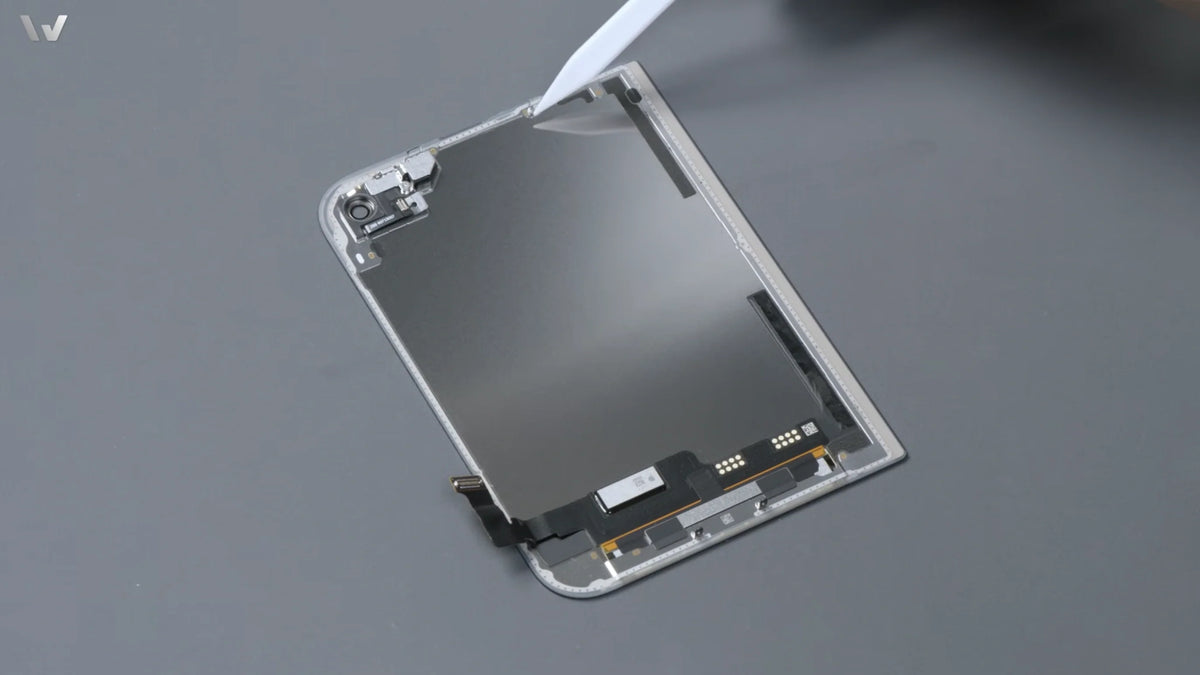
WekiHome describes a polymer nano-texture surface, dual layers of UTG (ultra-thin glass), specially formulated optical elastic adhesive and a 120-micrometer titanium-alloy support plate behind the inner display. Those components serve different mechanical and optical roles. The teardown describes a multilayer assembly; it does not provide a complete manufacturing cross-section with every layer’s position and thickness.
Nano-texture polymer surface
The top treatment diffuses reflected light, helping suppress sharp reflections that reveal the fold. It also changes the image’s perceived clarity compared with the glossy outer screen. This is a functional part of the display finish, rather than just a shipping film.
Dual UTG layers
UTG means ultra-thin glass. Thin glass can accommodate bending in a properly engineered stack, unlike a conventional thick phone cover. The reported dual-UTG construction should not be read as two layers of Ceramic Shield 2 or as a guarantee against pressure damage.
Optical elastic adhesive
The layers follow different bending radii as the phone closes. WekiHome describes them sliding relative to one another, like pages in a book, to release stress. The optical adhesive has to maintain a clear bonded interface while allowing that deformation. The presenter’s earlier suggestion of a special OCA formulation is a hypothesis, not an identified chemical recipe.
120 μm titanium-alloy support
At 0.12 mm thick, the rear support plate helps support the folding display assembly. WekiHome also shows a patterned structure around the folding area. Support, flexibility and stress distribution have to work together; a thin metal backing alone does not eliminate the crease.
The screen stack and the hinge work as a system. The teardown shows material used to level the central hinge area beneath a steel sheet, helping support a flatter opened surface. This is a mechanical contribution to flatness, while the matte surface changes how visible the remaining contour becomes. Our iPhone Duo crease analysis examines that optical difference in more detail.
The outer screen uses a different protection and packaging approach
The outer screen combines a rigid Ceramic Shield 2 front with a metal-backed display assembly. WekiHome finds a concealed metal bracket reinforcing the perimeter and front-camera area, with positioning structures and dust-protection foam around the camera.
At the bottom, the bracket also protects the DDIC—the display driver integrated circuit. The reviewer identifies perimeter LIPO packaging, meaning low-injection-pressure overmolding, and an Apple-custom Broadcom touch controller. LIPO here describes a packaging process, not a lithium-polymer battery.
The inner display also uses an Apple-custom Broadcom touch solution, according to the teardown. Broadcom’s role is therefore distinct from Samsung Display’s panel supply. The footage does not identify the UTG glass manufacturer or adhesive supplier, so it cannot support naming either company.
480Hz PWM is separate from the 120Hz refresh rate
The supplied specification image and transcript report 480Hz PWM on the outer screen, and the transcript reports the same on the inner screen. PWM is pulse-width modulation, a method of controlling perceived brightness by varying the light’s on-time. Refresh rate describes how frequently the display updates its image.
A 120Hz refresh figure concerns motion and scrolling; 480Hz PWM concerns light modulation. Frequency alone does not describe the waveform, modulation depth or how an individual viewer will respond. Matching PWM figures also do not prove the two screens behave identically at every brightness setting.
Why the inner screen can look less clear despite similar brightness
Switching between Duo’s glossy outer screen and matte inner screen makes the surface difference especially obvious. The nano-texture layer spreads reflected light, which can make the image appear less glass-like under some lighting. At the same time, quieter reflections can make reading and viewing more comfortable under overhead lights.
WekiHome notes that removing the layer makes the image look more transparent, but also exposes the fold more clearly and changes the calibrated optical stack. The layer was present during Apple’s display calibration. Our glossy-versus-matte comparison shows how reflections and the visible fold change after removal.
The materials explain the trade-off: similar OLED technology and measured brightness sit beneath different surfaces. Choosing between them for a task is as much about reflections, screen area and presentation as it is about peak nits.
Watch WekiHome’s original teardown
Sources: WekiHome’s iPhone Duo teardown and supplied Chinese transcript for panel identification, internal construction and measurements; Apple’s technical specifications for published display ratings.
FAQ
Does the 1-nit minimum mean the screen is off?
No. It describes a very low light output while the display is on. OLED can also switch individual pixels off to display black, which is a separate behavior.
Can I treat the folding screen like the Ceramic Shield 2 outer screen?
The inner display has a different cover and bending structure. Its surface needs the care specified for that assembly. For cleaning, layer replacement and compatible protection, start with our iPhone Duo cover-layer guide.
Related Articles
- Why the iPhone Duo crease is still there but harder to see
- iPhone Duo glossy vs matte screen comparison
- iPhone Duo cover layer: replacement and protection guide
- Apple’s cover-layer replacement fixture and cleaning rules
- Does the iPhone Duo inner display drain more battery?
- iPhone Duo case materials, protection and fit