Quick Answer
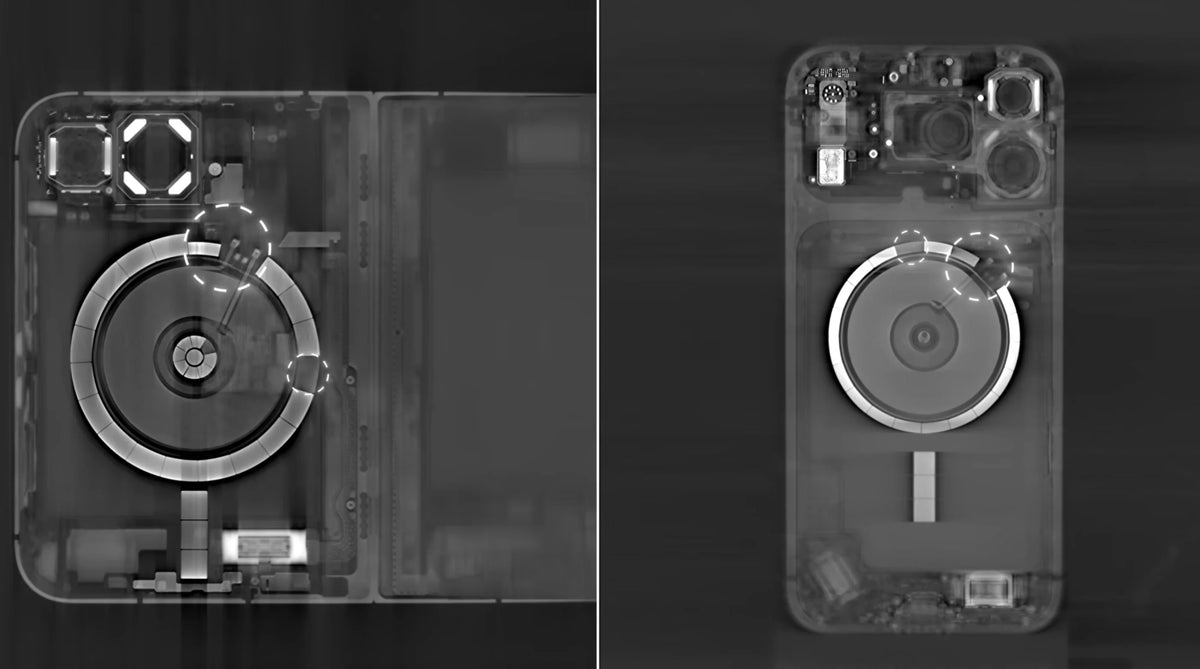
The supplied comparison shows interrupted MagSafe magnet rings on both iPhone Duo and iPhone 18 Pro, rather than uninterrupted circles.
The Duo also has an additional central magnetic feature, identified in the accompanying account as a center magnet. The 18 Pro comparison does not show the same feature.
Its purpose remains unconfirmed. The images alone cannot establish how it interacts with every wireless charger.
The pictured force gauges read approximately 7.8 N for Duo and 8.5 N for 18 Pro, indicating slightly weaker attachment for Duo in that setup.
Third-party wireless-charging compatibility is worth checking, but these observations do not prove that the center magnet causes charging interference.
What Is Different About the iPhone Duo MagSafe Ring?
The comparison supplied for this article highlights three details: gaps in both phones' outer magnet arrays, an extra magnetic feature in the center of the Duo's ring, and a slightly lower force-gauge reading for Duo. Together, they raise useful questions about accessory attachment and wireless charging.
Those questions need separate answers. A magnet-layout image describes the arrangement; a pull test describes one attachment setup; a charging test would establish whether a particular phone and charger work reliably together. None of these measurements replaces the others.
Both MagSafe Rings Have Gaps—Does That Mean Magnets Are Missing?

In this image, neither phone has a visually uninterrupted ring. The marked gaps are part of what is visible in the comparison. Calling the ring “incomplete” describes its appearance; it does not establish that a component has broken off or that the phone is defective.
What the image establishes
Both outer arrays contain interruptions, and the two layouts are not identical. The Duo's central feature is an additional difference beyond the gaps around the perimeter.
What still needs an engineering explanation
The image does not explain why Apple chose each gap, give the magnets' grade or polarity, or establish the effect of any individual segment on attachment. It cannot show whether the gaps caused the difference in the pull comparison.
A useful question for owners is whether the intended accessory seats correctly and remains attached in normal use. For a car mount, also check the supported phone orientation: our iPhone Duo car-mount orientation guide treats that separately from charging compatibility.
Why Does iPhone Duo Have an Extra Magnet in the Center?

The purpose of the additional center magnet is not yet established by the evidence supplied here. The central pattern is visible in the Duo demonstration, while the 18 Pro layout comparison does not show the same central feature.
That is an interesting hardware difference, but identifying its position is not the same as identifying its job. An Apple explanation or a component-level investigation would be needed to assign a specific function confidently.
Does the extra magnet make Duo's overall hold stronger?
The pictured pull comparison does not show that outcome: Duo has the lower reading. Without isolating the central feature, the comparison cannot tell us how much it contributes to attachment, if at all, with the accessory used.
iPhone Duo vs iPhone 18 Pro: Which Has Stronger MagSafe Attachment?

iPhone 18 Pro shows the stronger attachment in this comparison. The displayed difference is modest, consistent with the accompanying observation that Duo's magnetic hold is slightly weaker.
| Item | iPhone Duo | iPhone 18 Pro |
|---|---|---|
| Outer magnet ring | Interrupted in the image | Interrupted in the image |
| Central magnetic feature | Shown; purpose unconfirmed | Same feature not shown |
| Visible force reading | Approximately 7.8 N | Approximately 8.5 N |
| Wireless-charging result | Not established by the layout images or force-gauge screenshot | |
The N on the gauges means newtons, a unit of force. It does not mean watts or charging speed. The available material does not provide repeated trials, calibration details or results across multiple accessories, so the figures should not be treated as universal ratings.
A pull comparison also does not establish resistance to sideways sliding or rotation. The accessory, case and phone position belong in any practical comparison of magnetic mounts.
Could Duo's Center Magnet Affect Third-Party Wireless Charging?
It is an open compatibility question, not a demonstrated charging fault. The unusual central feature makes it reasonable to test individual third-party chargers, but neither the images nor the pull readings establish interference or a failure probability.
Magnets and charging coils do different jobs
The Wireless Power Consortium explains that alignment magnets position the phone while the coils transfer power. Static magnets in the intended alignment arrangement do not automatically interfere with that transfer. This general principle does not, by itself, validate every charger against the Duo's particular layout.
A charging failure would still need a cause
To connect a failure to the center magnet, testing would need to separate that feature's effect from alignment, physical clearance, power supply, temperature and charging electronics. A charger working with 18 Pro but stopping on Duo would be a compatibility observation; it would not isolate the reason.
Wireless chargers also assess more than physical attachment. The WPC's Qi specification history describes power-loss accounting and foreign-object checks. Their existence does not show that the Duo's built-in center magnet is being detected as a foreign object.
Apple's MagSafe charging guidance likewise says delivered power depends on the iPhone model, power adapter and system conditions. A firmer magnetic snap therefore cannot establish faster charging.
What Should You Check Before Reusing a Charger or Magnetic Case?
Use the actual phone, charger and case combination you intend to keep. The most useful checks answer three practical questions rather than trying to infer compatibility from the number of magnets.
Does it sit correctly?
Check that the charging surface sits against the intended rear charging area without being lifted by the camera surround, wallet, grip or stand. Compare with the case removed if the fit is uncertain.
Does charging remain consistent?
Confirm the charging indicator and observe whether charging continues normally. If comparing phones, keep the charger, adapter, case condition and starting conditions as similar as practical. A single successful attachment is not a sustained-charging result.
Does the accessory support your use?
A desk charger, battery pack and car mount make different demands on attachment. Follow the manufacturer's model and orientation guidance. For case hardware, see how Duo ring-stand cases handle MagSafe charging; check the exact case and variant rather than assuming every model in a collection supports it.
For desk and travel options, our MagSafe charger comparison covers MagTri Gen2 and SuVolt Gen5 by use case. Their product descriptions are separate from the magnetic-layout observations here and do not establish what the Duo's central magnet does.
Frequently Asked Questions
Is the Duo's center magnet the reason its MagSafe pull is weaker?
The comparison does not establish that cause. It shows a central magnetic feature and a lower pull reading, but does not isolate the contribution of each magnet or other differences in the setup.
Does the 7.8 N reading mean Duo cannot hold a MagSafe battery pack?
No such conclusion follows. The reading belongs to the pictured attachment setup. A particular battery pack's fit and retention need their own assessment with the intended case.
Should you add a metal ring to fill the gaps?
The images do not establish a defect that needs correcting. Use an accessory designed for the phone and wireless-charging setup instead of treating the visible interruptions as a repair instruction.
Can a magnetic-viewing film prove Qi2 certification?
No. It shows a magnetic pattern, not certification or electrical performance. Verify an exact product's certification in the WPC product database when a certification claim matters to your purchase.
Related Articles
- Does MagSafe Charging Work with an iPhone Duo Ring Stand Case?
- Can a MagSafe Car Mount Hold iPhone Duo Unfolded?
- MagSafe Charger Stands for iPhone 18 Pro Max and iPhone Duo
- 12 iPhone Duo Cases Compared: Materials, Stands and Protection
- Why Wireless Charging Slows Down in the Car
- iPhone Duo Case Resource Hub: Fit and Accessory Guides
Evidence note: The three comparison images and accompanying hardware observations were supplied for this article by ZEERA. The displayed force readings are described as shown; ZEERA has not independently reproduced or calibrated the pictured test for this article. The center magnet's purpose and its effect on particular third-party chargers remain unconfirmed. Apple and WPC references provide general charging guidance, not confirmation of this component's function.