Quick Answer
iPhone Duo is very close to iPhone 18 Pro Max in Geekbench CPU performance: 4,012 / 11,199 versus 4,025 / 11,383 in the comparison.
The Pro Max has the advantage in the GPU stress test, with a higher best score and a higher lowest score than Duo in either folding position.
The heat-summary graphic shows 49°C for Duo, 45.5°C for Pro Max and 44.8°C for Pro, with heat concentrated on one half of the Duo.
Duo's network results vary by location: it trails heavily at the subway station, but leads both Pro models in the parking-garage download test and mall upload test.
Choose Duo for its folding workspace; choose Pro Max if sustained graphics performance and the stronger subway-station result matter more to you.
Does the Same A20 Pro Chip Mean the Same Performance?
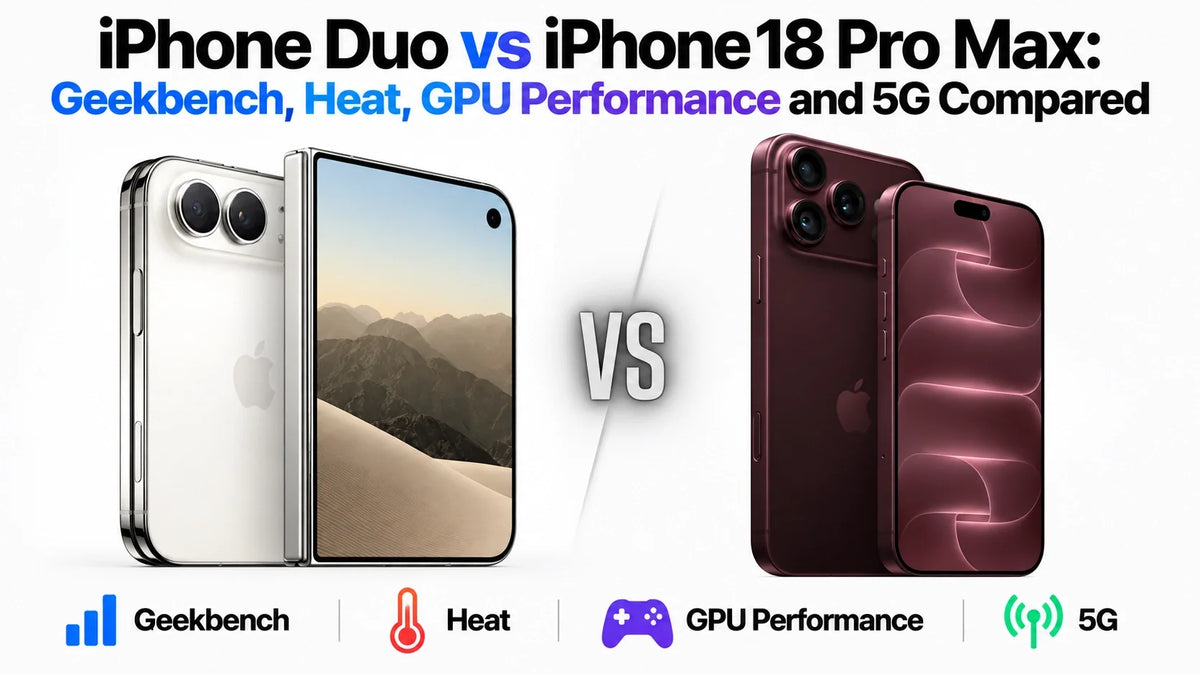
The iPhone Duo, iPhone 18 Pro and iPhone 18 Pro Max share the A20 Pro chip, but they put it inside very different bodies. Mediastorm's comparison shows what changes in practice: CPU scores stay close, while graphics performance, surface heat and cellular throughput separate the phones.
For someone moving from a Pro Max to Duo, the useful question is how much that difference matters during the tasks they actually do. The numbers suggest little reason to worry about basic CPU speed, with a clearer trade-off under sustained graphics load.
Geekbench 7: Duo's CPU Scores Are Almost Level with Pro Max

| Phone | Single-core | Multi-core |
|---|---|---|
| iPhone Duo | 4,012 | 11,199 |
| iPhone 18 Pro | 4,027 | 11,510 |
| iPhone 18 Pro Max | 4,025 | 11,383 |
Duo is about 0.3% behind Pro Max in single-core and 1.6% behind in multi-core, calculated from these scores. The smaller 18 Pro posts the highest CPU result of the three in this run.
That is a narrow gap. For CPU-heavy bursts, Duo is firmly in the same performance range as the Pro models. If you read our earlier iPhone Duo Geekbench report, this side-by-side review adds the more useful next step: seeing what happens under a longer graphics workload.
GPU Stress Test: Pro Max Holds the Higher Performance Floor

| Phone / mode | Best | Lowest | Stability |
|---|---|---|---|
| 18 Pro Max | 8,604 | 5,367 | 62.4% |
| 18 Pro | 8,808 | 5,231 | 59.4% |
| Duo unfolded | 8,279 | 5,005 | 60.5% |
| Duo folded | 7,887 | 4,883 | 61.9% |
Unfolded Duo trails Pro Max by about 4% in the best loop and 7% in the lowest loop. Folded Duo scores lower again. Pro Max therefore offers the stronger graphics-performance floor in this comparison, even though 18 Pro reaches the highest peak.
Read the scores alongside the stability percentage
Duo's stability percentages sit between the Pro models. A similar percentage can still accompany lower absolute performance, because it describes how much of each device's own best score is retained. Here, the best and lowest scores both favor the Pro phones.
For long graphics-heavy sessions, that is a better buying signal than the tiny CPU difference. The large folding screen gives Duo more space to play, but it does not make its GPU the fastest of these three.
Heat Comparison: Duo Reaches 49°C with a More Concentrated Hotspot

Duo is the hottest device in the summary graphic, reaching 49°C (120.2°F). Pro Max is shown at 45.5°C (113.9°F), while Pro is at 44.8°C (112.6°F).
The heat distribution matters as much as the peak. Duo's processor sits in one half of the folding body, and the image shows a strong contrast between the warmer and cooler halves. That unevenness can make the hotspot more noticeable in your hands.

Mediastorm also reported that Duo ran about 2°C warmer unfolded than folded in its testing. Opening the device changes the thermal behavior, so a larger exposed body does not automatically give the cooler result.
The reviewer found thermal behavior improved after a software update compared with an earlier hot demo unit. Even with that improvement, the side-by-side results still leave Duo warmer and behind the Pro models in GPU scores. The tests do not isolate a particular clock-speed limit, so the clearest conclusion is the visible one: a different balance of heat and graphics performance.
5G Network Speeds: The Location Changes the Winner

The network chart adds an important detail to the review's broader impression that Duo trails the Pro series: Duo is not slower in every location or direction. Here are all the figures, with download and upload kept separate.
Underground parking garage
| Phone | Down, Mbps | Up, Mbps |
|---|---|---|
| Duo | 24.7 | 5.7 |
| 18 Pro | 22.3 | 4.6 |
| 18 Pro Max | 22.4 | 4.0 |
Duo leads both download and upload here, although all three have relatively low throughput.
Shopping mall
| Phone | Down, Mbps | Up, Mbps |
|---|---|---|
| Duo | 46.6 | 19.4 |
| 18 Pro | 67.9 | 7.0 |
| 18 Pro Max | 58.2 | 4.2 |
The Pro phones download faster, while Duo uploads faster than either of them.
Subway station
| Phone | Down, Mbps | Up, Mbps |
|---|---|---|
| Duo | 191.6 | 38.5 |
| 18 Pro | 682.0 | 95.5 |
| 18 Pro Max | 613.8 | 90.5 |
This is Duo's clearest loss: Pro Max downloads at about 3.2 times its speed, and Pro is faster still.
These measurements describe data throughput at the tested locations. They do not measure call-drop rates or signal strength in dBm. For buyers, the useful lesson is to check the carrier and places you use most often, especially if large uploads or downloads are part of your commute.
What the Results Mean for Daily Use and Gaming
Choose Duo for the larger workspace
The CPU results give you little reason to give up the folding screen for a tiny benchmark lead. If reading, browsing and working across a larger display drive the purchase, Duo keeps the CPU performance close while offering a very different layout.
Choose Pro Max for the stronger sustained GPU result
Pro Max combines the highest lowest-loop score with lower peak surface heat in the summary graphic. That makes it the more convincing choice here for someone who values long graphics-heavy sessions over the folding form factor.
Whichever phone you choose, charging during a demanding task adds another source of heat. At a desk or in a car, consider the charging setup as well as the case. Our guide to heat and wireless charging in the car explains the navigation scenario, while the MagSafe charger comparison covers desk, travel and car options.
Frequently Asked Questions
Is iPhone Duo slower than iPhone 18 Pro Max?
It is very close in the shown Geekbench CPU run, but lower in the GPU stress test. The size of the difference depends on the workload.
Does opening Duo improve graphics performance?
The unfolded stress-test result is higher than the folded result: 8,279 versus 7,887 at best, and 5,005 versus 4,883 at lowest. The review also reports higher temperature unfolded, so performance and heat move together here.
Does Duo have worse signal everywhere?
The speed chart does not show that. Duo wins the garage download/upload comparisons and the mall upload comparison, but loses both directions at the subway station. Speed and signal strength are also different measurements.
Is 49°C the CPU's internal temperature?
It is the surface-temperature figure in the review's heat comparison. A thermal camera shows surface heat rather than the chip's internal junction temperature.
Watch the Original Review
Video and comparison images: Mediastorm / 影视飓风, iPhone Duo in-depth review.
Related Articles