Quick Answer
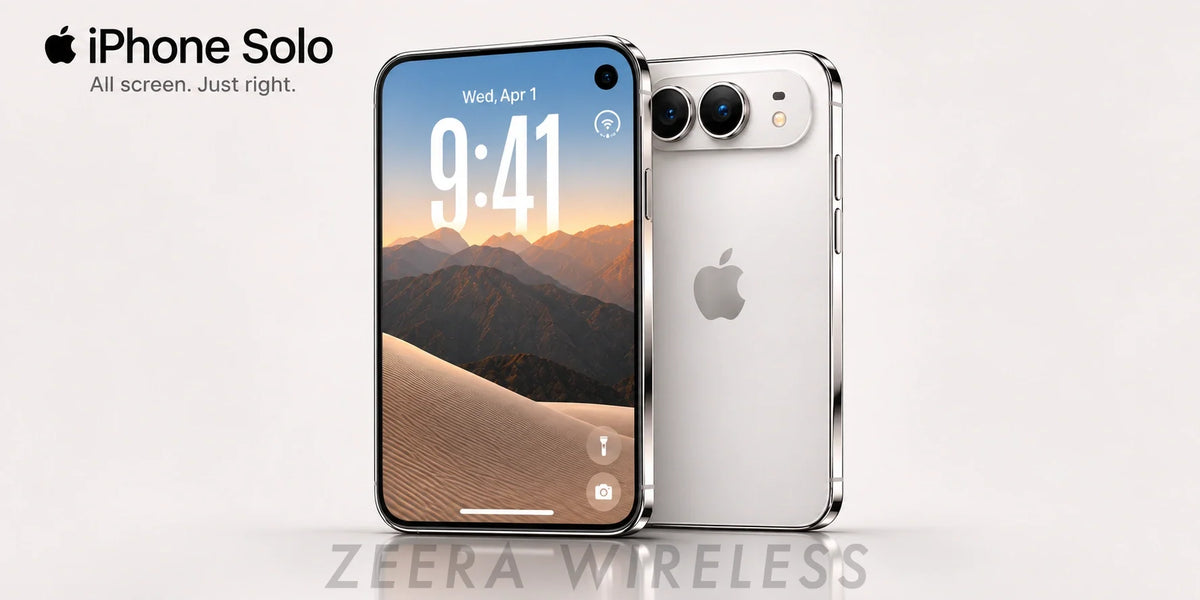
iPhone Solo is a concept name for a shorter, non-folding iPhone, not an announced Apple product. The appeal is easy to picture: some of the iPhone Duo outer-screen experience in a simpler, lighter slab.
Recent discussion points toward an approximately 18:9 screen, but the originating leaker called that idea personal speculation. It also differs from the much broader Huawei Pura X View.
Our concept forecast favors a roughly 6.0–6.2-inch OLED display, everyday flagship performance and pricing below Duo. The strongest audience would be people who want easier top-of-screen reach without a folding mechanism. Specifications below are ZEERA design predictions; market figures separate published industry data from illustrative demand scenarios.

Why call it “half an iPhone Duo”?
Imagine keeping the convenience of a single outward-facing screen and removing the second half, hinge and folding display. That is the appeal behind iPhone Solo: one screen, one familiar phone shape, fewer reasons to unfold anything. Solo also pairs neatly with the Duo name.
The phrase describes a product idea, not a literal engineering shortcut. A standalone phone still needs its own battery, antennas, cameras, speakers and cooling. It would neither inherit half of Duo's weight nor automatically cost half as much.

What the latest reports actually suggest
A shorter iPhone is the relevant Apple idea
On November 9, 2026, Weibo leaker Instant Digital described an iPhone that keeps its width but loses some height, moving from roughly 19.5:9 toward 18:9. The proposal combines top controls with the status bar and ties the redesign to a smaller camera opening or an under-display camera. Crucially, the original post presents this as the leaker's imagination, rather than a disclosed Apple production plan.
MacRumors' November 9 coverage preserves that distinction. It gives the Solo discussion a timely starting point, but supplies no Solo specification sheet or launch date.
Our earlier wide slab phone report covered a separate industry direction: much broader rigid-screen phones, with Huawei already selling a product and Chinese rivals linked to development projects. That report also corrected the assumption that Apple was a confirmed participant.
For this article, “iPhone Solo” means our proposed short-slab Apple model. Calling it Apple's first wide slab iPhone is a positioning question: could Apple create a distinct alternative to both tall flagships and foldables?
18:9 or 16:9: two different design choices
These ratios describe the screen's long side relative to its short side. An 18:9 display is still twice as tall as it is wide in portrait. A 16:9 or 16:9.5 design moves further toward the broad, almost small-tablet shape associated with today's wide-slab discussion.
| Long:short ratio | Height versus a 19.5:9 screen |
|---|---|
| 19.5:9 | 100%: the reference height |
| 18:9 | 92.3%: about 7.7% shorter |
| 16:9 | 82.1%: about 17.9% shorter |
ZEERA geometry calculation: height scales with the long:short ratio when screen width stays fixed. Ideal rectangles exclude bezels, rounded corners and camera cutouts.
At the same width, shortening the display also reduces its area. Reorganizing iOS could recover space occupied by controls, but cannot preserve every app's visible content automatically. Conversely, widening a screen can improve page layout while making the phone harder to grip.
The same distinction applies to video: fewer black bars do not prove a larger physical picture. Our iPhone Duo versus Pro Max video-size comparison explains why screen shape and image dimensions need separate attention.
Predicted iPhone Solo specifications
The following is ZEERA's coherent design scenario, not a leaked bill of materials. We favor the less radical 18:9 route because it could shorten the phone while staying closer to familiar iPhone grip widths. All numerical Solo specifications and prices in this table are editorial targets.
| Feature | ZEERA prediction and reasoning |
|---|---|
| Display | Approximately 6.0–6.2-inch rigid OLED, close to 18:9. A shorter everyday display rather than a folding tablet. |
| Refresh rate | Up to 120Hz as a premium target; important to making a smaller phone feel like a deliberate choice. |
| Body size | Roughly 143–149 mm tall and 73–77 mm wide, depending on display size and bezels; around 7–8 mm thick, excluding the camera bump. |
| Weight | A target of approximately 160–185 g, with aluminum the practical starting point. A polished titanium frame would be an alternative concept treatment, with different cost and weight. |
| Processor | A contemporary Apple A-series chip at launch. There is insufficient evidence to assign Solo a specific future chip name. |
| Memory and storage | 8–12GB RAM; 256GB and 512GB storage, with 1TB a possible upper tier. These are portfolio assumptions. |
| Rear cameras | A 48MP-class main camera, potentially paired with an ultra-wide. A large dedicated telephoto would compete with battery space in a compact chassis. |
| Front camera and unlock | A small visible camera opening is the conservative option. Under-display imaging and biometric packaging remain unresolved; a clean render does not establish Face ID or Touch ID hardware. |
| Battery | Approximately 3,800–4,500 mAh as a design target. Actual capacity would depend on thickness, chemistry and camera packaging; runtime cannot be predicted from capacity alone. |
| Charging | USB-C and magnetic wireless charging would fit the intended role. No defensible Solo-specific wattage is available. |
| Software | iOS with efficient top controls, readable keyboard layouts and app adaptation. Extra-wide split-screen support would require an explicit software decision. |
| U.S. price target | $899–$1,099 before tax: our proposed premium compact positioning, not an Apple price leak. |
The dimensions are a packaging exercise, not measurements of a prototype. A rectangular 6.0-inch 18:9 screen is approximately 136.3 × 68.2 mm before bezels; at 6.2 inches, it is approximately 140.9 × 70.4 mm. That leaves a plausible route to a short body without adopting Huawei's 87 mm width.
Release timing: the camera is a dependency, not a calendar
There is no evidenced Solo release window. If Apple links the concept to a high-quality under-display front camera, it becomes a longer-term possibility. A visible-camera version could be designed without waiting for that technology, but nothing in the current proposal establishes a 2027 or 2028 launch.
iPhone Solo versus the likely alternatives
The most useful comparison separates products people can buy from concepts and development reports. Competitor specifications below come from the manufacturers; the Solo column remains our forecast.
| Model and status | What it offers—and where Solo would differ |
|---|---|
| iPhone Solo Concept |
Our approximately 6.0–6.2-inch 18:9 proposal prioritizes lower height and simpler everyday carry. It would have no expanding inner display. |
| iPhone Duo Shipping product |
Apple lists a 5.4-inch outer display, 7.6-inch folding inner display and 254 g weight. Duo supplies a much larger canvas on demand; Solo would exchange that ability for a single rigid-screen chassis. |
| iPhone 18 Pro Max Shipping product |
Apple lists a 6.9-inch display and 163.4 × 78.0 mm body. Its larger conventional screen and dedicated telephoto make it the clearer fit for buyers prioritizing camera reach and a large phone. |
| Huawei Pura X View Shipping in China |
A much broader interpretation: 6.39-inch OLED, marketed 16:9.5 shape, 87 mm body width, 7,000 mAh typical battery and approximately 201 g weight. It starts at RMB 5,999 in China. |
| Samsung Galaxy Z Fold8 Shipping foldable |
Competes through an expanding wide-format screen. Solo would instead address buyers who want a fixed-size device and do not need the tablet-like unfolded experience. |
| OPPO, Xiaomi and HONOR wide slabs Reported projects |
Potential future competitors, with final global availability and specifications unsettled. They illustrate interest in the category rather than a complete retail comparison. |
Sources: Apple iPhone Duo specifications; Apple iPhone 18 Pro specifications; Huawei Pura X View and official specifications; Omdia's wide-foldable analysis; Android Authority's Xiaomi and rival-project reporting. China and U.S. prices are local-market references, not currency-adjusted equivalents.
A Solo-versus-Huawei comparison is therefore about two priorities: a shorter iPhone with familiar grip width, or a broader content-first phone. Solo would not need to win a battery-capacity or camera-resolution contest to have a clear reason to exist.
Who would buy an iPhone Solo?
People who keep wishing their iPhone were shorter
They want less thumb travel to top controls and less phone protruding from a pocket. This audience overlaps with compact-phone buyers, but width matters: an 18:9 Solo would not automatically recreate the narrow grip of an iPhone mini.
Buyers attracted to Duo's everyday screen, not its folding mechanism
Some people like the idea of a short, broad outer display but rarely need to open a tablet-sized screen. A rigid-screen Solo could concentrate spending and battery space on the part they use all day. That is a stronger proposition than presenting it as a stripped-down foldable.
People who already carry an iPad or work at a Mac
When a larger screen is already available for long sessions, the phone can prioritize portability. Our iPad mini 8 versus unfolded iPhone Duo comparison explores that one-device versus two-device choice.
Readers and casual gamers could also benefit from a better-balanced display, especially in a genuinely wide 16:9 variant. But the 18:9 version forecast here would mainly improve reach and proportions. It would not reproduce Duo's unfolded workspace or guarantee a larger game field of view.
Buyers who spend most of their time on vertical video, want the narrowest one-handed grip, need long-range camera hardware or regularly use a folding screen would have stronger reasons to choose another model.
How big could the wide slab phone market become?
There is no credible standalone iPhone Solo sales forecast in the sources reviewed. Published smartphone and foldable research provides scale; an explicit scenario model can then show what modest adoption would mean.
The published market baseline
Omdia reported 1.25 billion worldwide smartphone shipments in 2025. Separately, its August 2026 foldable forecast recorded 18.2 million foldable shipments in 2025 and projected 36 million in 2028.
Foldables are an adjacent market, not a proxy for wide-slab demand. Their growth shows interest in different screen shapes; it does not establish that those buyers would prefer a non-folding phone.
For the calculation below, assume a distinct category of new phones marketed specifically around shorter or wider slab designs. We use the 2025 shipment total as a fixed historical denominator, not as a forecast of future annual smartphone sales.
| Assumed share of the historical 1.25bn baseline | Implied annual category units |
|---|---|
| 0.2% adoption scenario | 2.5 million |
| 0.5% adoption scenario | 6.25 million |
| 1.0% adoption scenario | 12.5 million |
Calculation: 1.25 billion × assumed category share. Shares are ZEERA scenario inputs, not measured market shares, probabilities or iPhone Solo sales predictions.
At an assumed $900 average retail price, those unit scenarios imply approximately $2.25 billion, $5.63 billion or $11.25 billion in annual retail value across the whole category. The $900 assumption is illustrative; this is neither manufacturer revenue nor a forecast for Apple.
Our view is that a several-million-unit niche across brands is a useful scenario to evaluate before assuming a mainstream replacement for tall phones. Apple would capture only some unknown fraction of that category. Much of Solo's demand could also come from people who would otherwise buy another iPhone, so unit sales would not equal incremental Apple growth.
Where Solo should sit in Apple's lineup
The clearest positioning would be a premium compact iPhone for everyday use: shorter than a Pro Max, simpler than Duo and more focused on balanced carry than maximum screen area. We would prioritize battery reliability, a fluid display and a strong main camera before adding expensive specialist hardware.
Our $899–$1,099 concept range leaves a meaningful gap below Duo's current $1,999 U.S. starting price, checked November 11, 2026 before tax. It would still need a compelling advantage over conventional iPhones at nearby prices. A new shape alone would struggle if it came with weak battery life or a noticeably compromised camera.
What would make the concept convincing?
A comfortable grip in a real hand, ordinary apps that use the shorter screen well, and enough battery for the intended routine. “Half an iPhone Duo” is a memorable introduction. A successful Solo would have to feel complete on its own.
Related Reading
- Wide Slab Phones: Huawei Pura X View, Rival Projects and Apple's Position
- 2027 Foldable Phones: The iPhone Duo Effect
- iPhone Duo vs Pro Max: Actual 16:9 Video Size Compared
- iPad Mini 8 vs iPhone Duo Unfolded: Which Is Better?
- iPhone Duo Display Zoom Missing: Setup Options Explained
FAQ
Would iPhone Duo cases fit a non-folding Solo?
Shared proportions would not establish compatibility. A dedicated Solo design would need case dimensions matched to its body, camera layout and controls. The accessory modules in this article identify the existing models they serve.
Would a shorter screen make text larger?
No. Text size depends on iOS scaling, accessibility settings and app layouts. Reducing display height at the same width does not itself enlarge text; it changes the amount of vertical space available.
Could the same apps work on both 18:9 and wider slab phones?
They could, with layouts that adapt to available space. Key checks would include safe areas, keyboard height, landscape controls and content hidden behind fixed toolbars. Hardware proportions alone do not ensure that every app behaves well.