Quick Answer
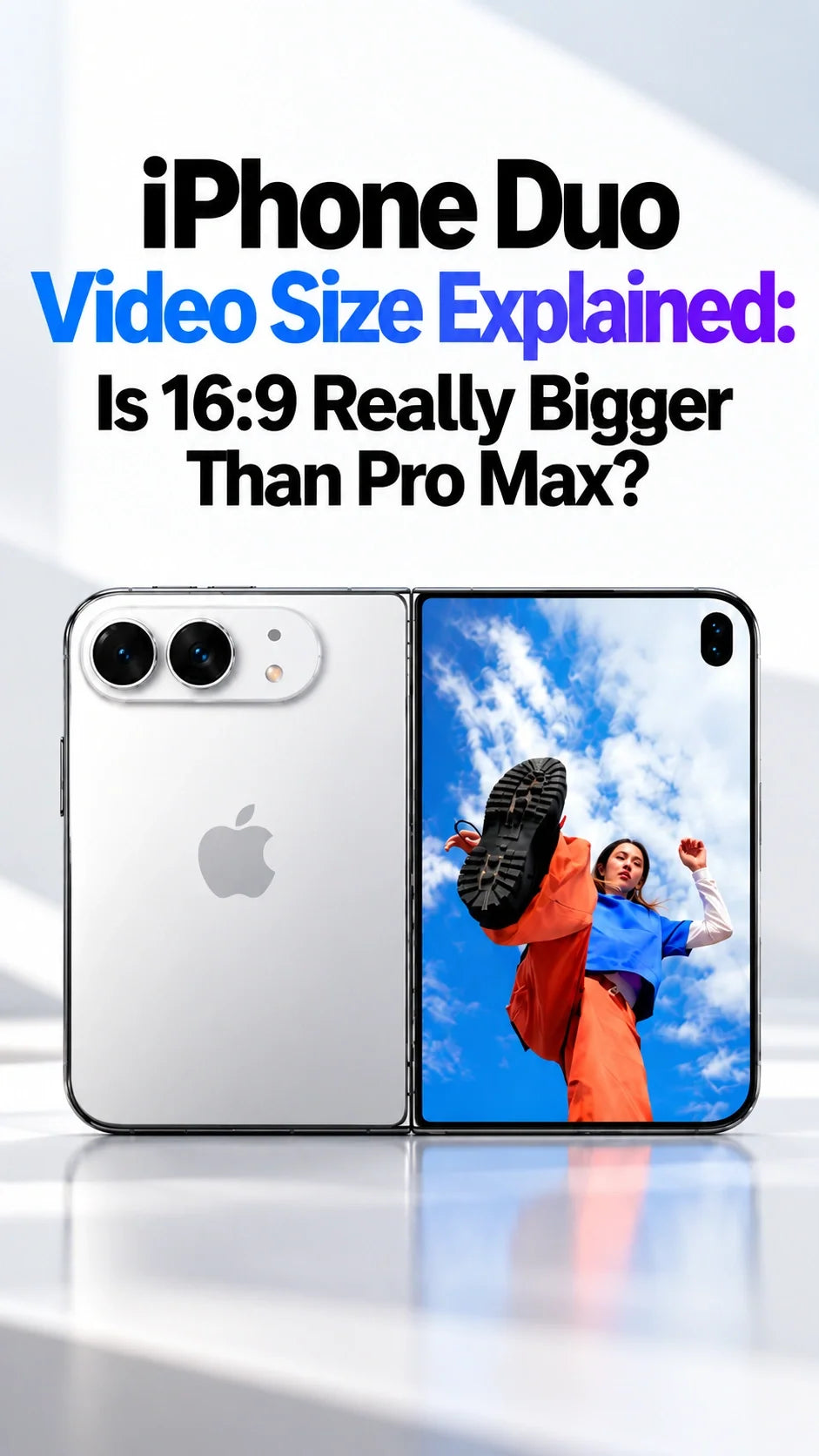
Yes. Unfolded iPhone Duo shows a complete 16:9 video about 22% wider and taller than iPhone 18 Pro Max.
The estimated picture is 15.75 × 8.86 cm, versus 12.95 × 7.29 cm—about 48% more video area.
That is roughly a 7.11-inch video diagonal versus 5.85 inches, with both phones in landscape and cropping disabled.
Duo still has top and bottom black bars. For 2.39:1 movies, picture size is essentially tied.
Its wider canvas may also suit books and documents, but reading comfort depends on text layout; a wider screen does not prove reduced eye strain.
Why screen diagonal does not tell you video size
A 7.6-inch screen cannot be compared directly with a 6.9-inch screen without considering shape. A complete 16:9 video fits inside the panel: Duo is limited by its landscape width, while Pro Max is limited by its landscape height. The unused screen becomes black bars.
How big is a 16:9 video on iPhone Duo vs Pro Max?
The figures below compare the visible video rectangle, excluding black bars. The reference is iPhone 18 Pro Max; these numbers should not be applied automatically to every older Pro Max model.
| Device | Width | Height | Area |
|---|---|---|---|
| Duo, unfolded | 15.75 cm 6.20 in |
8.86 cm 3.49 in |
139.5 cm² |
| 18 Pro Max | 12.95 cm 5.10 in |
7.29 cm 2.87 in |
94.3 cm² |
Practical difference: approximately 2.80 cm more picture width, 1.57 cm more picture height and 45.1 cm² more picture area on Duo.
Calculated estimates, not physical measurements. Small rounding differences are expected.
The picture grows by about 21.6% in each direction. Area grows by approximately 47.9% because both dimensions increase together. A claim of “48% bigger” therefore describes area, not width or diagonal.
Same-scale display illustration
iPhone Duo unfolded · 16:9 picture: 15.75 × 8.86 cm
iPhone 18 Pro Max · 16:9 picture: 12.95 × 7.29 cm
What the calculation uses
Apple’s Duo specifications give a 1878 × 2670 inner display and a 7.58-inch standard-rectangle diagonal. Apple’s Pro Max specifications give 1320 × 2868 and 6.86 inches. We use those diagonals rather than the rounded 7.6- and 6.9-inch labels.
Reproducible method: for diagonal D and landscape pixel ratio a:b, screen width = D × a ÷ √(a² + b²); screen height = D × b ÷ √(a² + b²).
For video aspect ratio R, picture width = the smaller of screen width and screen height × R. Picture height = picture width ÷ R. Multiply the two for area.
The estimated landscape panels are 15.75 × 11.08 cm for Duo and 15.83 × 7.29 cm for Pro Max. Pixel resolution supplies the shape; it is not a claim that the stream plays at the panel’s full pixel resolution.
These are ideal full-screen rectangular limits. Player controls, safe areas, app layout, rounded corners and zoom settings can change the actual image. This article is a geometry comparison based on published specifications, not a ZEERA hands-on playback test.
For carrying dimensions and folded thickness, see our separate iPhone Duo size and dimensions guide.
Why Duo still has black bars with 16:9 video
Duo’s inner panel is approximately 1.42:1 in landscape, not 16:9. A 16:9 picture uses about 80% of its rectangular display area, leaving roughly 10% of the panel height above and another 10% below.
Pro Max is approximately 2.17:1 in landscape. It places a complete 16:9 picture between left and right bars, using about 82% of its rectangular area. Duo can therefore show a larger picture while also leaving a slightly larger percentage of its panel unused.
Fit preserves the full frame. Use this when comparing image size or watching content where edge details matter.
Fill removes bars by cropping. On Duo, filling the inner panel with 16:9 content would discard approximately 20% of the source width in total, assuming centered scaling. Stretching instead would distort the image.
Compare the same source with the same fit setting. A cropped screenshot can make one phone look more immersive while hiding part of the original picture.
Does Duo make every movie bigger?
No. Video aspect ratio changes the result. Wider movies make better use of Pro Max’s long landscape panel, so Duo’s advantage shrinks as the source becomes wider.
| Format | Duo | 18 Pro Max | Duo difference |
|---|---|---|---|
| 4:3 | 163.6 cm² | 70.8 cm² | +131% |
| 16:9 | 139.5 cm² | 94.3 cm² | +48% |
| 2:1 | 124.0 cm² | 106.1 cm² | +17% |
| 2.39:1 | 103.8 cm² | 104.8 cm² | About −1% |
For a 2.39:1 movie, Duo’s estimated picture is 15.75 × 6.59 cm; Pro Max’s is 15.83 × 6.62 cm. Treat this as essentially the same size, rather than a meaningful Pro Max win based on a fraction of a millimeter.
A film’s actual image may also contain black bars encoded into the video file. Check the active picture, not only the player window or the platform’s name.
Can a wider screen also feel better for reading?
Yes, it can. The useful advantage is more choice over text size and line length. At the same physical text size, a wider reading column can hold more characters before wrapping. Alternatively, you can enlarge the text while keeping a useful number of words on each line.
What Huawei Pura X View demonstrates
Huawei presents Pura X View as a wide, non-folding phone with a 16:9.5 display, promoting book-like reading, comics and document viewing. It demonstrates the appeal of a broader page layout beyond foldable phones.
Its ratio is different from Duo’s. In landscape, an ideal 16:9.5 rectangle uses about 94.7% of its area for an uncropped 16:9 video, leaving approximately 5.3% unused in total. Duo uses about 80%. “Almost no black bars” on that Huawei format should not be transferred to Duo.
Books and long articles: wider columns may reduce awkward wrapping or allow larger type. Reader mode and adjustable margins help prevent lines becoming excessively long.
Documents and comics: a broader canvas can make a page or panel easier to inspect at a useful scale. A fixed-layout PDF may still need zooming; the shape alone does not guarantee readable text.
A more page-like feel: the wider proportions can resemble a book page more closely than a tall phone. Paper formats vary, so there is no single “natural” book ratio.
Why “matches human vision” is not proof of easier reading
Human vision with both eyes open extends farther horizontally than vertically, as discussed in visual-field research. That helps explain the intuition behind a broad viewing canvas. However, peripheral awareness is different from resolving text: the National Eye Institute identifies the fovea as the region of sharpest vision.
The overall visual field therefore does not establish an ideal reading-screen ratio. Comfortable text reading also depends on font size, line length, spacing, contrast, viewing distance and the reader. A tall screen is not automatically working against human vision.
In Dyson and Kipping’s screen-reading experiments, longer lines were read faster than very short ones, while moderate lines were rated easiest. Preference and measured performance did not align. This was not a Duo or Pura X View test, but it shows why “wider” and “less effort” are separate claims.
W3C’s visual-presentation guidance likewise emphasizes control over line length and spacing, including an option for lines no longer than 80 characters, or 40 for CJK text. This is accessibility guidance, not a scientifically ideal phone aspect ratio.
Our assessment: wider screens can provide a more comfortable reading layout for some people. The sources reviewed here do not establish that Pura X View or Duo reduces eye strain or requires fewer eye movements. A shorter text column can reduce line breaks, but that alone cannot quantify total reading effort.
If you are considering Duo as a reading device, our Duo vs iPad mini guide addresses the separate question of tablet replacement and app experience.
What do you give up with a wider display?
Portrait short videos: a 9:16 clip cannot fill Duo’s broad inner screen without cropping. Rotating the unfolded phone into portrait can enlarge the intact clip, but leaves side bars. The tall Pro Max shape makes more efficient use of its panel for this format.
Feeds and vertical lists: a shorter viewport can show fewer equal-height rows. However, wider text wraps into fewer lines, so an article may need less scrolling. Actual scrolling depends on app layout; fewer visible rows do not automatically mean more swipes for every task.
One-handed use: extra width increases the reach needed to touch the far edge. Duo’s unfolding option adds flexibility, but comfortable two-handed reading and thumb reach are different priorities.
Tall phone design balances reach, portability, interface design and internal packaging. Calling it solely a compromise for the thumb would oversimplify the tradeoff.
For hands-free viewing, compare stand support, opening clearance and protection in the ZEERA iPhone Duo case collection. A stand changes how you position the phone; it does not change the video dimensions calculated here.
FAQ
Will subtitles be larger on Duo?
They may be if the app scales them with the picture. Some players use a separate caption-size setting, so a 22% taller picture does not guarantee 22% taller subtitle text.
Does a bigger picture mean sharper video?
No. Picture size is a physical measurement. Perceived detail also depends on stream resolution, compression, source quality and viewing distance.
Can I use the whole Duo screen for video and comments?
An app may use the extra space for comments or other controls, but then its video window can be smaller than our full-screen estimate. The result depends on the app’s layout and your chosen view.
How can I compare both phones fairly in a store?
Open the same 16:9 clip, fully unfold Duo, rotate both phones to landscape and disable zoom-to-fill. Hide controls and compare the picture edges at the same viewing distance.
Should I choose Duo mainly for movies?
Its size advantage is strong for 16:9 and 4:3 viewing. If your library is mainly 2.39:1 films, the picture-size benefit is minimal. Try your own content and reading app before deciding.
Related Articles
- iPhone Duo Size and Dimensions: Folded vs Unfolded
- iPhone Duo vs iPad mini 8: Can It Replace an iPad?
- Best iPhone Duo Case: Slim, Wallet and Hinge Protection Guide
- Ultra-Thin iPhone Duo Cases: How Much Weight and Bulk Do They Add?
- iPhone Duo Cases by Problem: Ring, Stand, Wallet and MagSafe
- iPhone Duo Case Materials: Aramid Fiber vs PC vs Vegan Leather
Sources and Calculation Notes
Sources checked October 18, 2026. Video measurements and percentages are ZEERA calculations from published display specifications. They assume square pixels, a flat unfolded inner display, full-screen playback and aspect-ratio-preserving fit. They exclude corner and interface losses. Reading observations are layout-based analysis, not clinical findings or ZEERA device-test results.
- Apple: iPhone Duo technical specifications—inner-panel resolution and standard-rectangle diagonal.
- Apple: iPhone 18 Pro and Pro Max technical specifications—Pro Max resolution and standard-rectangle diagonal.
- Huawei: Pura X View product overview—16:9.5 positioning and reading use cases.
- W3C: Understanding Visual Presentation—adjustable text presentation and line-length guidance.
- Dyson and Kipping, 1998: The Effects of Line Length and Method of Movement on Patterns of Reading from Screen—reading performance and subjective preference.
- Comparing artistic and geometrical perspective depictions of space in the visual field—horizontal and vertical visual-field extent.
- National Eye Institute: About the Eye—the fovea and sharp central vision.