Quick Answer
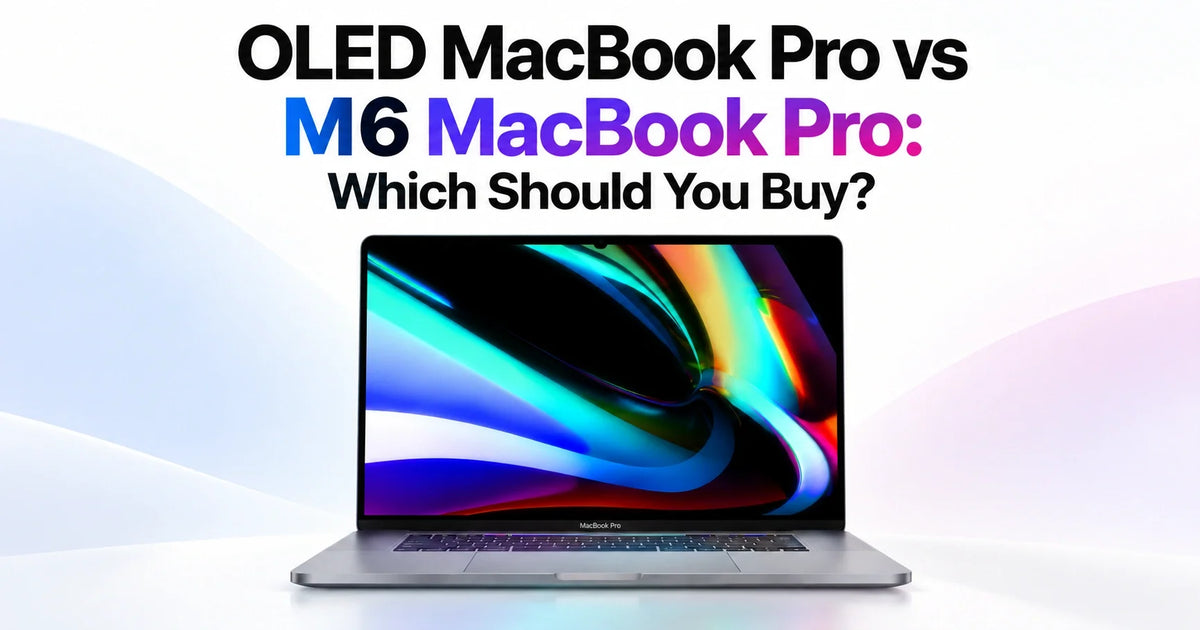
For most everyday buyers, the rumored base M6 MacBook Pro is the value-focused option to evaluate; the OLED MacBook Pro is worth considering if its built-in screen and reported redesign will improve your daily work.
These are separate reported models: an entry 14-inch M6 refresh and higher-end OLED touchscreen laptops expected to use M5 Pro or M5 Max.
A newer chip number alone does not establish which laptop is faster for your workload.
If your current Mac works, wait for the expected late-October announcements and compare actual configurations.
As of October 17, 2026, neither new laptop line has published Apple pricing or final specifications. This is a buying framework based on reporting, not a hands-on review.
OLED MacBook Pro vs M6: what are you actually comparing?
OLED describes a display technology; M6 identifies a chip. In this guide, “M6 MacBook Pro” means the reported entry-level 14-inch refresh, while “OLED MacBook Pro” means the reported premium redesign. They should be compared by configuration and price, rather than treated as successive generations of the same laptop.
October 15 reporting on Mark Gurman’s latest roadmap associates the OLED models with M5 Pro and M5 Max, while the base laptop moves to M6. Apple’s current MacBook Pro lineup remains M5, M5 Pro and M5 Max. For the broader launch context, see our October Mac lineup guide.
The comparison at a glance: confirmed facts and reported plans
Checked October 17, 2026. The two upcoming-model cards below summarize reporting, not Apple specification sheets. Prices refer to the US market unless stated otherwise.
Reported base 14-inch M6 MacBook Pro
Positioning: entry point to the Pro laptop family, with a chip refresh expected to retain the established design.
Display: expected to retain mini-LED rather than gain the premium OLED touchscreen. Final panel specifications are unannounced.
Processor: M6 is expected; laptop CPU/GPU configuration, memory limits and benchmark results remain unconfirmed.
Price, battery, weight and ports: await Apple’s laptop specifications. Mac mini M6 specifications cannot be copied across.
Best candidate for: office work, study, coding and lighter creative work when the final configuration meets your needs.
Reported OLED MacBook Pro redesign
Positioning: higher-end 14-inch and 16-inch laptops, according to current reports.
Display and design: OLED touchscreens, a lighter chassis and a revised camera area are reported. Brightness, refresh rate, surface finish and exact weight need confirmation.
Processor: M5 Pro or M5 Max is currently reported, rather than a guaranteed M6 Pro/Max upgrade.
Price, battery and ports: unannounced. The size of any OLED price premium is unknown.
Best candidate for: buyers who use the laptop screen extensively and can justify the complete higher-end configuration.
Sources: reported split between M6 and OLED models; October 15 redesign and media-experience reporting. Apple has introduced M6 in the Mac mini, which confirms the chip exists, not the specifications of an unreleased MacBook.
Is the OLED screen worth paying more for?
Consider OLED if the laptop screen is central to your day
A photographer reviewing images while traveling, a video editor working away from a monitor, or someone watching films on the built-in display has a practical reason to care about the panel. Apple’s OLED explanation for iPad Pro describes pixel-level light emission and deep blacks. Those characteristics explain the appeal of OLED; they do not establish the upcoming MacBook’s brightness or accuracy.
Buying implication: compare the actual MacBook screen in reviews and, ideally, in person. Judge reflections, text rendering and usable brightness alongside dark-scene contrast.
Keep the screen premium in perspective
Apple’s current Liquid Retina XDR display already offers ProMotion up to 120Hz and a rated 1,600-nit peak for HDR content. Those are current-model specifications, not promises for either upcoming laptop.
If your work mainly involves spreadsheets, browser tabs and documents, first ask whether more memory or storage would solve a larger problem. If you use an external monitor most of the time, an expensive built-in panel delivers less benefit during those hours.
OLED also needs a realistic longevity discussion. Apple notes that prolonged static, high-contrast content at high brightness can contribute to burn-in on OLED. That is a technology consideration, not evidence of a defect in an unreleased MacBook. Wait for model-specific guidance and long-term testing instead of assuming either zero risk or inevitable damage.
Is M6 faster than M5 Pro or M5 Max?
The name alone cannot answer that. A base chip and a Pro or Max chip can differ in CPU/GPU resources, memory bandwidth, memory capacity and media engines. A newer base generation can improve some tasks without winning every sustained professional workload.
Compare your actual bottleneck
Office work and study: check responsiveness, memory pressure and battery tests. Paying for unused GPU capacity will not necessarily make writing or browsing feel meaningfully better.
Video and 3D: compare exports, effects, renders and playback using the same software and similar project settings. OLED itself does not accelerate an export.
Development and local AI: check project build times, model memory requirements and sustained behavior. Choose a configuration that holds your workload before paying for a display upgrade.
Apple’s current specifications show meaningful differences between the M5, M5 Pro and M5 Max configurations. They explain why chip tier matters, but they cannot predict an M6 laptop result. We have not tested either upcoming laptop, and desktop M6 benchmarks do not establish laptop battery life, cooling or fan noise.
Which model should you buy for your budget and workflow?
ZEERA’s provisional recommendation: choose the least expensive configuration that comfortably handles your work, then decide whether the OLED experience earns an additional budget. The recommendations below are our analysis, conditional on Apple’s final models and prices.
Students, writers and general office users: start with the base M6 option
If your work is mostly research, calls, documents, browser tools and occasional photo editing, evaluate the base M6 laptop first when it is announced. Keep enough budget for the memory and storage you need. OLED may be desirable, but it does not automatically improve the outcome of those tasks.
Mobile creators: compare the OLED model seriously
If you edit photographs or video on the built-in screen for several hours most days, the display is part of your workspace. Compare an OLED configuration against a mini-LED configuration with the same chip tier, memory and SSD where available. That comparison reveals the cost of the screen and redesign more clearly than comparing unrelated base prices.
Desk-based professionals: prioritize capacity and connectivity
If the laptop spends most of its time connected to a monitor, focus on memory, GPU requirements, external-display support, ports and sustained performance. A discounted current Pro/Max configuration could be the better purchase if it fits those needs.
If you do not need a portable computer at all, include a Mac mini and the full cost of a monitor and peripherals in your shortlist. Our desktop-versus-laptop budget guide covers that separate decision. The MacForge and MacFrost promotions in this article are for compatible Mac mini setups; they are not MacBook accessories.
Budget test: calculate the premium after matching specifications
Use the final checkout prices, including your required memory and SSD upgrades. As a purely hypothetical example, a $500 premium spread across five years equals $100 per year, or about $8.33 per month. This is a budgeting example, not a leaked price.
Pay it if the screen and design improve something you do often. Skip it if it forces you to buy too little memory or storage for work you already know you will do. Compare local prices separately in the UK and Europe; US prices and currency conversion do not establish local tax-inclusive pricing.
Should you buy now or wait for the late-October announcements?
On October 15, MacRumors reported media invitations for an October 28 experience in Los Angeles. That does not fix the public announcement, preorder or delivery date. Separate reporting suggests a possible November 6 retail launch for the touchscreen models; Apple has not confirmed that sales date.
Your current Mac works: wait for the actual comparison
At the October 17 checkpoint, the reported late-October window is close enough that waiting for the announcements is reasonable. Use the time to record your current memory use, required ports and storage needs. Then compare the real purchase prices and reviews rather than committing to a rumor.
Your Mac is failing or delaying paid work: buy for the deadline
If you must replace it immediately, a currently available Mac that meets your requirements can be the sensible choice. Check the seller’s return terms and the quoted delivery date. A rumored announcement cannot complete a job or guarantee that your preferred configuration will arrive on time.
You already own a capable M-series Mac: identify the missing benefit
If your machine still handles your projects comfortably, neither “M6” nor “OLED” creates an automatic need to upgrade. A current M5 Pro/Max owner should look for a meaningful screen, weight or workflow improvement; the reported reuse of those chips means a major processing gain should not be assumed.
Do not build the purchase around unconfirmed extras. Touch input alone does not establish Apple Pencil compatibility; our Apple Pencil support guide explains the distinction. Likewise, do not assume a cellular configuration, a specific battery gain or unchanged ports until Apple publishes the relevant specifications.
What to check before placing your order
- Identify the exact model. Confirm the display, chip tier and size; do not use “2026 MacBook Pro” as a specification.
- Match memory and SSD capacity. Compare complete configurations, including any upgrades you require.
- Look for relevant independent tests. Prioritize your software, battery use, fan noise and sustained workloads.
- Check the screen and connections. Verify brightness ratings, reflections, ports, external-display support and any explicitly supported touch accessories.
- Check the actual delivery quote. An announcement or preorder opening does not mean immediate availability in your country.
Our buying verdict: the base M6 model is the sensible first shortlist for everyday value, provided its final price and configuration are competitive. Choose OLED when you will use its screen benefits often and the full system suits your workload. For buyers who can wait, Apple’s specifications and independent reviews should decide the purchase.
FAQ
Will every M6 MacBook Pro have an OLED display?
Do not assume that. Reporting separates an entry-level 14-inch M6 refresh from higher-end OLED touchscreen models. Apple has not published the final specifications for either new line as of October 17, 2026.
Will the OLED MacBook Pro use M6 Pro or M6 Max?
The latest reporting instead points to M5 Pro and M5 Max for the first OLED models. That remains a report until Apple announces the machines; older rumors linking OLED to M6 Pro/Max should not be treated as current confirmed specifications.
Should I buy a discounted M5 Pro MacBook Pro instead?
It can be a good choice if its measured performance, memory, storage and display meet your needs. Compare the complete purchase price and seller terms. An OLED redesign does not make an existing machine less capable at your current work.
Will OLED give the MacBook Pro better battery life?
There is no verified model-to-model answer yet. Display power use, brightness, battery capacity, chip configuration and workload all matter. Wait for Apple’s ratings and comparable independent battery tests.
Is it worth upgrading from an M4 Pro or M5 Pro MacBook Pro?
Only if the new machine fixes a limitation you actually notice. If your current Mac handles your work well, wait for display and portability reviews before paying mainly for a new screen.
Can I order the OLED or M6 MacBook Pro now?
Apple’s checked MacBook Pro lineup still lists M5, M5 Pro and M5 Max as of October 17, 2026. The reported late-October announcements and possible November launch are not an official preorder opening or a guaranteed delivery date.
Sources and reporting notes
Research checked October 17, 2026. Apple pages establish currently published product information; the MacRumors articles below summarize Mark Gurman’s reporting about unannounced laptops. Buying recommendations and budget examples are ZEERA’s analysis. No hands-on testing of the upcoming models is claimed.
- Apple: current MacBook Pro lineup
- Apple: current MacBook Pro technical specifications
- Apple: M6 introduction in Mac mini
- Apple Support: OLED technology and long-term display considerations on iPad Pro
- MacRumors, October 15: OLED models and the M5/M6/M7 chip roadmap
- MacRumors, October 15: October 28 media experience
- MacRumors, October 15: possible November 6 retail launch
- MacRumors, October 8: separate OLED and base M6 MacBook Pro plans
Related ZEERA guides
- October 2026 Mac lineup: M6 refreshes and OLED redesign rumors
- OLED touchscreen MacBook Pro: Apple Pencil support explained
- MacBook Pro 5G, C2 modem and hotspot questions
- Best Mac under $1,000: desktop and laptop buying choices
- M6 Mac mini vs M4 Pro and M5 Pro: workload comparisons
- External SSD performance: USB-C versus Thunderbolt